
 EN
EN




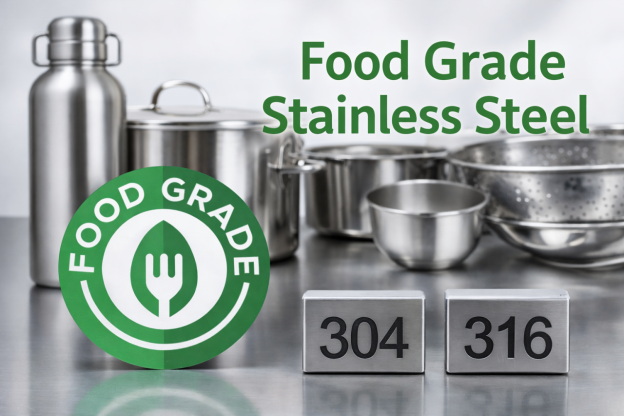
There is no single stainless steel grade that is automatically right for every food-processing application. Buyers should match 304, 316 or 430 to the actual food medium, moisture, salt or chloride exposure, cleaning procedure, fabrication method and hygienic requirements.
For many general applications, 304/304L provides a practical balance of corrosion resistance, fabrication and cost. When chloride exposure or cleaning severity increases, 316/316L is often the stronger choice. 430 can be economical in selected dry or mild environments where its lower corrosion resistance is acceptable.
- Compare 304, 316 and 430 for real food-processing conditions
- Check chloride, cleaning, welding and surface requirements before ordering
- Understand where 304 vs 316 and 304 vs 430 differ
- Include traceability and documentation requirements in the RFQ
Quick Selection Guide for Food Grade Stainless Steel
Use this table as a practical starting point. Final material selection should still follow the actual process environment and buyer specification.
| Application | Typical Grade | Why It Is Used |
|---|---|---|
| General food processing equipment | 304 / 304L | Provides a practical balance of corrosion resistance, fabrication and cost for many standard food-processing applications. |
| Salt, brine, seafood or chloride-bearing cleaning | 316 / 316L | The molybdenum addition gives 316 better resistance to localized corrosion in many chloride-bearing environments than 304. |
| Welded tanks, piping and sanitary fabrication | 304L / 316L | Low-carbon grades are commonly selected for welded fabrication. The final choice between 304L and 316L depends mainly on corrosion exposure. |
| Dry or mild indoor food applications | 430 | A lower-cost ferritic grade that may suit selected environments with limited moisture, salt and aggressive cleaning exposure. |
| Cutlery, knives and blades | 420 | A martensitic grade used in selected cutting applications where hardness and wear resistance are important. |
What Is Food Grade Stainless Steel?
Food-grade stainless steel refers to stainless steel that is suitable for direct or indirect food contact under the intended processing conditions. Suitability depends on more than the grade number alone.
The alloy, surface finish, corrosion resistance, welding quality, equipment design, cleaning procedure and required documentation can all affect whether a material is appropriate for a particular food-processing project.
Food Contact Regulations and Standards: FDA, NSF and EU Requirements
Food-contact and hygienic-equipment requirements vary by destination market, equipment design and intended use. Buyers should identify the regulations, customer specifications and third-party standards that apply to the actual project.
Examples that may be relevant include: FDA food-contact requirements in the United States, NSF/ANSI 51, 3-A Sanitary Standards, EU Regulation 1935/2004 and EHEDG guidance.
These references do not mean that a grade name alone proves compliance. The applicable requirements, supporting documents, fabrication condition and surface criteria should be verified for the supplied equipment or material.
Surface finish matters alongside alloy selection. Specify the required finish, roughness target, polishing condition and inspection criteria in the purchase specification instead of assuming one finish is suitable for every hygienic application.
What Makes Stainless Steel Suitable for Food Contact?
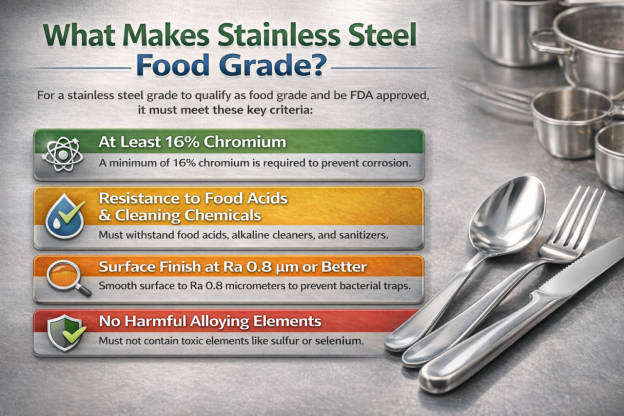
For food-processing service, evaluate the material against the actual operating environment rather than relying on a general “food grade” label.
1. Grade and Service Environment
Check the food or process medium, operating temperature, moisture, chloride concentration, salt exposure and cleaning chemicals. These conditions are often more important than the grade name by itself.
2. Cleaning and Fabrication Conditions
Review washdown frequency, weld areas, joints, crevices, fabrication condition and any required passivation or post-fabrication treatment.
3. Surface Requirement
State the required finish and any project-specific roughness, polishing or inspection requirement in the RFQ. The suitable target depends on the equipment design and applicable hygienic standard.
4. Documentation and Traceability
Request the mill test certificate, heat-number traceability, grade confirmation and any inspection or compliance documents required by the buyer. Any certification claim should match the actual supplied material.
Common Food Grade Stainless Steel Grades: 304, 316 and 430
304, 304L, 316, 316L and 430 are among the stainless steel grades frequently evaluated for food-processing and food-contact equipment. 420 is also used in selected applications such as blades and cutlery.
| Grade | Family | Main Buyer Consideration | Typical Use | Main Limitation |
|---|---|---|---|---|
| 304 | Austenitic | General-purpose corrosion resistance and fabrication | Many standard food-processing applications | More limited resistance than 316 in demanding chloride-bearing conditions |
| 304L | Low-carbon austenitic | Welded fabrication | Welded tanks, piping and fabricated equipment | Chloride exposure still needs to be evaluated |
| 316 | Molybdenum-bearing austenitic | Higher chloride-related corrosion resistance | Brine, seafood and more demanding cleaning environments | Higher cost and still not suitable for every severe chemical environment |
| 316L | Low-carbon molybdenum-bearing austenitic | Welding plus demanding corrosion conditions | Welded sanitary equipment exposed to more aggressive service | Higher cost than 304L |
| 430 | Ferritic | Lower cost and limited corrosion exposure | Selected dry or mild food-service environments | Lower corrosion resistance than 304 and 316 in many wet or chloride-bearing conditions |
| 420 | Martensitic | Hardness and wear resistance | Selected knives, blades and cutlery | Not a general replacement for 304 or 316 process equipment |
304 vs 316 Food Grade Stainless Steel: What Is the Difference?
Both 304 and 316 are austenitic stainless steels widely used in food-processing equipment. The main practical difference for buyers is their resistance to more demanding corrosion conditions.
304/304L is usually the economical starting point for general food-processing equipment. It is widely used for tanks, work surfaces, processing equipment, conveyors and fabrication where chloride exposure is not severe.
316/316L adds molybdenum, which improves resistance to localized corrosion in many chloride-bearing environments. For this reason, it is often preferred when equipment handles salt, brine, seafood or more aggressive cleaning chemicals.
| Factor | 304 / 304L | 316 / 316L |
|---|---|---|
| General food processing | Common choice | Also suitable where specified |
| Chloride resistance | Moderate | Better |
| Brine / seafood exposure | Requires careful evaluation | Often preferred |
| Aggressive cleaning | Evaluate chemical concentration and temperature | Usually provides a greater corrosion margin |
| Welded fabrication | 304L commonly used | 316L commonly used |
| Relative material cost | Lower | Higher |
304 vs 430 Stainless Steel for Food Equipment
304 and 430 can both appear in food-related equipment, but they are different stainless steel families with different corrosion behaviour and cost structures.
304 is an austenitic stainless steel and generally provides broader corrosion resistance, better performance in wet environments and greater fabrication flexibility.
430 is a ferritic stainless steel with much lower nickel content than 304. It is usually less expensive, but its resistance to moisture, chloride-bearing cleaners and more demanding food-processing environments is more limited.
| Factor | 304 | 430 |
|---|---|---|
| Stainless family | Austenitic | Ferritic |
| General corrosion resistance | Higher | Lower |
| Wet food-processing environments | More widely used | Best limited to suitable mild conditions |
| Dry / mild applications | Suitable | Can be a cost-effective option |
| Relative material cost | Higher | Usually lower |
Applications of Food Grade Stainless Steel
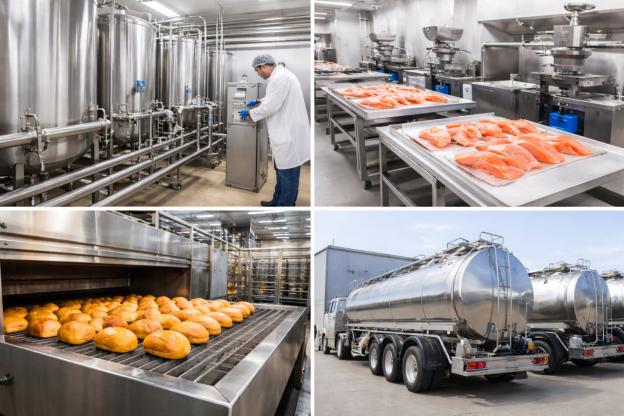
The most suitable grade changes with the food medium, sanitation frequency, chloride level, weld condition and corrosion risk.
Dairy & Beverage
304L is widely used in general fabricated equipment, while 316L is often selected where process chemistry or cleaning conditions demand greater corrosion resistance.
Meat & Fish Processing
316 or 316L is often evaluated where brines, curing salts, seafood or chloride-bearing cleaning solutions increase localized corrosion risk.
Bakery & Dry Food
304 is a common general-purpose choice. In suitable dry and mild environments, 430 may also be considered where the specification permits it.
Food Storage & Transport
Compare 304 and 316 against the actual stored product, temperature, cleaning cycle, weld condition and chloride exposure.
Countertops & Sinks
304 is widely used where moisture and repeated cleaning are expected. 430 may suit selected lower-corrosion applications when its limitations are acceptable.
Cutlery
420 and other martensitic grades are used in selected knives and blades where hardness and wear resistance are important.
How to Choose the Right Food Grade Stainless Steel
Material selection should start with the real operating environment rather than the grade name alone.
Food or Process Medium
Consider acids, salt, brine, moisture and any ingredients that can influence corrosion behaviour.
Cleaning Chemicals
Review detergent type, chloride content, concentration, temperature and washdown frequency.
Welding Requirements
For welded equipment, check the specified grade, welding procedure, weld finishing and any required post-weld treatment.
Surface Finish
Specify the required finish and hygienic surface criteria rather than assuming the alloy grade alone determines cleanability.
Operating Temperature
Temperature can change the severity of food acids, chloride exposure and cleaning chemicals, so it should be included in material selection.
Documentation Requirements
State mill test certificate, heat-number traceability, inspection and any project-specific compliance documents in the purchase specification.
Price of Food Grade Stainless Steel: 304 vs 316 vs 430
Stainless steel pricing varies with alloy grade, product form, dimensions, finish, order quantity and market alloy surcharges. Nickel and molybdenum content are important cost drivers.
430
A low-nickel ferritic grade that is generally less expensive than 304 and 316. It can be economical where corrosion exposure is limited.
304 / 304L
Commonly offers a strong balance of corrosion resistance, availability, fabrication performance and cost for general food-processing equipment.
316 / 316L
The molybdenum-bearing composition generally increases material cost but also provides better resistance than 304 in many chloride-bearing environments.
Note: Actual prices change with raw-material markets, product form, dimensions, finish, quantity and delivery requirements.
How to Buy Food Grade Stainless Steel from a Supplier
For B2B purchasing, buyers should provide enough process and specification information for the supplier to quote the correct material and product form.
- Grade: 304, 304L, 316, 316L, 430 or another specified material
- Product form: sheet, plate, coil, pipe, tube, bar or custom-cut material
- Food or process medium
- Operating temperature
- Salt or chloride exposure
- Cleaning chemical and washdown conditions
- Surface finish: 2B, BA, No.4, HL, polished or project-specific finish
- Thickness, width, length, diameter and tolerance requirements
- Required quantity
- Mill test certificate and heat-number traceability
- Inspection or compliance documents required by the project
- Destination port and required delivery schedule
For available material forms, review Voyage Metal's stainless steel materials, stainless steel plate options, stainless steel coil options and stainless steel pipe options.
Conclusion
For many general food-processing applications, 304/304L is the practical starting point. When chloride, salt, brine or aggressive cleaning increases corrosion risk, 316/316L usually provides a better corrosion margin. 430 can be a cost-effective choice for selected dry or mild applications where the environment and specification allow it.
The final decision should combine alloy grade with the food or process medium, temperature, cleaning chemicals, welding, surface finish, hygienic requirements and required documentation.
FAQs About Food Grade Stainless Steel
Is all stainless steel food grade?
No. A stainless steel grade name alone does not establish suitability for every food-contact application. The intended use, corrosion environment, surface condition, cleaning procedure and applicable specification must also be considered.
What is the difference between 304 and 316 stainless steel for food use?
304 is widely used for general food-processing equipment. 316 contains molybdenum and generally provides better resistance to localized corrosion in chloride-bearing environments, making it useful for brine, seafood and more demanding cleaning conditions.
Is 304 stainless steel food grade?
304 is widely used in food-processing equipment, but suitability depends on the actual food medium, cleaning method, temperature, surface requirement and applicable specification.
Is 430 stainless steel food grade?
430 can be used in selected food-related applications, particularly in dry or mild environments. It generally has lower corrosion resistance than 304 and 316, so moisture, chloride and cleaning exposure should be evaluated carefully.
Which is better for food processing, 304 or 316?
304 is usually more economical for general food-processing service. 316 is generally preferred when salt, brine, chloride-bearing cleaners or more aggressive process conditions increase corrosion risk.
Which is better, 304 or 430 stainless steel?
304 usually provides broader corrosion resistance and is better suited to wet processing and frequent cleaning. 430 is generally less expensive and may suit selected dry or mild applications.
What surface finish does food-grade stainless steel need?
The required finish depends on the equipment design, hygienic standard and buyer specification. Buyers should state any required finish, roughness, polishing and inspection criteria in the RFQ.
Why are 304L and 316L often used for welded equipment?
Their lower carbon content makes 304L and 316L common choices for welded fabrication. Grade selection should still consider corrosion exposure, welding procedure, surface condition and project requirements.
Does food-grade stainless steel need FDA approval?
Food-contact suitability is not established simply by calling a stainless steel grade “FDA approved.” Buyers should identify the applicable regulatory and project requirements for the final equipment or application.
What certificates should buyers request?
Common purchasing documents include a mill test certificate, heat-number traceability and grade confirmation, together with any inspection or compliance documents required by the project.
Request Stainless Steel for Your Food Processing Project
Voyage Metal supplies stainless steel sheet, plate, coil, pipe, tube and bar for industrial fabrication and food-processing equipment projects.
For a more accurate material discussion and quotation, please send your application, food or process medium, operating temperature, chloride or salt exposure, cleaning chemicals, required grade, product form, dimensions, surface finish, quantity, destination and required certificates or traceability documents.
Request a Food Processing RFQ