
 EN
EN



Stainless Steel Surface Finish Guide: Types, Ra Values & How to Choose
Stainless Steel Surface Finish Guide: 2B, BA, No.4, HL and Mirror
Stainless steel surface finish affects corrosion resistance, cleanability, appearance, and application compliance. This guide explains common finish types such as 2B, BA, No.4, HL and mirror finish, along with typical Ra values and selection recommendations for stainless steel sheet, plate and coil.
Key point: Choosing the wrong stainless steel surface finish can lead to premature corrosion, hygiene non-compliance, poor appearance, or unnecessary polishing costs.
Stainless steel surface finish affects corrosion resistance, cleanability, and whether the material meets requirements for its intended application. For example, a 2B finish stainless steel surface that is acceptable for general industrial process equipment may not meet every food-grade hygiene requirement. Likewise, a No.4 finish stainless steel surface suitable for architectural cladding may still be too coarse for some pharmaceutical contact surfaces.
Selecting the correct finish requires understanding what each designation means, the Ra value it produces, and what the application actually demands. This guide explains the main stainless steel surface finish types, their Ra values, and how to choose the right finish for your application.
What Do Stainless Steel Surface Finish Designations Mean?
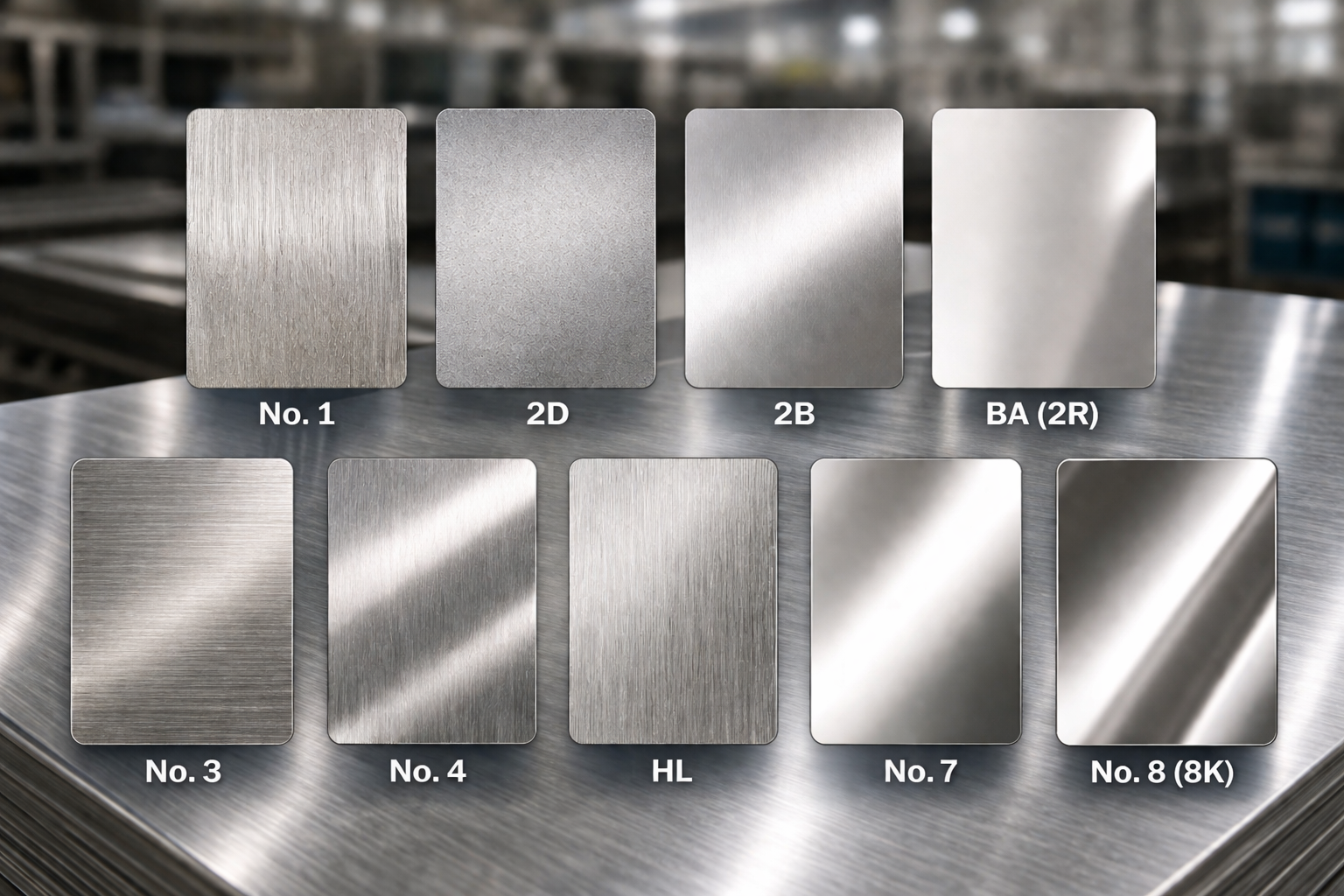
Stainless steel surface finish designations such as 2B, No.4, BA and No.1 follow common industry standards such as ASTM A480. These designations indicate how the material was processed and the resulting surface characteristics. In practice, stainless steel finishes fall into two main groups:
Mill Finishes
Includes No.1, 2D, 2B, and BA. These finishes are produced during rolling, annealing, and pickling at the steel mill.
Mechanical Finishes
Includes No.3, No.4, HL, No.7, and No.8. These are produced later through grinding, polishing, and buffing operations.
The key quantitative parameter used alongside finish designation is Ra, or surface roughness, measured in micrometers (µm). Ra describes the average deviation between surface peaks and valleys and is critical when specifying stainless steel for engineering, hygiene, and corrosion-sensitive applications.
Stainless Steel Surface Finish Types and Ra Values
The table below summarizes the most common finish types, typical roughness values, production methods, common grades, and application areas.
| Finish | Category | Process | Ra (µm) | Typical Grades | Application |
|---|---|---|---|---|---|
| No.1 | Mill | Hot rolled, annealed, descaled | 2.0–8.0 | 304, 309, 310, 321 | Structural, heat-resistant equipment, furnace parts |
| 2D | Mill | Cold rolled, annealed, pickled | 0.2–1.0 | 304, 316, 430 | Industrial piping, equipment, tanks |
| 2B | Mill | Cold rolled, annealed, pickled, skin-passed | 0.1–0.5 | 201, 304, 304L, 316, 316L, 430 | General industrial, chemical equipment, food base material |
| BA (2R) | Mill | Bright annealed | 0.03–0.1 | 201, 304, 304L, 430 | Decorative panels, appliances, trim |
| No.3 | Mechanical | 80–100 grit polishing | 0.6–1.5 | 304, 316 | Food equipment, semi-finished polishing base |
| No.4 | Mechanical | 120–180 grit polishing | 0.2–0.8 | 304, 304L, 316, 316L, 430 | Kitchen equipment, food contact surfaces, architecture |
| HL | Mechanical | Continuous grain finish | 0.1–0.5 | 304, 316, 430 | Decorative panels, elevators, cladding |
| No.7 | Mechanical | Fine buffing | 0.1–0.2 | 304, 316 | Reflective surfaces, decorative applications |
| No.8 | Mechanical | Mirror polishing | 0.02–0.1 | 304, 304L, 316, 316L, 2205 | Mirrors, pharmaceutical, high-hygiene use |
The 2B stainless steel surface finish is the standard mill finish and is commonly used as the base material for further polishing into No.4, No.7, and No.8 finishes.
Need help selecting the right stainless steel finish?
Voyage Metal can recommend the right finish, grade, and processing route based on your application, hygiene requirements, appearance needs, and budget.
Request a Quote2B vs No.4 vs BA Stainless Steel Finish
The most commonly specified stainless steel finishes are 2B, No.4, and BA. Each serves a different purpose in terms of cost, appearance, cleanability, and performance.
| Finish | Appearance | Cost Level | Typical Use |
|---|---|---|---|
| 2B | Smooth, slightly reflective | Low | Industrial and process equipment |
| No.4 | Brushed | Medium | Food equipment, kitchen equipment, architecture |
| BA | Bright and reflective | Higher | Decorative panels, appliances and precision uses |
Why Surface Finish Affects Corrosion Resistance
Surface finish not only affects visual appearance but also plays a direct role in stainless steel corrosion resistance. Corrosion resistance depends on a stable chromium oxide passive layer formed on the surface.
Rougher surfaces contain microscopic crevices and surface defects where chloride ions, dirt, and cleaning residues can accumulate, increasing the risk of pitting corrosion. By contrast, smoother surfaces with lower Ra values provide fewer sites for attack and improve passive layer stability.
- Lower Ra helps reduce contamination retention.
- Smoother surfaces are easier to clean.
- Improved finish often supports better corrosion performance in demanding environments.
Passivation vs Electropolishing
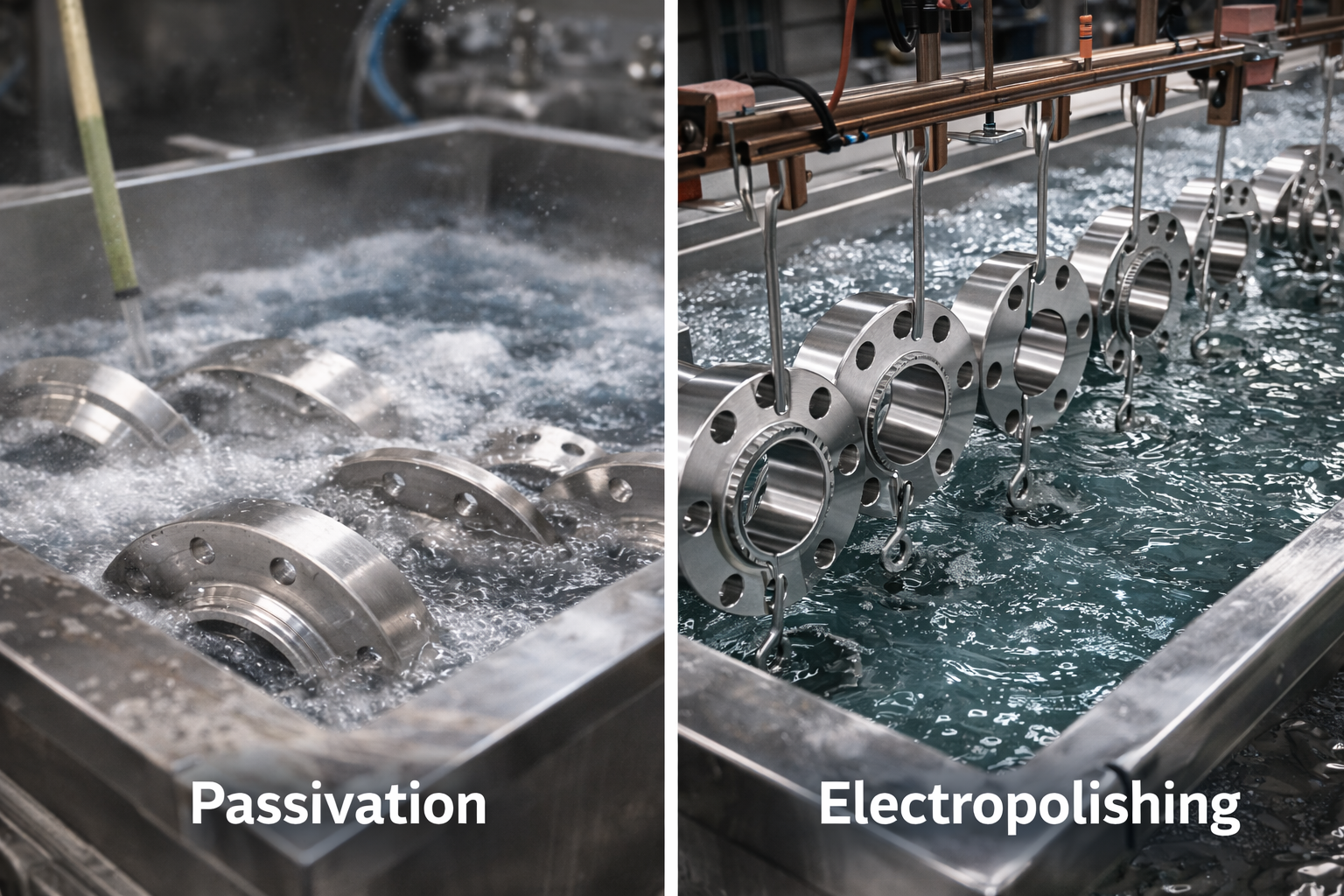
Passivation
A chemical treatment that removes free iron and surface contaminants, restoring the passive layer without significantly changing Ra.
Electropolishing
An electrochemical process that removes a thin metal layer, reducing Ra and producing a smoother, brighter, more hygienic surface.
In general, passivation is suitable when the existing finish already meets the specification and only corrosion resistance needs to be restored after fabrication. Electropolishing is preferred when lower roughness, improved cleanability, or a brighter finish is required.
Choosing the Right Stainless Steel Surface Finish
- If cost is the priority: choose 2B.
- If hygiene is critical: choose No.4, electropolished stainless steel, or a specified Ra value.
- If appearance matters: choose BA, HL, or mirror finish.
- If the surface is non-visible or structural: choose No.1 or 2D.
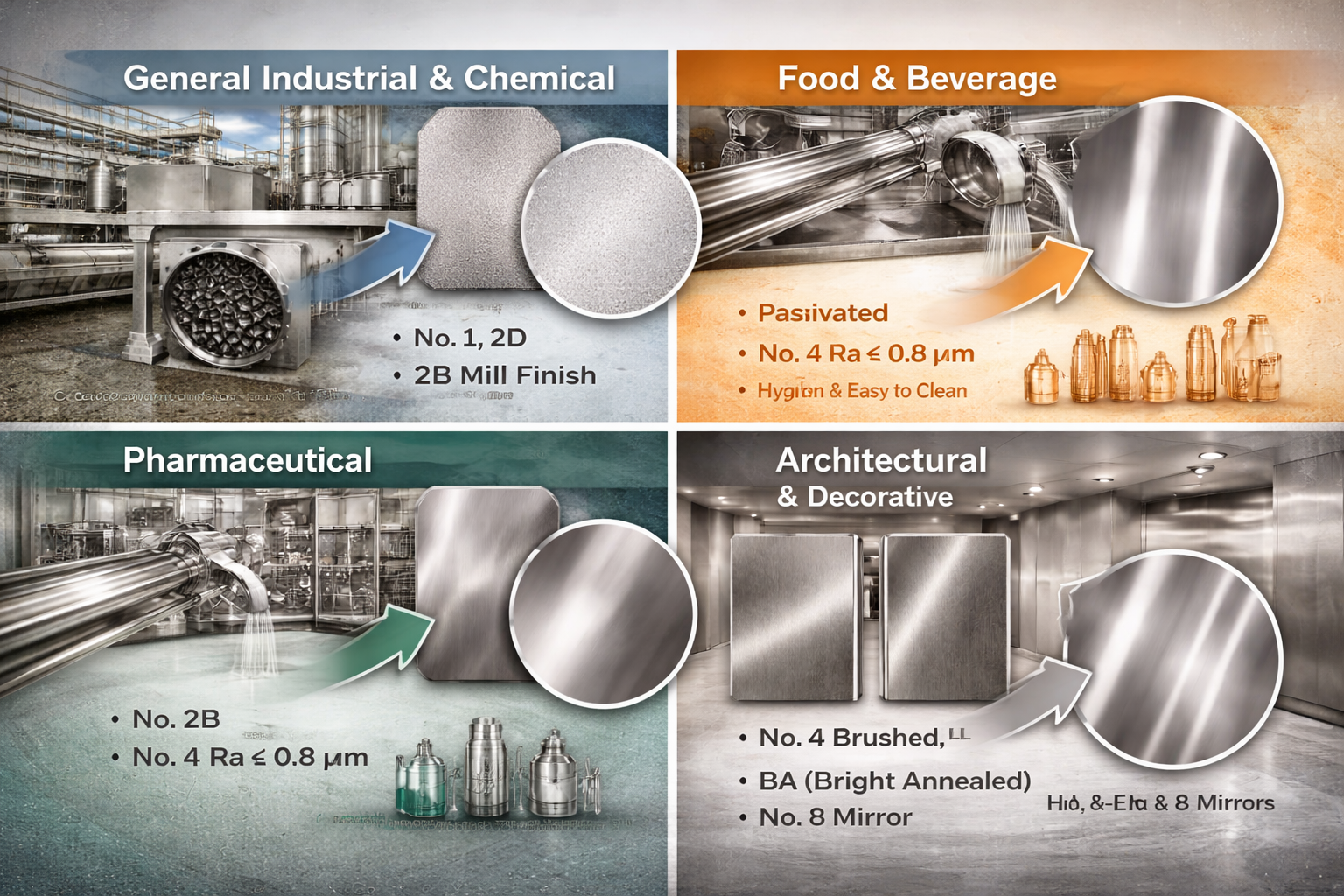
General Industrial
2B is commonly used for stainless steel sheet, stainless steel coil, tanks, and process equipment.
Food & Beverage
No.4 finish or Ra ≤ 0.8 µm finishes are widely used, often with passivation after fabrication. For food-contact applications, buyers can also review this food grade stainless steel guide.
Pharmaceutical
Ra ≤ 0.5 µm with electropolished stainless steel is commonly specified for product-contact surfaces.
Architectural
No.4, HL, BA, or mirror finish are selected depending on the desired appearance. These finishes are often used on stainless steel plate and sheet for visible surfaces.
How to Buy Stainless Steel Sheet or Coil with the Right Surface Finish
When ordering stainless steel sheet, plate or coil, buyers should confirm both the material grade and the required surface finish. The same grade, such as 304 or 316L, can be supplied with different finishes including 2B, BA, No.1, No.4, HL and mirror finish.
| Information to Confirm | Example |
|---|---|
| Product form | Stainless steel sheet, plate, coil or strip |
| Grade | 201, 304, 304L, 316, 316L, 430 or 2205 |
| Surface finish | 2B, BA, No.1, No.4, HL, mirror or custom polished finish |
| Size | Thickness, width, length or coil weight |
| Application | Food equipment, kitchenware, elevator panels, tanks, cladding or industrial fabrication |
| Documents | Mill test certificate, surface finish requirement, Ra value if required |
Request Stainless Steel with a Specific Surface Finish
Send your required grade, thickness, width, length, surface finish, quantity and destination port. Voyage Metal can supply stainless steel sheet, plate and coil with 2B, BA, No.4, HL, mirror and other finishes.
Request a QuoteConclusion
Stainless steel surface finish is not only a visual property but also a performance specification. When ordering stainless steel materials, it is important to confirm the finish designation, maximum Ra value, and whether passivation or electropolishing is required after fabrication.
Not sure which finish is right for your project? Send your drawings or specifications. Voyage Metal can recommend the right stainless steel finish, grade, and processing solution for your application.
FAQs
What is the difference between 2B and No.4 stainless steel finish?
2B is a smooth mill finish commonly used for industrial and process applications, while No.4 is a mechanically polished brushed finish often used for food equipment, kitchen surfaces, and architectural panels. No.4 generally has a more visible grain pattern and higher finishing cost than 2B.
What Ra value is considered food-grade for stainless steel?
In many food and beverage applications, the commonly accepted target is Ra ≤ 0.8 µm. For more demanding hygienic systems such as dairy, bioprocessing, or pharmaceutical equipment, lower Ra values such as 0.5 µm or below may be specified.
Is 2B finish suitable for food-grade stainless steel equipment?
It can be, but only if the verified roughness value meets hygiene requirements and the design allows proper cleaning. In many cases, buyers prefer No.4 or electropolished surfaces for direct product-contact equipment because they offer more predictable cleanability.
Which stainless steel grades are commonly available in 2B and No.4 finish?
Common grades include 201, 304, 304L, 316, 316L, and 430. The available finish may vary depending on product form, thickness, and mill supply conditions.
What is BA finish on stainless steel?
BA finish stainless steel refers to bright annealed material produced in a controlled atmosphere furnace. It has a smooth, reflective appearance and is commonly used for decorative panels, appliances, and precision components.
Does electropolishing improve corrosion resistance?
Yes. Electropolishing can improve corrosion resistance by smoothing the surface, reducing micro-crevices, and improving the surface condition of the passive layer. It is widely used in pharmaceutical, semiconductor, and high-purity process systems.
What is the smoothest stainless steel surface finish?
No.8 mirror finish and electropolished stainless steel are among the smoothest finishes commonly specified. These finishes are often selected for pharmaceutical, decorative, and high-hygiene applications.
How do I choose the right stainless steel surface finish for my project?
You should evaluate four factors: corrosion environment, hygiene requirement, appearance, and budget. For example, 2B is often sufficient for industrial use, No.4 is preferred for many food-contact applications, and electropolished or mirror finishes are selected where higher smoothness or premium appearance is needed. For complex projects, it is best to confirm both finish designation and maximum Ra value before ordering.