

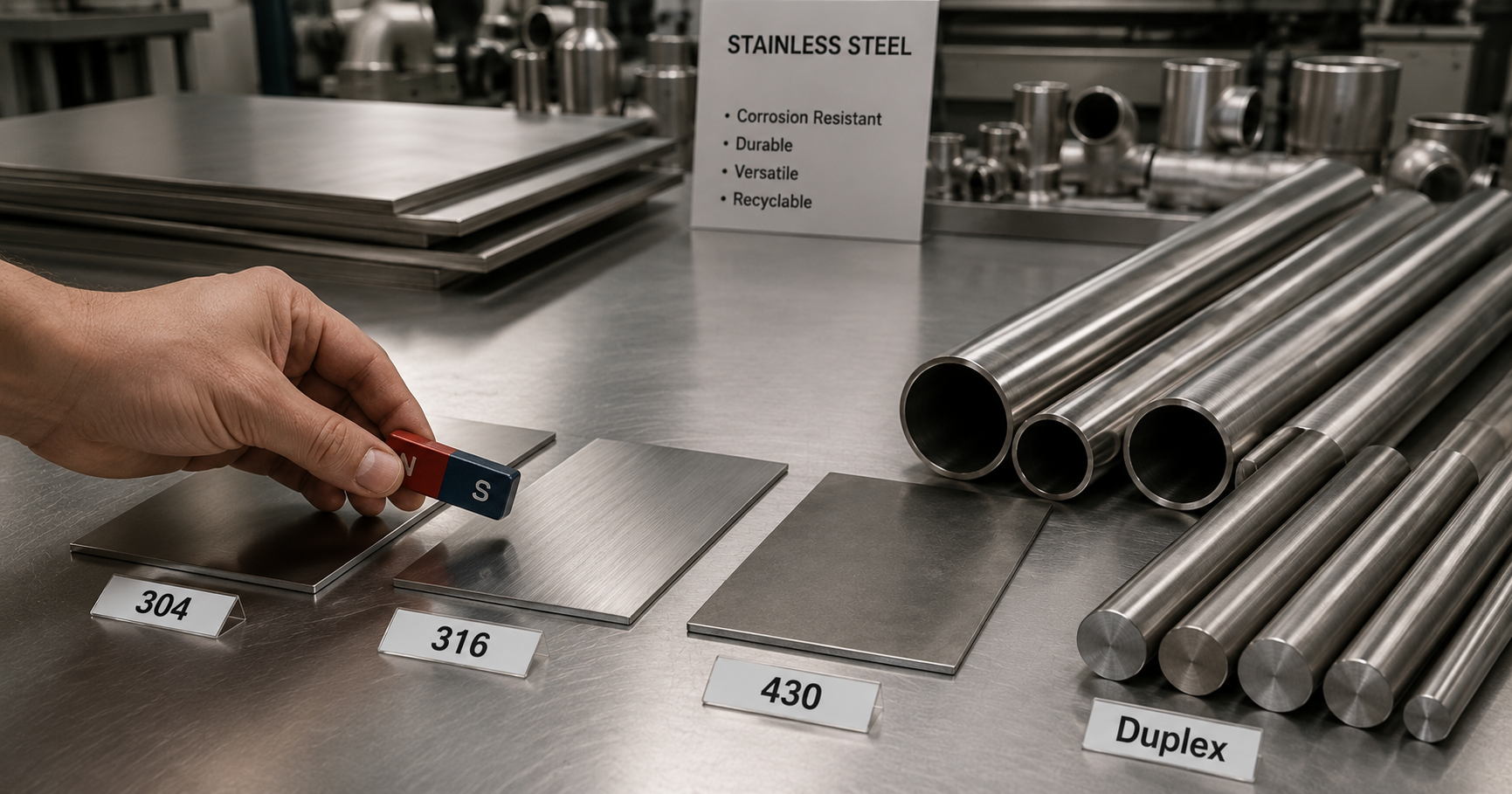
Is Stainless Steel Magnetic? 304, 316, 430 & Duplex Explained
Yes, some stainless steels are magnetic and some are not. 304 and 316 usually show very low magnetic response in the annealed condition, while 430, 2205 duplex and 2507 super duplex stainless steels are magnetic.
Which Stainless Steel Grades Are Magnetic?
| Grade | Stainless Steel Family | Typical Magnetic Response | Why? |
|---|---|---|---|
| 304 / 304L | Austenitic | Usually very low when annealed; may increase after cold work | Cold deformation can form some strain-induced martensite. |
| 316 / 316L | Austenitic | Usually very low when annealed | Its austenitic structure is generally more stable than 304, although processing can still affect magnetic response. |
| 430 | Ferritic | Magnetic | Ferritic stainless steel has a naturally magnetic structure. |
| 410 | Martensitic | Magnetic | Martensitic stainless steel is magnetic. |
| 420 | Martensitic | Magnetic | Martensitic stainless steel is magnetic. |
| 2205 | Duplex | Magnetic | Its microstructure contains both ferrite and austenite. |
| 2507 | Super Duplex | Magnetic | Its duplex microstructure contains a ferrite phase. |
Is 304 Stainless Steel Magnetic?
304 stainless steel normally shows very low magnetic response in the annealed condition. However, it can become noticeably more responsive to a magnet after cold working.
304 is an austenitic stainless steel. When it is fully annealed, the material structure is mainly austenitic and normally shows little attraction to a handheld magnet. During cold rolling, bending, stamping, drawing or deep forming, part of this structure can transform into strain-induced martensite. Martensite is magnetic.
This means two products both supplied as 304 stainless steel may not react to a magnet in exactly the same way. A flat annealed sheet may show almost no attraction, while a heavily bent edge, stamped corner or deep-drawn area may respond more clearly.
For engineering projects that use common 304 and 316 materials, buyers can review 304 and 316 stainless steel supply options for sheet, coil, pipe, tube and bar products.
Is 316 Stainless Steel Magnetic?
316 stainless steel also normally shows very low magnetic response in the annealed condition. Like 304, it belongs to the austenitic stainless steel family.
However, 316 is generally more resistant than 304 to deformation-induced martensite. As a result, its magnetic response after cold working is often lower than that of heavily cold-worked 304. The actual response still depends on the chemical composition, product condition and degree of deformation.
316 contains molybdenum, which improves resistance to pitting and crevice corrosion compared with 304 in many chloride-containing environments. This is one reason 316 is widely considered for coastal, marine, chemical-processing and heat-exchanger applications.
For most buyers, corrosion resistance and service conditions should be more important reasons for choosing 316 than whether a handheld magnet reacts to the material.
Why Can Cold Work Make Austenitic Stainless Steel Magnetic?
Cold working means plastically deforming stainless steel below its recrystallization temperature through processes such as rolling, bending, drawing, stamping and forming. These processes can change the microstructure of austenitic stainless steels.
Practical example: A flat 304 stainless steel sheet may show very little magnetic attraction before forming. After bending or deep drawing, the worked edge or corner may attract a magnet more strongly. This does not automatically mean the material is not 304.
Industry reference: The Australian Stainless Steel Development Association explains that cold working can transform part of the austenitic structure into martensite and increase magnetic response. Source: ASSDA
Can Welded 304 or 316 Stainless Steel Show Magnetic Response?
Yes, a welded area may respond differently from the surrounding base metal. Austenitic stainless steel weld metal can contain some ferrite depending on filler metal, welding procedure and final microstructure. Because austenitic stainless steel weld metal may contain some ferrite, the weld itself can show a stronger magnetic response than nearby annealed base metal. Local response around the heat-affected zone can also vary depending on the material and welding conditions.
For buyers inspecting welded pipe, tube, tanks, fittings or fabricated components, a stronger response near a weld does not by itself prove that the stainless steel grade is wrong. The welding procedure, filler metal, material documentation and project requirements should be reviewed together.
Is 430 Stainless Steel Magnetic?
Yes. 430 stainless steel is magnetic.
430 is a ferritic stainless steel grade, so a magnet sticking to 430 is normal and does not indicate poor quality or fake stainless steel.
430 generally contains chromium as its main alloying addition and much less nickel than common 304 and 316 grades. It is widely used in applications such as appliance panels, kitchen backsplashes, decorative trim, automotive trim and indoor equipment.
For this specific grade, corrosion resistance is generally lower than 304 or 316 in many demanding wet, acidic or chloride-rich environments. Grade selection should therefore be based on the actual service environment rather than magnetic response alone.
For fabrication projects, buyers can review stainless steel plate and sheet materials .
Is Duplex Stainless Steel Magnetic?
Yes. Duplex stainless steel is magnetic.
Duplex stainless steel contains both austenite and ferrite. Because ferrite is magnetic, common duplex grades such as 2205 normally attract a magnet. The same principle applies to super duplex grades such as 2507.
Magnetism in duplex stainless steel is therefore an expected material characteristic rather than a defect. Buyers should not reject 2205 or 2507 simply because a magnet sticks to the material.
Duplex stainless steels are commonly considered when projects require:
- Higher strength than common austenitic stainless steels
- Improved resistance to chloride stress corrosion cracking
- Good pitting and crevice-corrosion resistance for the selected grade
- Useful performance in pressure, structural and process applications
For piping-related projects, buyers can review stainless steel pipe and tube products .
Industry reference: Outokumpu describes duplex stainless steel as having a ferritic-austenitic microstructure. The ferrite phase is why duplex and super duplex stainless steels normally respond to magnets. Source: Outokumpu
Why Are Some Stainless Steel Grades Magnetic?
Magnetic behavior mainly depends on the internal crystal structure of the stainless steel. The major stainless steel families behave differently.
Austenitic Stainless Steel
Grades such as 304, 304L, 316 and 316L normally show very low magnetic response when fully annealed. Cold working and some fabrication conditions can increase local magnetic response.
Ferritic Stainless Steel
Ferritic grades such as 430 and 444 are magnetic because the ferritic crystal structure is naturally magnetic.
Martensitic Stainless Steel
Martensitic grades such as 410 and 420 are magnetic and can often be heat-treated to obtain higher hardness and strength.
Duplex Stainless Steel
Duplex grades contain both ferrite and austenite. The ferrite phase makes grades such as 2205 and 2507 magnetic.
Industry reference: The British Stainless Steel Association explains that ferritic, martensitic and duplex stainless steels are generally magnetic, while austenitic stainless steels normally have much lower magnetic response. Source: BSSA
Can a Magnet Identify Stainless Steel Grade?
A magnet test can provide a quick observation about magnetic response, but it cannot reliably identify the exact stainless steel grade or chemical composition.
A magnet cannot reliably answer questions such as:
- Is this material 304 or 316?
- Is this 2205 or 2507?
- Does the material comply with the specified ASTM, ASME or EN grade?
- Does it contain the required nickel, molybdenum or nitrogen level?
- Does it meet the required mechanical properties?
- Is the supplied material traceable to the stated heat number?
- Will it provide suitable corrosion resistance in the actual service environment?
Magnetism should therefore be treated as one physical observation, not as final proof of material identity.
How Should Buyers Verify Stainless Steel Grade?
For professional B2B purchasing, grade verification should combine documentation, traceability and appropriate testing when required by the project.
Common verification methods include:
- Mill Test Certificate (MTC): documents chemical composition, mechanical properties, heat number and applicable material standard.
- Heat-number traceability: links the documentation to the supplied plate, coil, pipe, bar or fabricated product.
- Positive Material Identification (PMI): can help confirm key alloying elements using suitable testing equipment.
- Chemical analysis: may be required when more detailed composition verification is needed.
- Mechanical testing: checks properties such as tensile strength, yield strength, elongation, hardness or impact value where required.
- Dimensional and visual inspection: confirms size, tolerance, surface condition and finish.
Common Mistakes When Testing Stainless Steel with a Magnet
Mistake 1: “If it is magnetic, it is not stainless steel.”
Incorrect. 430, 410, 420, 2205 duplex and 2507 super duplex are examples of genuine stainless steels that are normally magnetic.
Mistake 2: “A magnet can tell whether the material is 304 or 316.”
Incorrect. Both 304 and 316 are austenitic stainless steels, and magnetic response depends on material condition and processing. Use material documentation, traceability and appropriate testing to verify the grade.
Mistake 3: “Magnetism tells me how corrosion-resistant the material is.”
Incorrect. Magnetic behavior does not directly measure corrosion resistance. Chemical composition, grade, surface condition, fabrication history and the actual service environment are much more important.
For more information about stainless steel corrosion behavior, see why stainless steel can rust .
Should You Choose Stainless Steel Based on Magnetism?
Usually, no. For most industrial projects, corrosion resistance, mechanical properties, fabrication requirements, temperature, service environment and applicable standards are more important than whether a handheld magnet sticks to the material.
Magnetic behavior becomes a primary specification when the application itself has a defined magnetic or permeability requirement. In those cases, simply writing “non-magnetic stainless steel” in an inquiry may not be sufficient.
What Should Buyers Include in an RFQ?
A clear stainless steel inquiry reduces specification errors and avoids relying on magnetic response as a substitute for material verification.
- Required stainless steel grade
- Product form: sheet, plate, coil, pipe, tube, bar or fitting
- Applicable ASTM, ASME, EN, JIS or project standard
- Dimensions and tolerance
- Surface finish
- Material or heat-treatment condition
- Required Mill Test Certificate
- Heat-number traceability requirements
- PMI or other inspection requirements
- Quantity
- Service environment and application
- Magnetic permeability limit if the project requires one
For general product selection, buyers can also review Voyage Metal stainless steel materials .
Summary: Is Stainless Steel Magnetic?
- 304: normally shows very low magnetic response when annealed, but cold work can increase magnetism.
- 316: normally shows very low magnetic response when annealed and is generally less prone than 304 to deformation-induced magnetic response.
- 430: magnetic because it is ferritic.
- 2205 duplex: magnetic because its microstructure contains ferrite.
- 2507 super duplex: also magnetic because its duplex structure contains ferrite.
A magnet is useful for a quick observation, but it cannot reliably verify the exact stainless steel grade. For professional purchasing, review the grade, standard, material condition, MTC, heat-number traceability and any required inspection or testing together.
Need Stainless Steel with Clear Grade Verification?
Voyage Metal supports overseas B2B buyers with stainless steel materials and project-based documentation requirements. Send the basic specification so grade, product form and verification requirements can be reviewed before ordering.
- Required grade
- Product form
- Standard
- Dimensions
- Quantity
- Application
- MTC requirement
- PMI requirement if applicable
Email: [email protected]
Frequently Asked Questions
Is 304 stainless steel magnetic?
304 stainless steel normally has very low magnetic response in the annealed condition. Cold rolling, bending, stamping, drawing or other deformation can increase magnetic response by forming some strain-induced martensite.
Is 316 stainless steel magnetic?
316 stainless steel normally has very low magnetic response when annealed. Cold working can affect its behavior, although 316 is generally more resistant than 304 to deformation-induced martensite and often shows a lower magnetic response after comparable cold work.
Is 430 stainless steel magnetic?
Yes. 430 is a ferritic stainless steel and is naturally magnetic. A magnet sticking to 430 is therefore normal.
Is duplex stainless steel magnetic?
Yes. Duplex grades such as 2205 contain both ferrite and austenite. The ferrite phase makes duplex stainless steel magnetic.
Is super duplex stainless steel magnetic?
Yes. Super duplex grades such as 2507 are magnetic because their microstructure also contains a ferrite phase. Magnetism alone is not a reason to reject the grade.
Why does a magnet stick to 304 stainless steel?
Cold working can transform part of the austenitic structure into magnetic martensite. This is why bent, rolled, stamped or deep-drawn areas of 304 may attract a magnet more strongly than fully annealed material.
Can a magnet tell the difference between 304 and 316?
No. A magnet test cannot reliably distinguish 304 from 316. Buyers should use the Mill Test Certificate, heat-number traceability and suitable material-identification or chemical-analysis methods when grade verification is required.
References
- British Stainless Steel Association, “Magnetic Properties of Ferritic, Martensitic and Duplex Stainless Steels.” View source
- Australian Stainless Steel Development Association, “Magnetic Effects of Stainless Steels.” View source
- worldstainless, “Stainless Steel Grade Datasheets.” View source
- Outokumpu, “Duplex Stainless Steel Grades and Properties.” View source