
 EN
EN



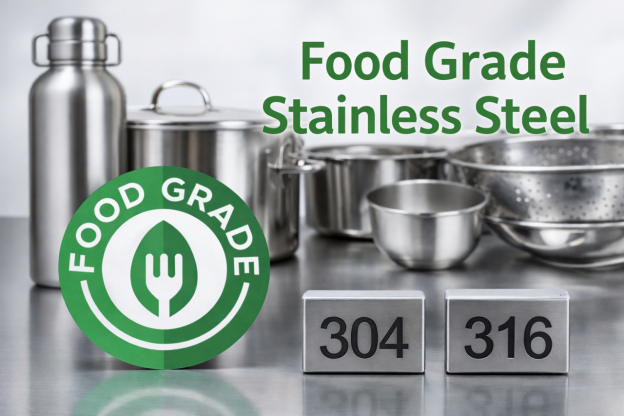
Not every stainless steel grade is food grade. Out of roughly 150 commercially used stainless steel grades, only a limited number from the 300 and 400 series are commonly accepted for direct food contact applications.
Choosing the wrong grade—or sourcing from an unreliable supplier—can lead to corrosion failure, contamination risks, and compliance issues.
· What buyers should know about FDA, NSF and food-contact requirements
· What makes stainless steel food safe
· How to choose the right grade for your application
· Where to source certified food-grade stainless steel reliably
Quick Selection Guide for Food Grade Stainless Steel
Use the table below as a quick reference before comparing each grade in detail.
| Application | Recommended Grade | Why It Is Used |
|---|---|---|
| General food processing equipment | 304 / 304L | Good corrosion resistance, cleanability and cost balance. |
| Salt, brine, seafood or acidic food | 316 / 316L | Better chloride and acid resistance due to molybdenum content. |
| Welded tanks, pipes and sanitary fabrication | 304L / 316L | Lower carbon helps reduce weld-related corrosion risk. |
| Dry food contact surfaces | 430 | Cost-effective option for mild, low-corrosion environments. |
| Cutlery, blades and knives | 420 | Higher hardness and edge retention after heat treatment. |
What Is Food Grade Stainless Steel?
Food-grade stainless steel refers to stainless steel that is suitable for direct or indirect food contact under the intended processing conditions. Suitability depends on the alloy grade, surface finish, corrosion resistance, welding quality, cleaning procedure and supplier documentation.
Food Contact Regulations and Standards: FDA, NSF and EU Requirements
In the United States, food contact materials fall under FDA oversight. Two major standards are commonly referenced for food processing equipment:
·NSF/ANSI 51 – Covers materials used in food equipment
·3-A Sanitary Standards – Focuses on hygienic design for dairy and food processing systems
Both standards require corrosion resistance, non-toxicity, and cleanability. In Europe, manufacturers also consider EU Regulation 1935/2004 together with EHEDG guidance for hygienic equipment design.
Important note: food-contact suitability is not determined by grade name alone. The final decision should consider material composition, surface finish, cleaning conditions, intended use and supporting documentation.
Surface finish matters as much as alloy selection. Food contact surfaces are commonly specified with a smooth mechanical or polished finish, depending on sanitation requirements.
What Makes Stainless Steel Suitable for Food Contact?
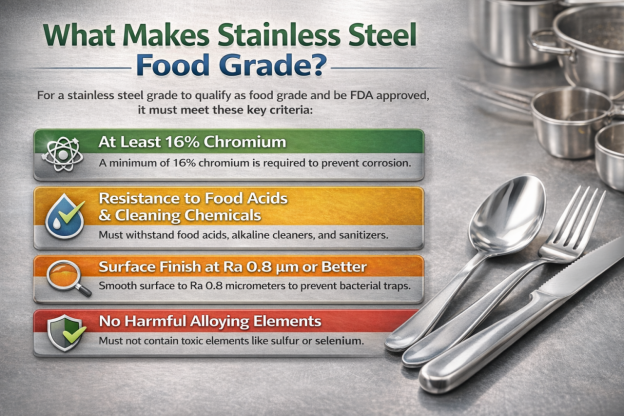
For stainless steel to perform well in food-contact service, it generally needs to meet four key requirements.
1. Sufficient Chromium Content
Chromium creates the passive oxide layer that protects the metal from corrosion. This barrier is essential for hygienic food contact applications.
2. Resistance to Food Acids and Cleaning Chemicals
The alloy should tolerate organic food acids, alkaline CIP agents, acidic sanitizers, and chloride-based cleaning chemicals without pitting or surface breakdown.
3. Surface Finish (Ra ≤ 0.8 μm)
A smoother finish helps reduce bacterial retention and makes routine sanitation easier and more effective.
4. Reliable Material Quality and Traceability
Buyers should request mill test certificates, heat number traceability and clear grade documentation. Free-machining grades that contain sulfur or selenium are generally not preferred for food-contact surfaces.
Common Food Grade Stainless Steel Grades: 304, 316 and 430
Most food-grade stainless steel comes from the 300 and 400 series. The most commonly used grades include 304, 304L, 316, 316L, 430, and 420.
| Grade | Series | Key Composition | Food Contact Use | Best For | Key Limitation |
|---|---|---|---|---|---|
| 304 | 300 (Austenitic) | 18% Cr, 8% Ni | Commonly used | General food equipment, tanks, countertops, dairy | Can pit in high-salt or chloride-heavy environments |
| 304L | 300 (Austenitic) | 18% Cr, 8% Ni, low carbon | Commonly used | Welded food equipment | Same chloride limits as 304 |
| 316 | 300 (Austenitic) | 16% Cr, 10% Ni, 2% Mo | Commonly used | High acid and high salt processing such as meat and fish | Higher cost than 304 series |
| 316L | 300 (Austenitic) | 16% Cr, 10% Ni, 2% Mo, low carbon | Commonly used | Welded equipment in aggressive or hygienic processing environments | Highest cost among standard food grades |
| 430 | 400 (Ferritic) | 16–18% Cr, no Ni | Commonly used | Countertops, sinks, dry food contact surfaces | Lower chloride resistance than 304/316 |
| 420 | 400 (Martensitic) | 12–14% Cr, higher carbon | Application dependent | Cutlery and knives requiring hardness | Less suitable for prolonged wet or acidic exposure |
Applications of Food Grade Stainless Steel
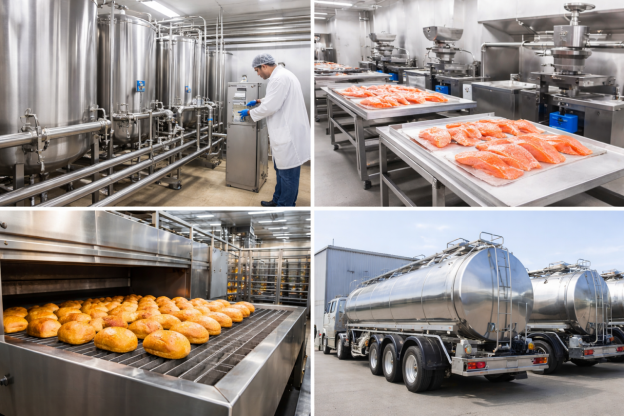
Each food-grade stainless steel serves a different processing environment depending on chloride exposure, sanitation frequency, and corrosion risk.
Dairy & Beverage
304L is widely used for tanks, pasteurization equipment, and standard processing lines. 316L is preferred where aggressive cleaning chemicals or more corrosive media are involved.
Meat & Fish Processing
316 or 316L performs better in chloride-rich environments such as brines, blood, and curing solutions.
Bakery & Dry Food
304 offers a strong balance of hygiene, durability, and cost for mixers, conveyors, and general food contact equipment.
Food Storage & Transport
304 works for many standard tank and transport applications, while 316 is better for acidic, salty, or vinegar-based products.
Countertops & Sinks
430 is often used in lower-corrosion service where appearance and basic cleanability matter more than advanced chloride resistance.
Cutlery
420 martensitic stainless steel is selected for knives and blades thanks to its hardness and edge retention after heat treatment.
How to Choose the Right Food Grade Stainless Steel
When selecting a grade, evaluate the full operating environment rather than composition alone.
Corrosion Environment
Salt, acid, chloride cleaners, and washdown frequency all affect grade selection.
Welding Requirements
If the equipment will be welded, low-carbon L grades are often the safer option.
Surface Finish
Even the right alloy can fail hygienic requirements if the finish is too rough.
Supplier Certification
Request mill test certificates, traceability documentation, and compliance records.
Price of Food Grade Stainless Steel (304 vs 316 vs 430)
Pricing depends on grade, form, quantity, and current alloy surcharges. Nickel and molybdenum content are major cost drivers.
430
Nickel-free ferritic grade commonly used where budgets matter and corrosion exposure is limited.
304 / 304L
The most common choice for general food contact applications, with strong value-to-performance balance.
316 / 316L
Higher nickel and molybdenum content increases cost but significantly improves chloride resistance.
Note: Prices shift with nickel market conditions, product form, and order volume.
How to Buy Food Grade Stainless Steel from a Supplier
For B2B purchasing, buyers should confirm more than just the stainless steel grade. A reliable supplier should provide material traceability and help match the grade to the actual food-processing environment.
- Confirm the grade: 304, 304L, 316, 316L, 430 or other required material
- Confirm product form: sheet, plate, coil, pipe, tube, bar or custom cut size
- Check surface finish: 2B, BA, No.4, HL, polished or custom finish
- Request mill test certificate and heat number traceability
- Confirm thickness tolerance, width, length and packaging method
- Confirm export packing and delivery schedule
Conclusion
The most widely used food-grade stainless steel grades include 304, 304L, 316, 316L, 430, and 420. However, food-safe performance depends not only on the alloy itself, but also on surface finish, welding practice, processing conditions, and supplier traceability.
If you need stainless steel for food processing, pharmaceutical systems, transport tanks, or sanitary fabrication, always match the grade to the actual service environment—not just the initial budget.
FAQs About Food Grade Stainless Steel
Is all stainless steel food grade?
No. Only grades with suitable chromium content, corrosion resistance, and hygienic finish are commonly accepted for food contact use.
What is the difference between 304 and 316 stainless steel for food use?
316 contains molybdenum, which improves resistance to chlorides and salt. 304 is ideal for general use, while 316 is better for aggressive processing environments.
What surface finish does food-grade stainless steel need?
Food contact surfaces are commonly expected to meet Ra 0.8 μm or smoother, which is roughly equivalent to a No. 4 finish.
Why are 304L and 316L often recommended for welded equipment?
The lower carbon content helps reduce sensitization risk near welds and supports better corrosion resistance in sanitary applications.
Is 304 stainless steel food grade?
304 stainless steel is one of the most commonly used grades for general food processing equipment, tanks, counters and hygienic fabrication.
Is 430 stainless steel safe for food contact?
430 can be used for some dry or low-corrosion food-contact applications, such as countertops and sinks. It is less resistant to chlorides than 304 or 316.
Does food-grade stainless steel need FDA approval?
Food-contact suitability is usually not based on grade name alone. Buyers should consider the material composition, surface finish, intended use, cleaning conditions and supplier documentation.
What certificates should buyers request?
Buyers should request a mill test certificate, heat number traceability, grade confirmation and any compliance documents required by the equipment manufacturer or project specification.
Request Food Grade Stainless Steel for Your Project
Voyage Metal supplies stainless steel sheet, plate, coil, pipe, tube and bar for food processing equipment, hygienic fabrication and industrial manufacturing.
Please send your required grade, product form, thickness, width, length, surface finish, quantity and destination port. Mill test certificates and heat number traceability can be provided with the order.
Request a Free Quote