
 EN
EN




904L Stainless Steel: Properties, Uses, and Price
904L Stainless Steel: Properties, Uses, and Price
904L stainless steel is a high-alloy austenitic grade that works better than standard stainless steels. It’s also known as UNS N08904 or EN 1.4539, and it features high nickel, molybdenum, and copper contents. And as a result, 904L is the ideal choice for chemical, offshore, and paper applications that deal with acids and chloride media.
In this guide, we will learn more about these 904L uses, features, and where it works and fails. Also, you’ll unveil how much 904L costs and how it compares with common grades like 316L and super austenitic materials such as 254 SMO and AL-6XN.
What Is 904L Stainless Steel?
904L stainless steel is a low-carbon, non-magnetic, and high-alloy superaustenitic steel that is highly useful in corrosive environments. Its exceptional performance traces directly to its chemical composition. For instance, the high nickel and molybdenum levels make it resist corrosion better than the 304L and 316L grades.
The other elements in 904L are as in the table below, with their percentages and uses.
| Element | % Composition Range | Role |
|---|---|---|
| Chromium (Cr) | 19-23% | Forms the passive layer for base corrosion resistance and polish potential |
| Nickel (Ni) | 23-28% | Stabilizes austenite. Also, it is the primary driver of stress corrosion cracking resistance in chloride environments |
| Molybdenum (Mo) | 4-5% | Resists pitting and crevice corrosion. It is also the key contributor to the PREN value of 32-36 |
| Copper (Cu) | 1-2% | Unique to 904L among standard grades. It provides resistance to sulfuric acid at all concentrations and other reducing acids |
| Carbon (C) | Max 0.02% | Low carbon prevents sensitization during welding and enables direct weldability without post-weld heat treatment |
| Manganese (Mn) | Max 2% | Deoxidizer that supports austenite stability |
| Silicon (Si) | Max 1% | Improves oxidation resistance |
| Iron (Fe) | Balance | Base metal |
The copper addition is what distinguishes 904L from other high-alloy austenitic grades. As documented in ATI Materials' datasheet for the alloy, copper is the element responsible for 904L's resistance to sulfuric acid at all concentrations up to 95°F (35°C), a property that neither 316L nor most duplex grades can match.
On the other hand, the low carbon maximum of 0.02 percent eliminates sensitization risk during welding. This makes 904L directly weldable in most fabrication contexts without subsequent heat treatment.
Properties of 904L Stainless Steel
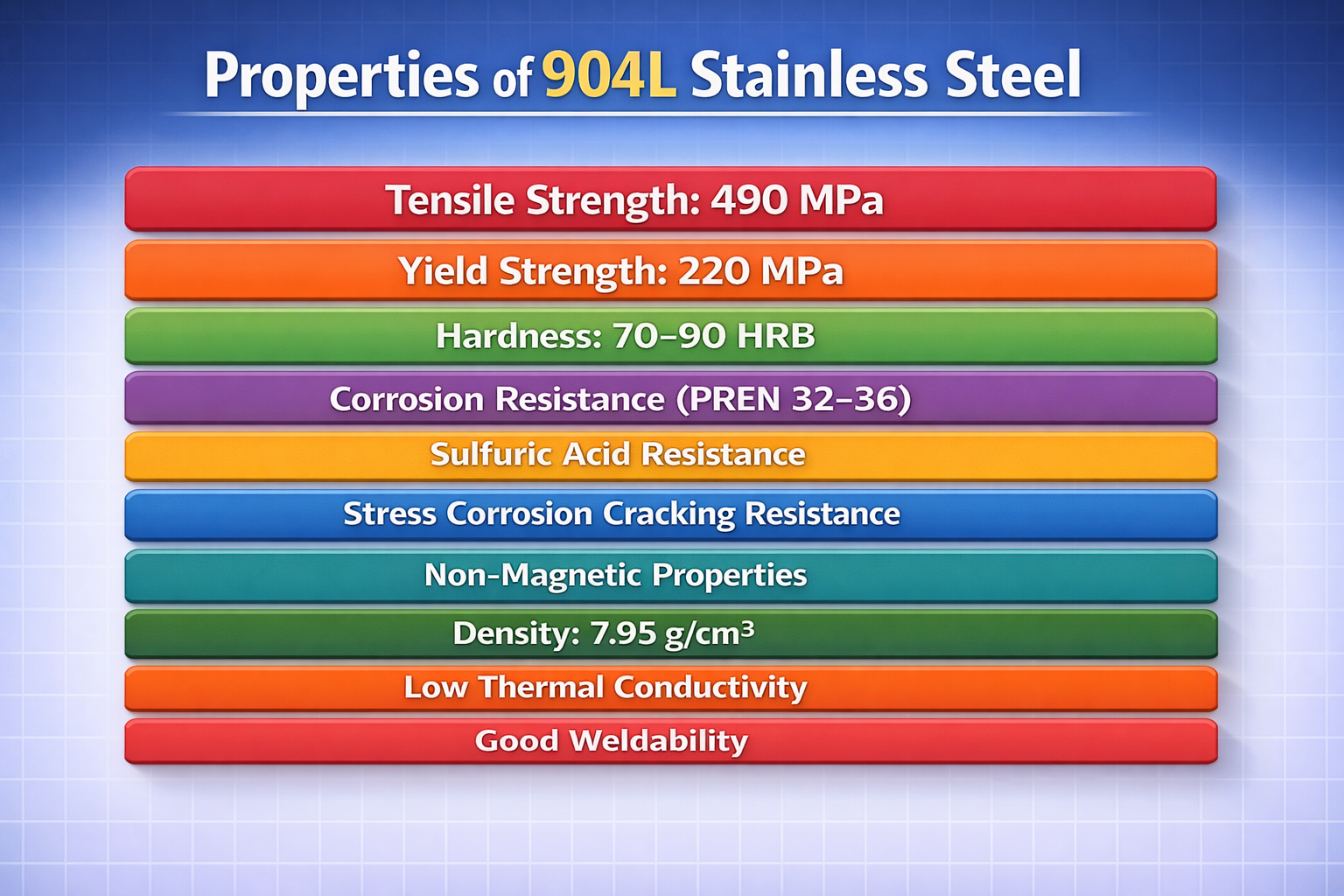
904 steel is made primarily for corrosion performance rather than mechanical strength. And hence, its property profile reflects that priority, with high alloy content, exceptional chemical resistance, and physical characteristics that directly influence fabrication behavior and performance.
Here’s a brief of the main properties:
- Tensile strength: Just like 316L, 904L has a minimum tensile strength of 490 MPa. This means it is strong enough to handle heavy loads while still resisting corrosion in harsh environments.
- Yield strength: The minimum yield strength of 904L steel is around 220 MPa. This level is ideal for many types of industrial equipment and structures used in chemical and marine works.
- Hardness: The 904L steel has hardness levels of 70–90 HRB. This means the metal is soft to machine, but with proper feed rate and speed to prevent work hardening during cutting.
- Corrosion resistance (PREN): Stainless steel 904L has a PREN value of 32 to 36, which is higher than that of 316L at 24 to 26. This makes the steel resist pitting and crevice corrosion better in chloride and acid environments.
- Sulfuric acid resistance: The copper content in 904L provides resistance to sulfuric acid at all concentrations at temperatures up to approximately 35°C. This property is absent from 316L and most standard austenitic grades.
- Stress corrosion cracking resistance: Due to elevated nickel content, 904L remains susceptible at extreme chloride concentrations above approximately 1,000 ppm at elevated temperatures and in boiling magnesium chloride test conditions.
- Magnetic permeability: The 904L metal is fully non-magnetic in all conditions, including after cold work, due to the high nickel stabilizing the austenite structure. This property is relevant to medical devices, electronic components, and precision watch uses.
- Density: 904L steel has a 7.95 g/cm3 density, which is slightly higher than 316L. The difference is negligible in most structural calculations.
- Thermal conductivity: 904L has a low thermal conductivity of about 11.5 W/m·K. However, during machining, heat tends to stay near the cutting area. This leads to fast tool wear compared to machining carbon steel.
- Machinability: 904 stainless steel is easy to machine by standard methods. Even so, you need a sharp carbide tooling, proper feed rates, and cooling to avoid work hardening during cutting.
- Weldability: 904 is readily weldable by TIG, MIG, and SMAW without post-weld heat treatment. Even better, the low carbon content prevents sensitization in the heat-affected zone.
In summary, the mechanical properties of 904L are broadly comparable to 316L, but its chemical and corrosion properties represent a different performance class. And because of that, 904L is more useful across many industries such as chemical processing, offshore, and precision manufacturing.
904L Stainless Steel vs. 316L
904L is not the same as 316L stainless steel! Even though they tend to perform almost similar functions, 904L is superior to 316L in many ways. The table below shows the key differences between the two metals:
| Factor | 904L Stainless Steel | 316L Stainless Steel |
|---|---|---|
| Nickel content | 23-28% | 10-14% |
| Molybdenum content | 4-5% | 2-3% |
| Copper content | 1-2% | None |
| PREN value | 32-36 | 24-26 |
| Sulfuric acid resistance | Excellent across all concentrations up to 35°C | Poor in dilute and moderate concentrations |
| Chloride pitting resistance | High that is suitable for warm seawater and brackish water | Moderate but adequate for most ambient seawater service |
| Stress corrosion cracking resistance | Substantially higher threshold | Lower threshold, so it is susceptible in warm chloride environments |
| Magnetic permeability | Fully non-magnetic, including after cold work | Non-magnetic, but can develop slight magnetism after cold work |
| Machinability | More demanding due to a higher work hardening rate | Easier with a lower work hardening rate |
| Availability | Limited with fewer global stockholders | Widely available globally |
These differences in properties and composition of 904L and 316L also translate into different use cases. For example, Rolex prefers 904L to make watches. This is because the alloy can achieve a brighter polish and resists sweat and saltwater during daily wear.
But in normal conditions, 316L also performs well and would rarely show corrosion on a watch. So, in most consumer cases, the difference is mainly finish quality and branding, while in industrial environments, the material choice depends on corrosion exposure.
904L Stainless Steel Price
904L costs more than most standard stainless grades, and that is because of its high nickel and molybdenum content. So, generally, 904L costs 2 to 3 times more per kilogram than 316L.
However, the real price of 904L per KG depend on several factors. First, it is dependent on the global market price of nickel and other elements, as well as the shop where you buy. Also, the product form you need (plate, pipe, bar), the dimensions, and the need for additional operations such as cutting or shaping add to the total cost.
This means the best way to know the current pricing on 904L stainless steel in plate, sheet, bar, pipe, or coil is to get a live quote from the shop. For instance, reach out to Voyage metal Co. Ltd. with your grade, form, and size, so we can confirm the real stock price and how you can buy.
What Are the Applications of 904L Stainless Steel?

904L is useful in many industries where aggressive chemical environments make standard grades impractical. These applications cluster around acid contact, chloride exposure, and operating conditions.
For example, chemical and petrochemical processing is the primary industrial application. Here, 904L is used for heat exchangers, reaction vessels, piping systems, and storage tanks handling sulfuric acid, phosphoric acid, and mixed acid environments. This is all because of its copper content, which makes it able to withstand sulfuric acid at all concentrations, unlike 316L, which corrodes easily.
In oil, gas, and offshore, 904L is also useful in piping, wellhead equipment, and subsea components where chloride and hydrogen sulfide are present. Its resistance to chloride stress corrosion cracking makes it a reliable option compared to 316L and more expensive super duplex or nickel alloys. Also, the grade is listed under NACE MR0175/ISO 15156 for sour service environments, which backs up why it is the ideal material choice for production systems that contain hydrogen sulfide.
Another application of 904L is in pulp, paper, and pollution control, whereby it is useful in bleaching systems, gas scrubbers, and flue gas desulfurization equipment. This is because the metal offers a combination of pitting resistance and broad acid resistance, thus able to withstand high chloride and acidic conditions.
Lastly, 904L is highly useful in luxury watchmaking, whereby Rolex transitioned fully to 904L for all steel watch cases and bracelets around 1985. Also, Ball Watch and a growing number of mid-tier manufacturers use the grade. This is because of its non-magnetic characteristics that offer additional value in watch movements where magnetic interference with mechanical escapements is a functional concern.
Conclusion: Reliable 904L Stainless Steel Supplier
904L stainless steel is a special, high-alloy grade that performs reliably where grades like 316L fail. Such applications include reducing acids, combined acid and chloride environments, and projects requiring the highest corrosion resistance available in a fully weldable, non-magnetic austenitic material. That's why the 904L steel costs a premium per kg than those other grades, which is also worth it.
But also, you must ensure you buy from a reliable and accredited source, thanks to Voyage metal Co. Ltd.. We supply 904L stainless steel in plate, sheet, bar, pipe, and coil forms with full mill test certificates and EN 10204 3.1 documentation. The grade is available in standard sizes and custom-cut dimensions to specification. So, contact us for a free quote now.
FAQs on 904L Stainless Steel
Why does Rolex use 904L stainless steel?
Rolex uses Oystersteel, which is a special 904L grade that is tough and can resist corrosion from sweat, saltwater, and daily chemical exposure. The alloy also has a shiny, more reflective polish than 316L due to its higher chromium content, which helps the watch retain its finish over time.
Where can I buy 904L steel?
904L is available through specialist alloy suppliers and metal service centers rather than general steel stockholders. For example, Voyage Metal Co., Ltd. stocks 904L stainless steel in multiple product forms with global delivery capability, EN 10204 3.1 certifications, and processing options including cut-to-length and custom dimensions.