
 EN
EN




Stainless Steel Explained: Grades, Properties, Applications, and How to Choose the Right Material
Stainless Steel Explained: Grades, Properties, Applications, and How to Choose the Right Material
Stainless steel is one of the most widely used engineering materials in modern industry. Its corrosion resistance, strength, clean appearance, and long service life make it a preferred choice across food processing, marine, medical, chemical, and structural applications.
For buyers, engineers, and project managers, stainless steel is not simply a rust-resistant metal. Different stainless steel grades perform differently under chloride exposure, chemical service, high temperatures, fabrication demands, and structural loading. Choosing the right grade can improve service life, reduce maintenance costs, and help avoid costly material failure.
What Is Stainless Steel?
Stainless steel is an iron-based alloy that contains chromium, typically at a minimum of 10.5%. Chromium reacts with oxygen in the air to form a thin passive oxide film on the surface. This protective layer helps the material resist rust, staining, and chemical attack.
Compared with carbon steel, stainless steel maintains both appearance and structural integrity more effectively in humid, corrosive, or hygiene-critical environments. That is why it is widely used in industrial equipment, architectural systems, fluid handling, and sanitary applications.
Why It Matters
The value of stainless steel is not only in corrosion resistance. It also offers durability, low maintenance, easy cleaning, attractive surface finish, and strong long-term lifecycle performance when the correct grade is selected.
Main Types of Stainless Steel
Austenitic Stainless Steel
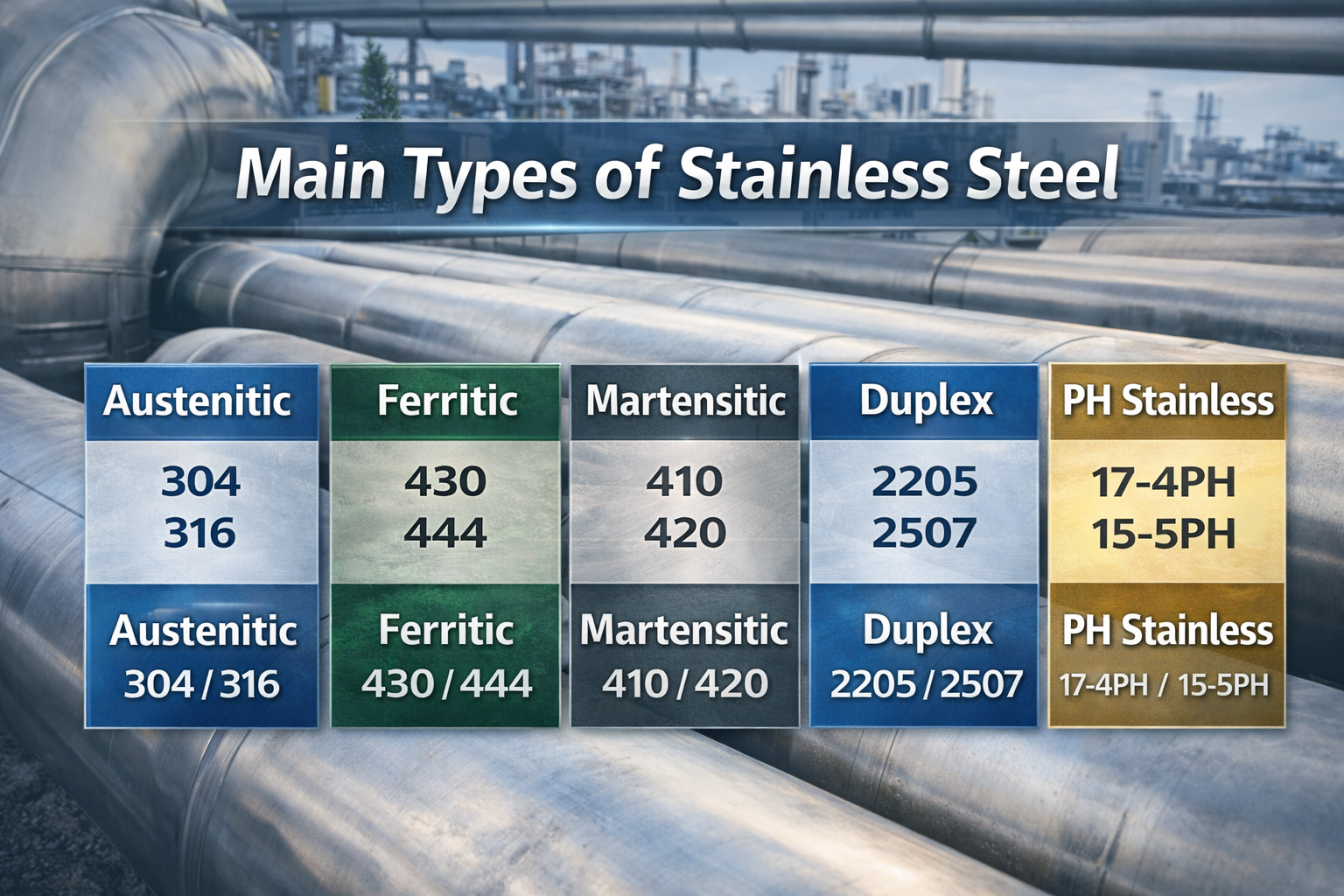
Common grades include 304, 316, and 321. Austenitic stainless steels are the most widely used because they provide excellent corrosion resistance, strong weldability, and good formability. Grade 304 is commonly used in food equipment, tanks, and architectural components, while 316 provides improved resistance in chloride-rich or marine environments.
Ferritic Stainless Steel
Common grades include 430, 444, and 446. Ferritic stainless steels are usually magnetic and often contain higher chromium with little or no nickel. They are used in appliances, decorative trim, and selected heat-resistant applications where cost control is important.
Martensitic Stainless Steel
Common grades include 410, 420, and 440C. These grades are chosen when high hardness, wear resistance, and mechanical strength are required. Typical applications include blades, valve parts, fasteners, and pump shafts.
Duplex & PH Stainless Steel
Duplex grades such as 2205 and 2507 combine high strength with strong resistance to chloride corrosion. Precipitation hardening grades such as 17-4PH and 15-5PH are selected when very high strength and good corrosion resistance are both required.
Common Stainless Steel Grades Comparison
| Grade | Family | Main Features | Typical Uses |
|---|---|---|---|
| 304 | Austenitic | Good corrosion resistance, excellent weldability, versatile for general use | Food equipment, tanks, kitchen systems, architectural parts |
| 316 | Austenitic | Better chloride resistance than 304 due to molybdenum content | Marine hardware, coastal projects, chemical equipment, medical use |
| 430 | Ferritic | Lower cost, magnetic, moderate corrosion resistance | Appliances, trim, decorative applications |
| 410 | Martensitic | High strength, moderate corrosion resistance, hardenable | Fasteners, shafts, valve parts, mechanical components |
| 2205 | Duplex | High strength, excellent pitting resistance, strong chloride performance | Offshore, chemical processing, structural systems, piping |
| 17-4PH | PH Stainless | Very high strength with good corrosion resistance | Aerospace parts, fittings, shafts, pump components |
Key Benefits of Stainless Steel
- Corrosion Resistance: Performs well in moisture, chemicals, and harsh industrial environments.
- Long Service Life: Suitable for demanding applications where reliability and reduced downtime matter.
- Easy Cleaning: Smooth surface supports hygiene-sensitive industries such as food, medical, and pharmaceutical processing.
- Strength and Heat Resistance: Many grades maintain good performance under load, pressure, and elevated temperatures.
- Lower Lifecycle Cost: Although initial cost may be higher, longer service life and lower maintenance often improve total project economics.
Where Stainless Steel Is Used
Food Processing & Medical Equipment
Stainless steel is preferred for hygienic environments because it is easy to clean, corrosion-resistant, and suitable for contamination-sensitive applications. Grades 304 and 316 are widely used for tanks, tubing, instruments, and processing systems.
Chemical Processing
Chemical plants require materials that can withstand acids, solvents, and aggressive media. Depending on the service environment, grades such as 316, 2205, or higher-alloy materials may be required to reduce the risk of pitting and premature failure.
Marine & Coastal Environments
Saltwater and airborne chlorides are highly aggressive to many metals. In these conditions, 316, 2205, and 2507 are frequently selected because they provide stronger chloride resistance than standard stainless grades.
Construction & Industrial Equipment
Stainless steel is used in structural supports, façades, piping systems, machinery, and fabricated assemblies because it combines corrosion resistance, fabrication versatility, and long-term durability in service.
How to Choose the Right Stainless Steel Grade
1. Evaluate the Service Environment
Moisture, chlorides, chemicals, operating temperature, and cleaning methods all influence grade selection. For example, 304 may perform well indoors, but 316 or duplex grades may be necessary in marine or chloride-rich environments.
2. Review Mechanical Requirements
Corrosion resistance alone is not enough. Buyers should also check tensile strength, hardness, impact resistance, fatigue performance, and weldability to ensure the material matches the actual application.
3. Consider Fabrication Needs
Some grades are easier to weld, bend, or machine than others. Austenitic stainless steels are generally preferred for fabrication, while martensitic and PH grades may be selected when higher hardness or strength is required.
4. Look at Lifecycle Cost, Not Just Purchase Price
A lower-cost grade may save money at the start, but it can become more expensive if it causes corrosion, replacement, or downtime later. The right choice should be based on total cost of ownership.
5. Confirm Supply and Certification
Reliable sourcing matters. Buyers should verify material specifications, production standards, traceability, certification, and mill test documentation. Depending on the project, this may include ASTM, ASME, EN standards, and MTC requirements.
Common Mistakes in Stainless Steel Selection
- Using 304 in chloride-rich environments where 316 or duplex is required
- Selecting a corrosion-resistant grade without checking mechanical strength
- Focusing only on initial price instead of service life and maintenance cost
- Ignoring fabrication requirements such as welding, forming, or machining
- Buying from suppliers without proper certification, traceability, or quality control support
Many stainless steel failures are caused not by poor manufacturing, but by incorrect grade selection. Careful matching of grade, environment, and project requirements is essential for long-term performance.
FAQ
What is the difference between 304 and 316 stainless steel?
The main difference is corrosion resistance. Grade 316 contains molybdenum, which improves resistance to chlorides and makes it more suitable for marine, coastal, and chemical environments than 304.
Is duplex stainless steel better than 316?
Duplex stainless steel is not always better, but it offers higher strength and stronger resistance to chloride-related corrosion in many demanding environments. The best choice depends on the application and service conditions.
Which stainless steel grade is best for marine applications?
Grade 316 is commonly used for marine applications, while 2205 or 2507 may be preferred in more aggressive seawater or offshore environments where higher chloride resistance is needed.
How do buyers choose the right stainless steel grade?
Buyers should evaluate the service environment, corrosion risk, mechanical requirements, fabrication needs, compliance requirements, and lifecycle cost before selecting a stainless steel grade.
Conclusion
Stainless steel remains one of the most reliable materials for industrial, commercial, and structural applications. Its combination of corrosion resistance, strength, durability, and cleanability makes it suitable for a wide range of operating environments.
However, stainless steel is not a one-size-fits-all material. Different grades are designed for different conditions, and the right choice depends on service environment, mechanical demand, fabrication needs, and long-term cost considerations.
Need Help Choosing the Right Stainless Steel Material?
If you are sourcing stainless steel pipe, tube, fittings, plate, or bar for industrial projects, our team can help you match the right grade to your application, service environment, and specification requirements.