
 EN
EN




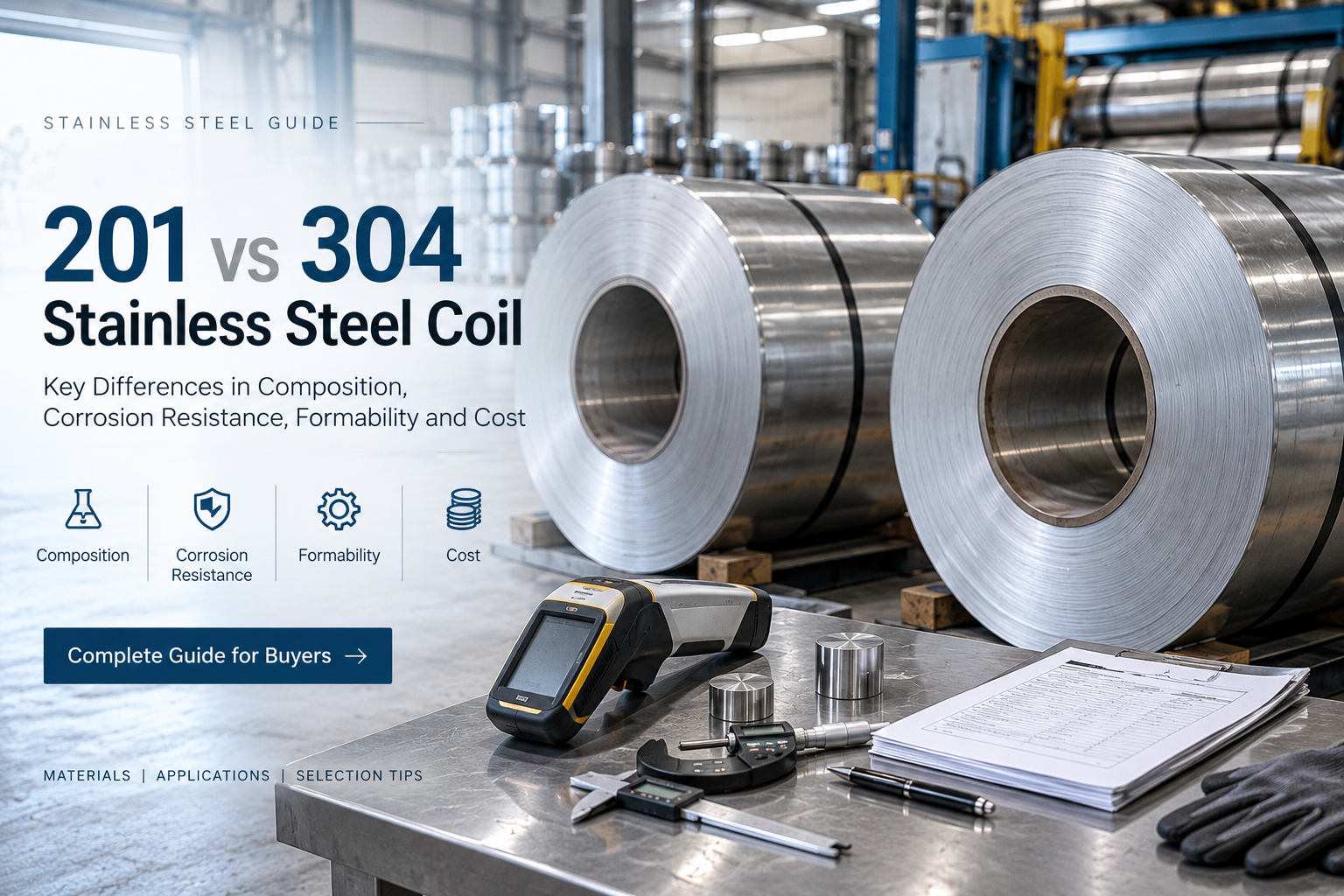
When comparing 201 vs 304 stainless steel coil, price should not be the only deciding factor. Both are austenitic stainless steels, but their chemical composition, corrosion resistance, typical applications, and purchasing considerations are different. Buyers should compare the complete material specification before approving a quotation or changing a specified grade.
201 vs 304 Stainless Steel: Key Differences
Both 201 and 304 belong to the austenitic stainless steel family. The main difference is their alloy chemistry. Type 201 contains more manganese and less nickel, while Type 304 contains more nickel and typically offers better general corrosion resistance.
| Comparison | 201 Stainless Steel | 304 Stainless Steel |
|---|---|---|
| Stainless family | Austenitic | Austenitic |
| UNS designation | S20100 | S30400 |
| Chromium | 16.0–18.0% | 18.0–20.0% |
| Nickel | 3.5–5.5% | 8.0–10.5% |
| Manganese | 5.5–7.5% | Up to 2.0% |
| General corrosion resistance | Suitable for many mild indoor and controlled environments | Generally better for a wider range of general-purpose environments |
| Typical positioning | Cost-sensitive fabrication and decorative applications | General industrial, architectural, equipment, and fabrication applications |
| Relative cost | Usually lower | Usually higher |
For cost-sensitive applications in relatively mild environments, buyers can review 201 stainless steel coil. For broader general-purpose applications, see 304 stainless steel coil.
Which Is Better: 201 or 304 Stainless Steel?
There is no single grade that is better for every project. The correct choice depends on the operating environment, fabrication process, required corrosion resistance, project specification, and budget.
Choose 201 when
The application is cost-sensitive, exposure is relatively mild, the component is mainly used indoors, and the project specification permits Type 201.
Choose 304 when
The application requires better general corrosion resistance, broader service capability, or the drawing and customer specification already require Type 304.
Outdoor exposure, moisture, salt, chlorides, cleaning chemicals, and process liquids can significantly affect stainless steel performance. Even 304 is not suitable for every corrosive environment.
201 vs 304 Corrosion Resistance
Corrosion resistance is one of the biggest differences between 201 and 304 stainless steel. In many general environments, 304 provides better corrosion resistance because of its higher nickel content and overall alloy chemistry.
201 can perform well in dry indoor applications and other relatively mild environments, but it requires more careful review when exposed to moisture, salt, chlorides, outdoor weather, or aggressive cleaning chemicals.
Actual corrosion performance also depends on temperature, surface condition, fabrication, contamination, cleaning procedures, and maintenance. Buyers should provide the real service environment when requesting material recommendations.
201 vs 304 Stainless Steel Price
201 stainless steel is generally positioned as a more economical alternative to 304 because it contains less nickel. However, grade is only one factor that affects stainless steel coil price.
Actual pricing can also vary with thickness, width, coil weight, surface finish, tolerance, slitting, polishing, protective film, packing, order quantity, mill source, alloy prices, freight, and delivery terms.
For a broader explanation of pricing variables, see what affects stainless steel prices.
Can 201 and 304 Have the Same Surface Finish?
Yes. Both grades can be supplied with different surface finishes depending on the production route and order requirement. Common options may include 2B, BA, No.4, brushed, hairline, and polished surfaces.
This means appearance alone cannot reliably identify whether a coil is 201 or 304. Surface finish and material grade are separate purchasing requirements.
Buyers comparing finish options can also review the stainless steel surface finish guide.
201 vs 304 Stainless Steel Applications
Application is another important factor when choosing between 201 and 304 stainless steel coil.
| Application | 201 Stainless Steel | 304 Stainless Steel |
|---|---|---|
| Indoor decorative fabrication | Commonly considered | Commonly used |
| Appliance components | Possible depending on environment | Widely used |
| General fabricated panels | Suitable for many mild environments | Widely used |
| Kitchen and food equipment | Requires project-specific review | Commonly specified depending on service and hygiene requirements |
| Outdoor applications | Requires careful corrosion review | Generally more suitable than 201, but exposure still needs evaluation |
| Chloride-rich environments | Requires careful material review | Also requires review; 304 is not universally suitable for chloride exposure |
These examples are general purchasing guidance. Final material suitability should follow the actual project environment, design requirement, and applicable standard.
Compare the Same Coil Specification Before Comparing Price
Two stainless steel coil quotations are not necessarily comparable simply because they show the same grade and dimensions. Surface finish, tolerance, edge condition, processing, documentation, packing, and delivery requirements can all affect price and suitability.
| RFQ Item | What Buyers Should Confirm |
|---|---|
| Grade | 201 / S20100, 304 / S30400, or the exact project designation |
| Product form | Coil, strip coil, or cut-to-length material |
| Thickness | Nominal thickness and required tolerance |
| Width | Master coil width or required slit width |
| Coil dimensions | Coil weight, inner diameter, and outer diameter where required |
| Surface finish | 2B, BA, No.1, No.4, hairline, polished, or other specified finish |
| Edge condition | Mill edge or slit edge, including burr requirements if applicable |
| Standard | Applicable product and material standard |
| Processing | Slitting, cut-to-length, polishing, brushing, or protective film |
| Documents | Mill test certificate and agreed inspection or traceability documents |
| Packing | Export packing and project-specific moisture or edge protection |
| Delivery | Quantity, destination, Incoterm, and required delivery schedule |
Buyers comparing additional grades, finishes, and dimensions can review the full stainless steel coil range.
How to Choose Between 201 and 304 Stainless Steel Coil
If the drawing already specifies 304 stainless steel, do not replace it with 201 only to reduce material cost unless the engineering team or customer approves the change.
201 vs 304 Stainless Steel Coil RFQ Checklist
Include the following information when requesting a stainless steel coil quotation:
- Required stainless steel grade and designation.
- Applicable material or project standard.
- Thickness and thickness tolerance.
- Coil width or slit width.
- Coil weight and inner diameter where required.
- Required surface finish and protective film.
- Edge condition and slitting requirements.
- Total quantity.
- Intended fabrication process.
- Service environment and end application.
- Required material certificate or inspection documents.
- Packing requirement, destination, and delivery terms.
A complete RFQ helps suppliers identify specification gaps before production and makes competing quotations easier to compare on the same basis.
Frequently Asked Questions
Is 201 stainless steel cheaper than 304?
201 is generally less expensive because it contains less nickel. Actual coil prices also depend on dimensions, surface finish, processing, quantity, alloy prices, packing, and freight.
Is 304 stainless steel better than 201?
304 generally provides better corrosion resistance and is suitable for a broader range of general-purpose applications. However, the correct grade depends on the specification, environment, fabrication process, and project requirements.
Can 201 stainless steel replace 304?
Not automatically. If a drawing, standard, or customer specification requires 304, changing to 201 should receive engineering or customer approval before purchase.
Can you tell 201 and 304 stainless steel apart by appearance?
No. Different stainless grades can have very similar surface finishes. Grade should be confirmed through specification, material traceability, certificates, or appropriate material testing rather than appearance alone.
Is 201 stainless steel suitable for outdoor use?
It depends on the environment. Moisture, salt, chlorides, pollution, temperature, cleaning chemicals, and required service life should all be considered before selecting 201 for outdoor applications.
What information is needed to order stainless steel coil?
Provide the grade, standard, thickness, width, tolerance, coil dimensions, surface finish, edge condition, quantity, processing requirements, certificates, packing, application, and destination.
Discuss Your 201 or 304 Stainless Steel Coil Requirement
Send the required grade, standard, thickness, width, tolerance, surface finish, quantity, processing requirement, application, and destination. The coil specification can then be reviewed before quotation and order confirmation.