
 EN
EN




304 vs 316 Stainless Steel: Differences, Corrosion Resistance, Cost & Applications
Compare 304 and 316 stainless steel by composition, corrosion resistance, strength, cost and applications before choosing a grade for an industrial project.
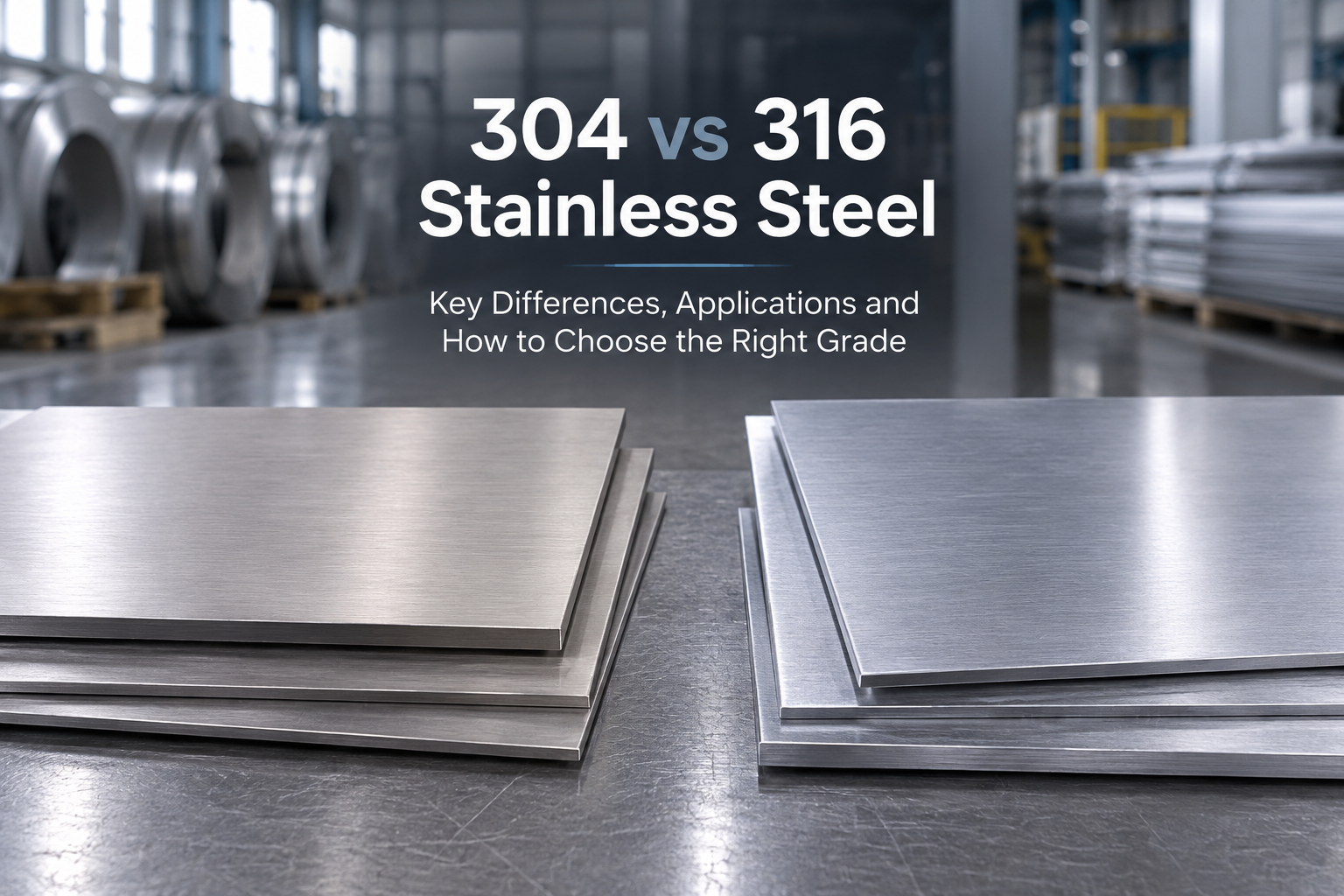
304 and 316 are two of the most widely used austenitic stainless steel grades. Both are easy to form and weld, and both provide useful corrosion resistance across a wide range of industrial applications.
The biggest difference is molybdenum. Standard 316 commonly contains about 2–3% molybdenum, while standard 304 does not normally specify molybdenum as a required alloying addition. That extra alloy content gives 316 better resistance to pitting in many chloride-containing environments.
This does not mean 316 is automatically the better choice. In a dry indoor plant, for example, 304 may deliver all the corrosion resistance the project needs at a lower material cost. In coastal equipment or a washdown system exposed to chlorides, 316 may justify the higher price.
What Is the Main Difference Between 304 and 316 Stainless Steel?
A practical general-purpose grade for many indoor applications, food equipment, machinery, tanks and architectural components. It is usually less expensive than 316.
Contains molybdenum and offers better resistance to chloride-related pitting in many service conditions. It is often used where salt, coastal exposure or aggressive cleaning is part of the environment.
If the environment is mild and chloride exposure is limited, 304 is often the first grade to check. If salt, chlorides or a more aggressive process environment is present, compare 316 more closely.
304 vs 316 Stainless Steel Comparison
| Comparison | 304 Stainless Steel | 316 Stainless Steel |
|---|---|---|
| Stainless steel family | Austenitic | Austenitic |
| Chromium | Commonly 18–20% | Commonly 16–18% |
| Nickel | Commonly 8–10.5% | Commonly 10–14% |
| Molybdenum | Not normally specified as a required addition | Commonly 2–3% |
| Chloride resistance | Lower in many comparable conditions | Generally better |
| Mechanical strength | Similar to 316 in many common product conditions | Similar to 304 in many common product conditions |
| Relative material cost | Usually lower | Usually higher |
| Low-carbon grade | 304L | 316L |
These are common reference ranges rather than a purchase specification. Exact chemistry and mechanical requirements depend on the product form and applicable standard. Final acceptance should follow the purchase specification and material test certificate.
304 vs 316 Chemical Composition
The molybdenum addition in 316 is the main chemical difference behind its improved performance in many chloride-containing environments.
Chromium is central to the passive surface film that gives stainless steel its corrosion resistance. Nickel helps maintain the austenitic structure. Molybdenum improves resistance to localized attack, particularly pitting in many chloride-containing conditions.
For a broader look at these alloying elements, see what stainless steel is made of.
304 vs 316 Corrosion Resistance
Indoor & Mild Service
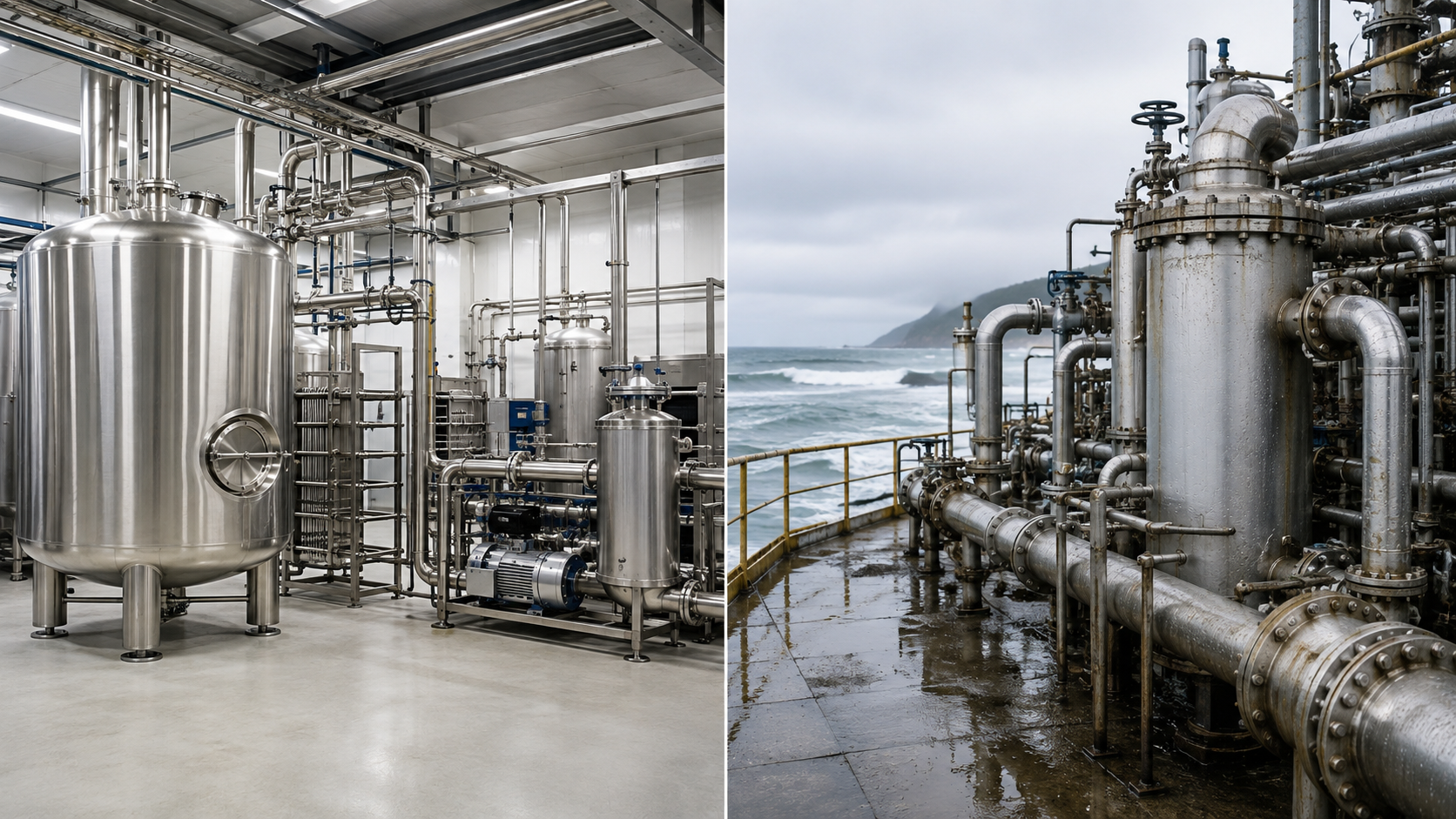
304 works well in many indoor environments where salt and aggressive process chemicals are not significant concerns.
Salt & Coastal Exposure
316 normally has the advantage when airborne salt, wash water or chloride-containing deposits are part of the service environment.
Chemical Processing
Neither grade should be chosen from the name alone. Chemical type, concentration and operating temperature matter.
316 is often described as more suitable for marine service, but that description can be misleading if taken too far. It is corrosion resistant, not corrosion proof. Warm seawater, stagnant areas, crevices and concentrated chlorides can still cause attack.
Is 316 Stainless Steel Stronger Than 304?
Not in a way that makes “316 is stronger” a useful buying rule. In many common annealed product specifications, 304 and 316 have similar mechanical property requirements.
Actual strength depends on more than the grade number. Product form, thickness, cold work, heat treatment and the governing standard all matter. A cold-worked 304 product, for example, may have very different mechanical properties from an annealed 316 product.
If strength controls the design, compare the mechanical property requirements in the actual product standard or drawing. Do not choose 316 simply because it contains more alloying elements.
Is 316 Stainless Steel More Expensive Than 304?
Usually, yes. 316 contains molybdenum and normally has a higher nickel range, so its alloy cost is generally higher than 304.
The gap is not fixed. Nickel and molybdenum prices move, and the final quotation also depends on product form, thickness, surface finish, processing, quantity, packing and inspection requirements.
A lower price per kilogram does not always mean a lower project cost. Compare equivalent standards, dimensions, finish, processing and documentation before deciding which quotation is cheaper.
304L vs 316L: What Changes?
304L and 316L are the low-carbon versions of 304 and 316. The lower carbon limit helps reduce the risk of sensitization during welding in relevant conditions, which is why L grades are common in welded fabrication.
316L still contains the molybdenum associated with the 316 family, so the basic corrosion-resistance difference between the two grade families remains.
The “L” designation should not be treated as a general upgrade. If a drawing calls for 316L, the supplier should not substitute 316 without approval. The same applies to 304 and 304L when the project specification controls the grade.
304 vs 316 Stainless Steel Applications
General Fabrication 304 Often Fits
Machinery, tanks, equipment frames and indoor fabrications are common 304 applications when the environment is not strongly corrosive.
Food Equipment Service Dependent
Both grades are widely used. Cleaning chemicals, salt content and sanitation conditions often determine whether 304 or 316 is preferred.
Coastal Equipment 316 Often Preferred
Airborne salt and repeated wetting increase the value of the improved chloride resistance provided by 316.
Chemical Equipment Review Service
Chemical composition, concentration and temperature should be checked before either grade is specified.
How to Choose Between 304 and 316 Stainless Steel
Identify the medium, temperature, cleaning method and whether exposure is continuous or occasional.
Salt, coastal air, process chlorides and some cleaning chemicals can shift the decision toward 316.
Welding, forming, machining and finishing can affect the grade, condition and product specification.
Match the grade to the actual plate, coil, pipe, tube or bar standard required by the project.
Specify More Than the Grade
“304” or “316” alone is not enough for an industrial purchase order.
Sheet & Plate
Include grade, standard, thickness, width, length, tolerance and surface finish.
View stainless steel plateCoil
State thickness, width, surface condition, edge and any slitting requirement.
View stainless steel coilPipe & Tube
Include OD, wall thickness or schedule, standard, length and manufacturing route.
View stainless steel pipeMultiple Product Forms
Align grade, standards and documentation when one project uses several stainless products.
Review 304 & 316 supply optionsWhat Should a 304 or 316 Stainless Steel RFQ Include?
State 304, 304L, 316 or 316L and the applicable product standard.
Provide thickness, width, length, OD, wall thickness, tolerance and quantity as applicable.
Include finish, polishing, slitting, cutting, machining or end preparation.
State the application, relevant exposure, MTC requirements and any third-party inspection.
Common 304 vs 316 Purchasing Mistakes
Buying 316 because it sounds like the premium option without checking whether the environment actually needs it.
Choosing 304 only on price while ignoring chloride exposure or cleaning conditions.
Comparing quotations when the standards, finish, testing or documentation are not equivalent.
Frequently Asked Questions
Is 316 stainless steel better than 304?
Not for every project. 316 offers better resistance in many chloride-containing environments, while 304 is often the more economical choice for milder service.
Does 316 stainless steel rust?
It can. 316 is corrosion resistant rather than corrosion proof. Chlorides, crevices, deposits and high temperatures can still cause attack.
Is 304 or 316 stainless steel stronger?
Neither grade is always stronger. In many common annealed product conditions, their mechanical properties are broadly comparable.
Why does 316 cost more than 304?
The main reason is alloy content. 316 contains molybdenum and generally has a higher nickel range, which increases material cost.
Can 304 and 316 be identified by appearance?
Not reliably. Finished products can look almost identical. Material documents or appropriate grade identification methods should be used.
Can 304 replace 316?
Only if the service conditions and project specification allow it. A substitution should not be made from price alone.
Prepare a Quote-Ready 304 or 316 Stainless Steel Requirement
Send the required grade, product standard, dimensions, surface condition, quantity, processing requirements, service environment and inspection needs so suppliers can quote the same scope.