
 EN
EN




What Is Stainless Steel Made Of? Key Elements Explained
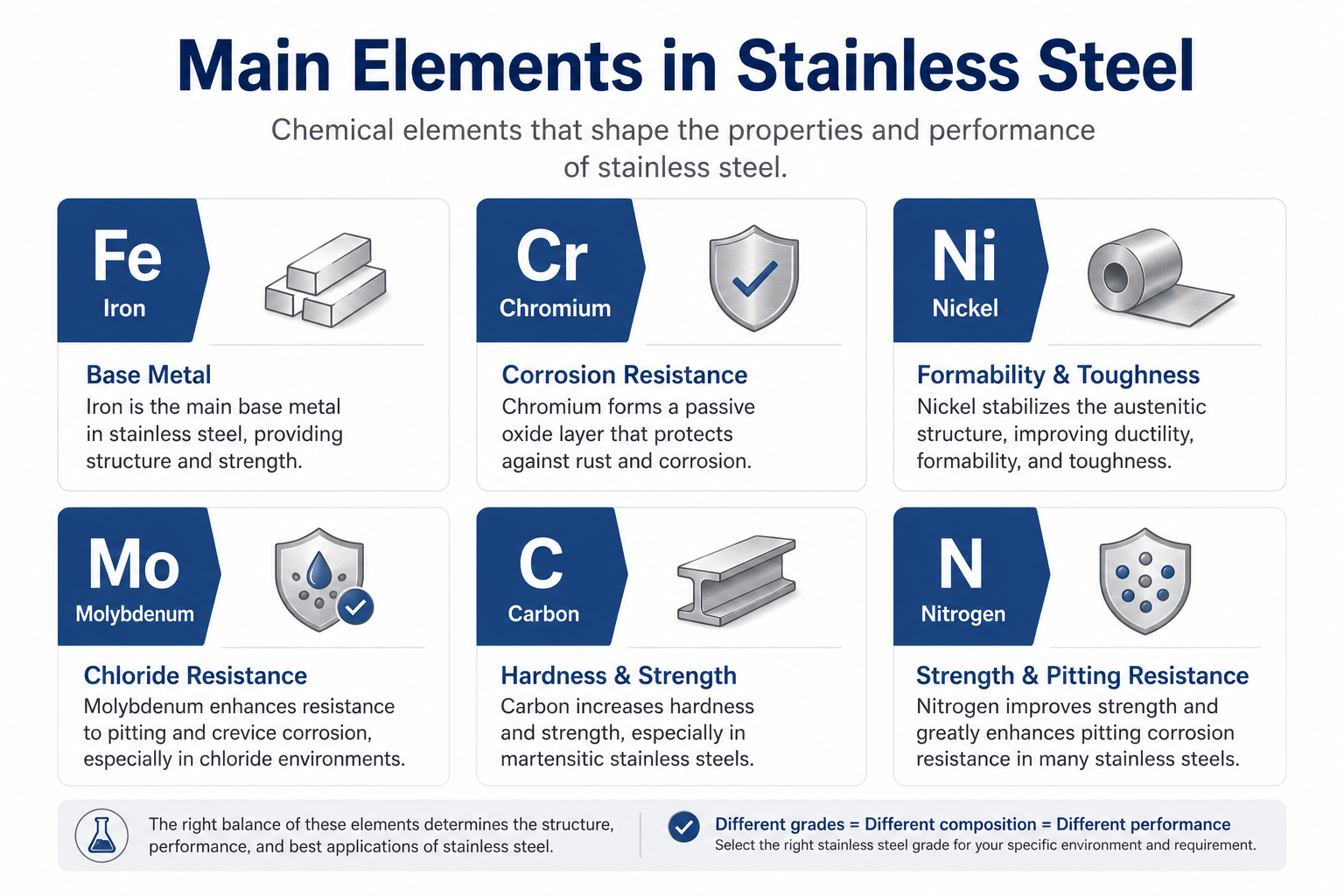
Stainless steel is used in food equipment, chemical plants, marine parts, construction, medical tools, and many other industries. Buyers often know that it resists rust, but the real question is: what is stainless steel made of, and why do different grades perform so differently?
Understanding stainless steel composition helps buyers choose the right grade instead of selecting materials only by appearance or price. A bright polished surface may look similar across different grades, but 304, 316, 430, 2205 duplex, and 321 stainless steel can behave very differently in real service.
For overseas purchasers, engineers, and fabricators, this knowledge helps reduce wrong-grade risks, corrosion failures, welding issues, and unnecessary material costs. Buyers comparing different stainless steel materials should always check the grade, standard, and working environment together.
What Is Stainless Steel Made Of?
Stainless steel is an iron-based alloy. An alloy is a metal made by combining two or more elements to improve performance.
The base element is iron. The key element is chromium. Stainless steel must contain enough chromium to form a thin protective surface film. This film is often called a passive film. It helps protect the steel from rust and corrosion.
In most industrial stainless steels, the composition may also include carbon, manganese, silicon, nitrogen, titanium, or niobium. Each element changes how the material performs in fabrication or service.
Industry reference: The World Stainless Association explains that stainless steels are iron-based alloys containing at least 10.5% chromium, which allows a protective passive layer to form on the surface. Source: worldstainless
The Main Elements in Stainless Steel Composition
Iron: The Base Metal
Iron is the main ingredient in stainless steel. It provides the basic metal structure and gives stainless steel its main strength.
However, pure iron rusts easily when exposed to air and moisture. Carbon steel also rusts because it does not contain enough chromium to protect the surface.
Buyer note: “Stainless” does not mean “rust-proof in every condition.” Stainless steel can still corrode if the grade is not suitable for the environment, especially in chloride-rich, acidic, or poorly ventilated conditions.
Chromium: The Element That Makes Stainless Steel “Stainless”
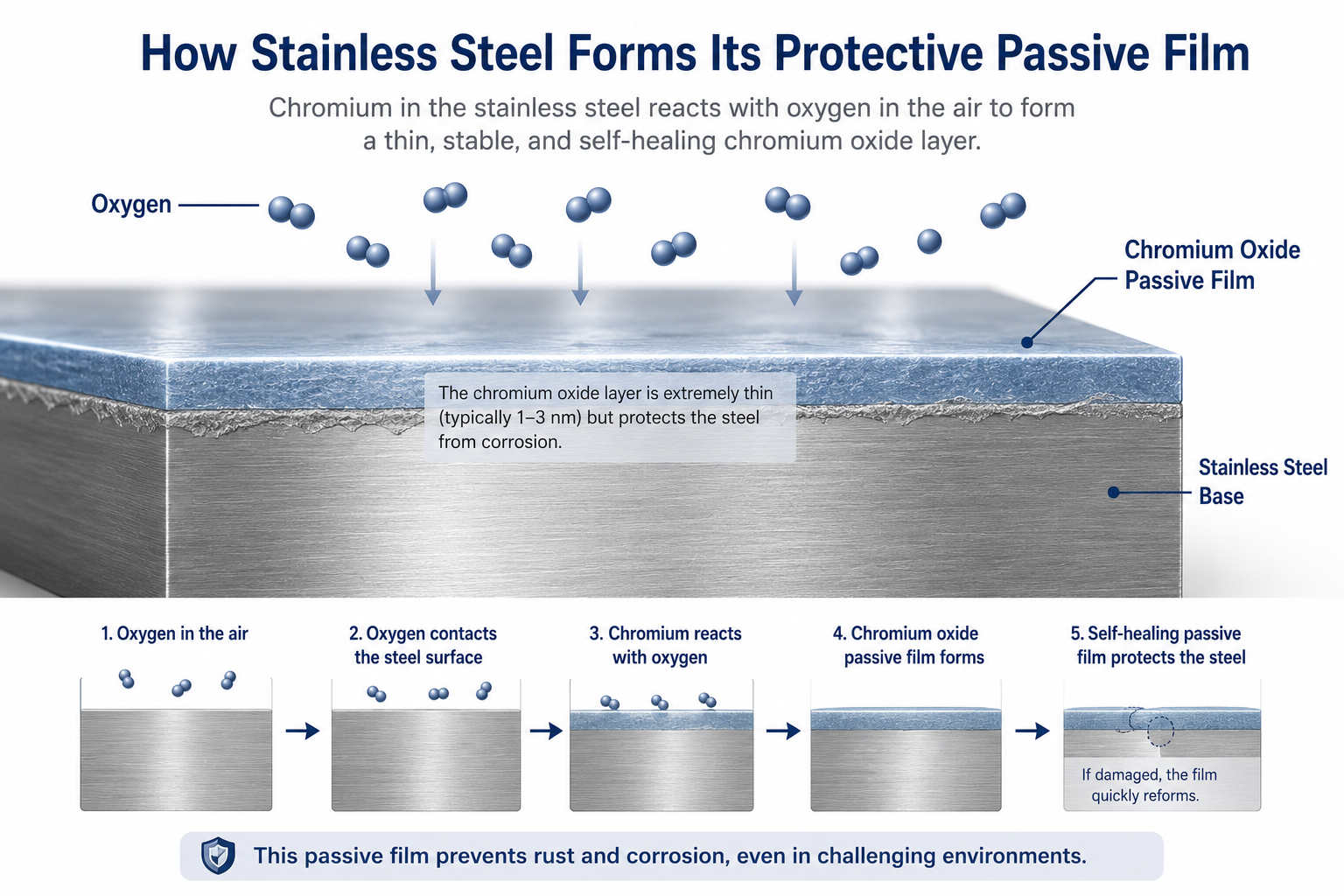
Chromium is the most important element in stainless steel composition. Without enough chromium, steel cannot form the protective passive film that gives stainless steel its corrosion resistance.
When chromium meets oxygen, it forms a very thin chromium oxide layer on the surface. This layer is invisible, but it helps block corrosion. If the surface is lightly scratched, the chromium oxide film can rebuild itself when oxygen is available.
Nickel: Why 304 and 316 Are Easy to Form and Weld
Nickel helps create and stabilize the austenitic structure. Austenitic stainless steels include widely used grades such as 304 and 316.
Nickel helps with:
- Good formability
- Good weldability
- Good toughness
- Better performance at low temperatures
Common use cases:
- Food equipment
- Storage tanks
- Kitchen equipment
- Formed sheet products
Nickel also affects cost. Grades with higher nickel content usually cost more than nickel-free or low-nickel ferritic grades. For example, 430 stainless steel is often used for indoor decorative panels or appliance parts when high nickel content is not needed.
For projects that commonly use 304 and 316 materials, buyers can review Voyage Metal’s 304 and 316 stainless steel supply options for sheet, coil, pipe, tube, and bar forms.
Molybdenum: Why 316 Handles Chlorides Better Than 304
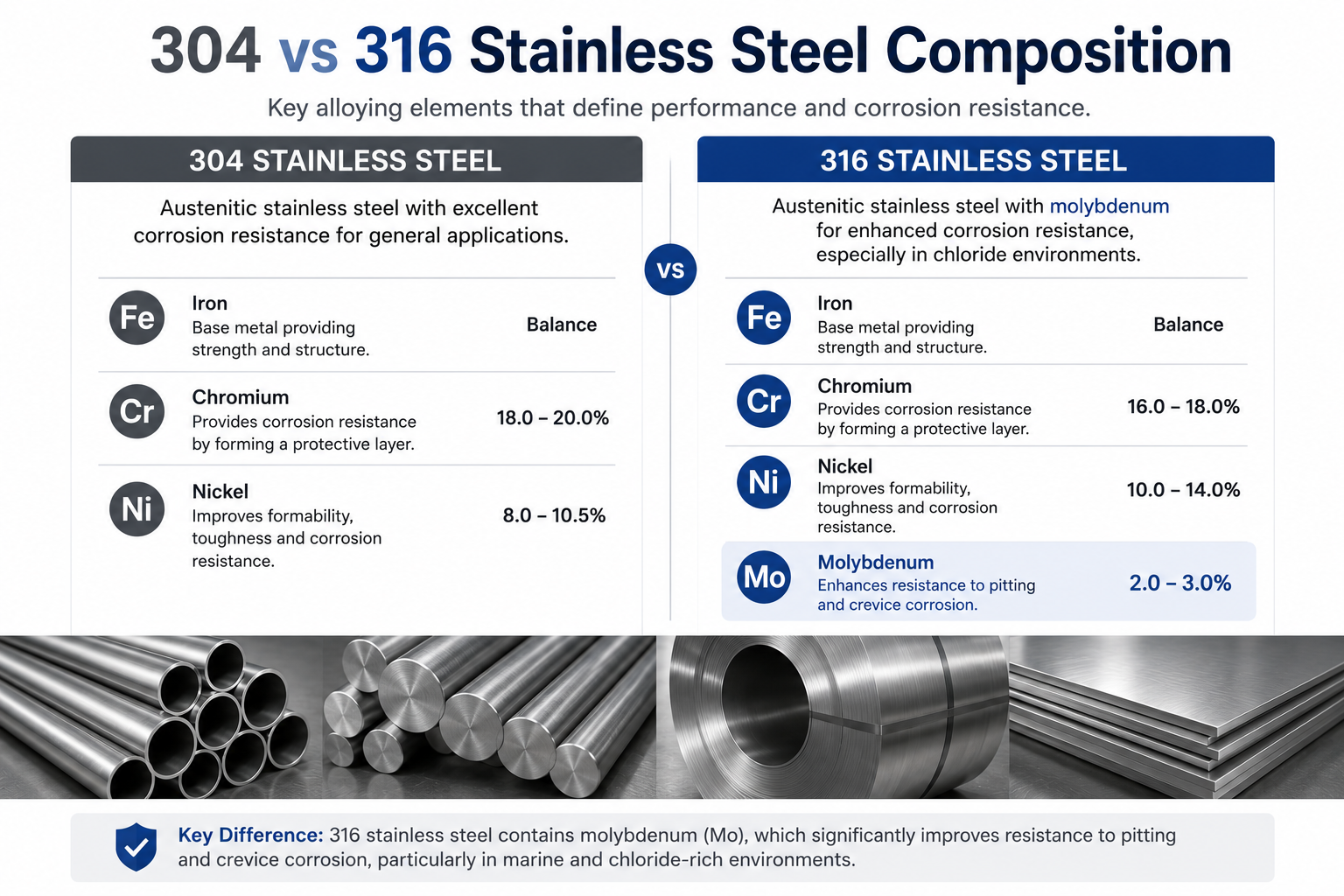
Molybdenum is a key reason 316 stainless steel performs better than 304 in many chloride-containing environments. Chlorides are found in seawater, coastal air, cleaning chemicals, salt spray, and some industrial fluids.
316 stainless steel contains molybdenum, while standard 304 stainless steel does not. This gives 316 better resistance to chloride-related corrosion in many service conditions.
- Marine hardware
- Coastal construction parts
- Chemical processing equipment
- Heat exchangers
- Pharmaceutical equipment
- Food systems using strong cleaning chemicals
However, 316 is not suitable for every severe seawater or chemical environment. In more demanding conditions, buyers may need duplex stainless steel, super duplex stainless steel, or higher alloy grades.
For harsher service conditions, such as chloride exposure, high temperature, or demanding chemical environments, buyers may also compare corrosion and heat resistant stainless steel grades, including 316L, duplex 2205, super duplex 2507, and heat-resistant stainless steel options.
Industry reference: worldstainless grade data explains that 316 is a molybdenum-bearing austenitic stainless steel and that molybdenum improves resistance to pitting and crevice corrosion, especially in chloride environments. Source: worldstainless grade datasheets
Carbon: Small Amount, Big Effect
Carbon is usually present in small amounts, but it can have a strong effect on stainless steel performance.
In martensitic stainless steels, higher carbon helps improve hardness and wear resistance after heat treatment. Grades such as 410 and 420 are often selected for parts that need higher hardness.
In many welded stainless steel applications, too much carbon can create problems. During welding, carbon may combine with chromium and form chromium carbides near the weld area. This can reduce corrosion resistance around grain boundaries.
- 304L has lower carbon than 304.
- 316L has lower carbon than 316.
- Low-carbon grades help reduce carbide precipitation during welding.
- Welded tanks, pipes, and pressure equipment often use L grades.
Manganese, Silicon, Nitrogen, Titanium, and Niobium
Manganese helps during steelmaking and appears in many stainless steel compositions. Silicon helps remove oxygen during production and can improve oxidation resistance in some grades.
Nitrogen can improve strength and pitting resistance, especially in duplex stainless steels. Titanium and niobium help stabilize certain grades for welded or high-temperature service, such as 321 and 347 stainless steel.
Common Stainless Steel Grades and What They Are Made Of
Stainless steel grade selection usually starts with the product form and service environment. For plate and sheet projects, buyers can check available stainless steel plate and sheet materials in common industrial grades for fabrication, equipment, and structural use.
| Grade | Main Type | Key Elements | Common Use |
|---|---|---|---|
| 304 | Austenitic | Iron, chromium, nickel | General equipment, food systems, tanks, fabrication |
| 316 | Austenitic | Iron, chromium, nickel, molybdenum | Marine, chemical, coastal, chloride exposure |
| 430 | Ferritic | Iron, chromium | Appliance panels, trim, indoor decoration |
| 410 | Martensitic | Iron, chromium, carbon | Shafts, valves, wear parts, mechanical components |
| 2205 | Duplex | Iron, chromium, nickel, molybdenum, nitrogen | Oil and gas, chemical processing, desalination |
| 321 | Stabilized austenitic | Iron, chromium, nickel, titanium | Heat service, welded parts, high-temperature equipment |
How Composition Changes Stainless Steel Performance
Stainless steel composition is not just a chemical list. It controls how the material works in real applications.
Corrosion and service life
- Chromium forms the passive film.
- Molybdenum improves chloride resistance.
- Nitrogen supports pitting resistance in some grades.
Fabrication and welding
- Nickel improves formability and weldability.
- Low carbon helps reduce weld corrosion risk.
- Titanium and niobium help stabilize certain grades.
The right stainless steel grade should match the environment. A lower-cost grade may work well indoors but fail faster near seawater. A higher alloy grade may be unnecessary for a dry indoor structure.
For piping systems, pressure lines, fluid handling, or fabrication projects, buyers can also check stainless steel pipe and tube products in common austenitic and duplex grade options.
Can Buyers Judge Stainless Steel Composition by Appearance?
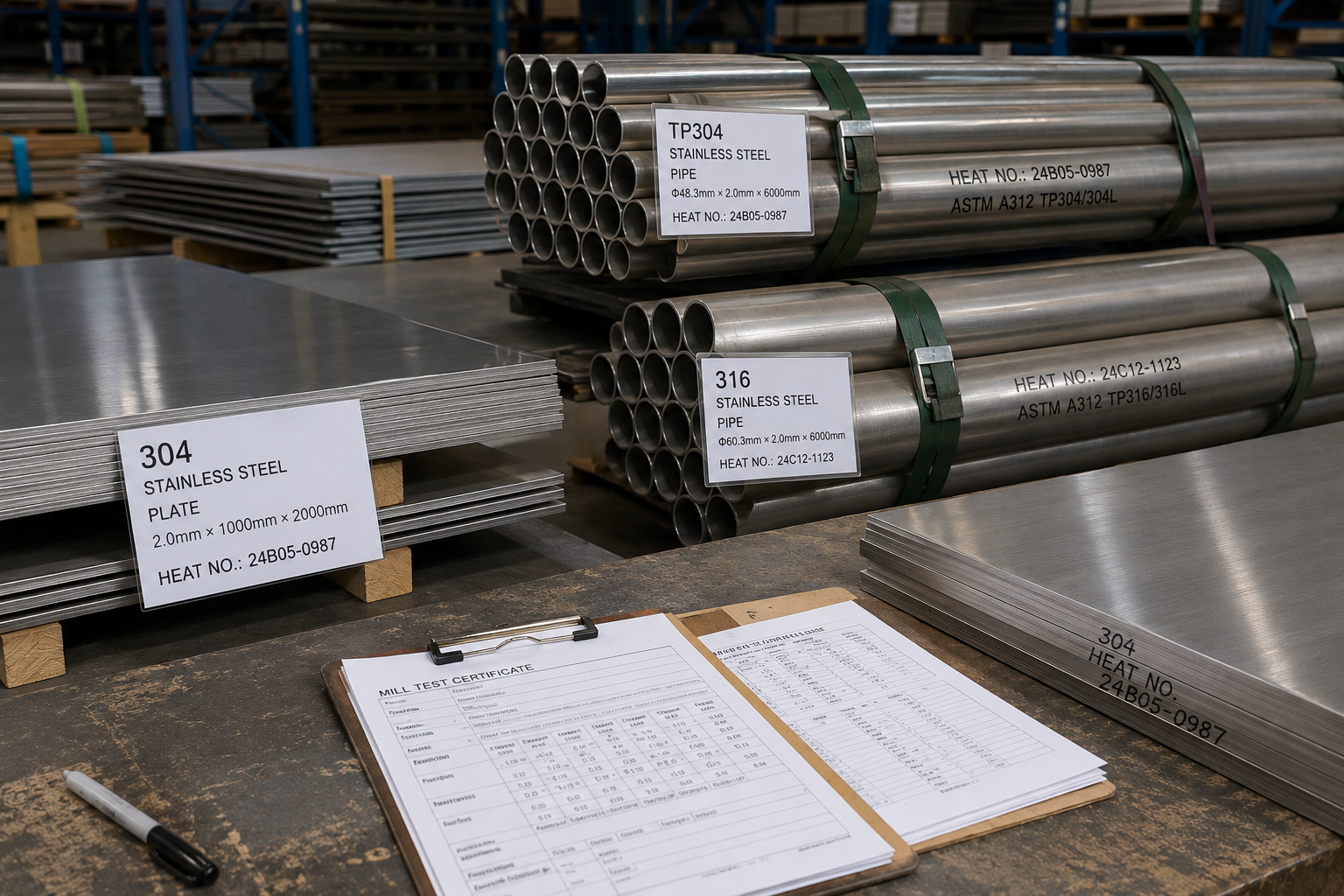
No. Stainless steel composition cannot be confirmed by appearance.
After polishing, 304, 316, and 430 stainless steel may look very similar. Surface finish can show brightness, smoothness, or roughness, but it does not prove chemical composition.
Magnet testing also has limits. It may give a quick clue about stainless steel family, but it cannot confirm the exact grade. For example, a magnet test cannot reliably separate 304 from 316.
Better verification methods include:
- Mill Test Certificate, or MTC: Shows chemical composition, mechanical properties, heat number, and standard.
- Positive Material Identification, or PMI: Uses testing equipment to check alloy elements.
- Chemical analysis: Confirms composition more accurately.
- Heat number traceability: Links product batches to production and test records.
- Standard-based inspection: Confirms ASTM, ASME, EN, JIS, or project requirements.
Practical Buying Tips for Stainless Steel Composition
For B2B stainless steel purchasing, clear specifications reduce risk. A request that only says “stainless steel” is too broad.
Before ordering, confirm:
- Required grade, such as 304, 316, 430, 2205, or 321
- Required standard, such as ASTM, ASME, EN, JIS, or GB
- Product form, such as sheet, plate, coil, pipe, tube, bar, or fitting
- Whether 304L or 316L is needed for welding
- Whether the environment contains chlorides, acids, heat, or cleaning chemicals
- Surface finish, thickness, tolerance, and edge condition
- Mill Test Certificate and heat number traceability
- Whether Positive Material Identification testing is needed
- Packaging and export requirements for overseas shipment
A small difference in composition can change corrosion resistance, welding behavior, and service life. For critical projects, material verification should happen before production or shipment, not after installation.
Summary: What Is Stainless Steel Made Of?
Stainless steel is mainly made of iron and chromium. Iron provides the base structure, while chromium forms the protective passive film that helps stainless steel resist corrosion.
- Nickel improves formability, toughness, and weldability.
- Molybdenum improves resistance to chloride-related corrosion.
- Carbon affects hardness, strength, and weld corrosion risk.
- Manganese and silicon support steelmaking and certain performance needs.
- Nitrogen improves strength and pitting resistance in some grades.
- Titanium and niobium stabilize certain stainless steels for welded or high-temperature service.
For B2B purchasing, stainless steel composition should be checked through certificates, heat number traceability, and testing when required. Appearance alone is not enough.
Need Stainless Steel Materials with Verified Composition?
For industrial projects, stainless steel composition affects corrosion resistance, fabrication, welding, and service life. Voyage Metal supports B2B buyers with stainless steel materials, clear documentation, and grade suggestions based on project environments and standards.
- Mill Test Certificate with heat number
- Grade and standard confirmation
- Stainless steel sheet, plate, coil, pipe, tube, and bar supply
- Surface finish and size selection
- Cutting and custom processing support
- Export packaging for overseas projects
- Application-based material suggestions
- PMI testing support when required
FAQ
What is the main ingredient in stainless steel?
Iron is the main ingredient in stainless steel. Chromium is the key element that makes it stainless. Most stainless steels contain at least about 10.5% chromium so that a protective passive film can form on the surface.
Why does stainless steel contain chromium?
Stainless steel contains chromium because chromium forms a thin oxide film on the surface. This passive film helps protect the steel from rust and corrosion. When oxygen is available, the film can reform after light surface damage.
What is the difference between 304 and 316 stainless steel composition?
Both 304 and 316 stainless steel contain iron, chromium, and nickel. The main difference is that 316 contains molybdenum. Molybdenum improves resistance to pitting and crevice corrosion in many chloride-containing environments.
How can buyers check stainless steel composition?
Buyers can check stainless steel composition through a Mill Test Certificate, Positive Material Identification testing, chemical analysis, and heat number traceability. Appearance, surface finish, or magnet testing cannot confirm the exact composition.
Why are some stainless steel grades more expensive?
Some stainless steel grades cost more because they contain higher levels of alloying elements such as nickel, molybdenum, nitrogen, or stabilizing elements. More expensive grades are not always required. The correct grade should match the working environment, fabrication method, and project standard.
References
- World Stainless Association, “What is Stainless Steel?” View source
- World Stainless Association, “Stainless Steel Grade Datasheets.” View source
- Nickel Institute, “Stainless Steels.” View source
- British Stainless Steel Association, “Stainless Steel Grades.” View source