
 EN
EN




Choosing stainless steel for food processing equipment is not simply a matter of selecting “food grade 304” or “food grade 316.” The right material depends on the food product, moisture level, salt and acid exposure, cleaning chemicals, welding requirements, surface finish, and documentation needed for the project.
Food grade stainless steel generally refers to stainless steel grades and surface conditions suitable for food-contact or food-processing environments. In practical B2B projects, suitability depends not only on the alloy grade, but also on corrosion resistance, hygienic design, cleanability, weld quality, surface roughness, and material traceability.
What Is Food Grade Stainless Steel?
Food grade stainless steel is stainless steel used in food-contact or food-processing environments where hygiene, corrosion resistance, and cleanability are required. It is widely used in food machinery, tanks, worktables, sanitary piping, conveyors, valves, fittings, and processing equipment.
However, “food grade” is not a single universal stainless steel grade. A 304 sheet, a 316L sanitary tube, and a 430 panel may all be used in food-related environments, but they are suitable for different service conditions.
Corrosion Resistance
The material should resist rust, pitting, and surface breakdown under the expected food-processing and cleaning conditions.
Cleanable Surface
The surface should be smooth, accessible, and free from deep scratches, cracks, pits, and crevices that can hold residue.
Food-contact Safety
The material should be non-toxic and suitable for direct or indirect food contact under the intended operating environment.
Application Fit
Grade selection should consider food type, moisture, salt, acid, temperature, cleaning chemicals, and welding requirements.
Under FDA 21 CFR 117.40, food-contact surfaces should be corrosion-resistant when in contact with food, made of non-toxic materials, and able to withstand the food, cleaning compounds, sanitizing agents, and cleaning procedures used in the operating environment.
Why Food Grade Stainless Steel Matters in Real Processing Lines
Food processing equipment faces daily exposure to moisture, cleaning chemicals, organic residues, salt, acids, and temperature changes. Even when the food product looks mild, the operating environment can be aggressive.
Salt and Chlorides
Seafood, brine, cured meat, sauces, and chloride-based cleaners can increase the risk of pitting corrosion, especially on 304 stainless steel.
Food Acids
Vinegar, fruit products, fermented foods, sauces, and some dairy processes may require stainless steel with higher corrosion resistance.
Frequent Washdown
Wet production areas and daily cleaning cycles expose stainless steel to moisture, detergents, sanitizers, and sometimes elevated temperature.
Welding and Fabrication
Poor weld finishing, lack of passivation, or crevice-prone design can create corrosion points even when the base stainless steel grade is correct.
Food Grade Stainless Steel Standards and Industry References
Food grade stainless steel selection is not only about the alloy. Standards and hygienic design rules also consider material safety, surface condition, corrosion resistance, cleanability, and final equipment design.
FDA 21 CFR 117.40
Food-contact surfaces should be corrosion-resistant, made of non-toxic materials, and able to withstand the intended food, cleaning compounds, sanitizing agents, and cleaning procedures.
NSF/ANSI 51
NSF/ANSI 51 covers materials and finishes used in commercial food equipment, including many food-contact components and surfaces.
3-A Sanitary Standards
For many product-contact stainless surfaces, 32 microinch Ra, about 0.8 micrometer Ra, or smoother is commonly specified.
EHEDG Guidance
EHEDG focuses on hygienic equipment design that supports effective cleaning and helps reduce contamination risk.
What Makes Stainless Steel Suitable for Food Contact?
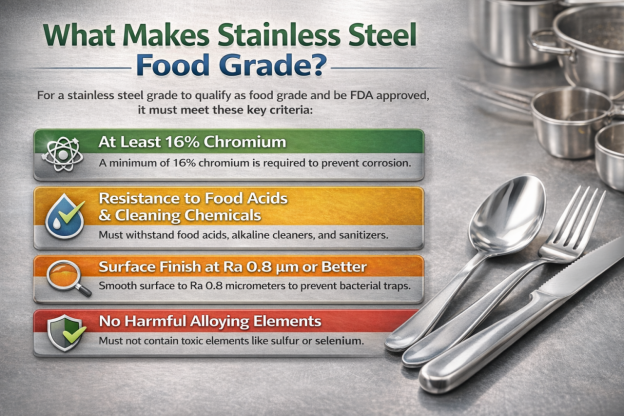
Enough Chromium for Passive Film Protection
Chromium helps stainless steel form a thin passive layer that protects the metal from oxidation and corrosion.
Resistance to Salt, Acid, and Cleaning Chemicals
Seafood, pickled products, sauces, brines, acidic fruit products, and chemical cleaning cycles may require 316 or 316L.
Smooth and Cleanable Surface Finish
For sanitary food-contact surfaces, buyers should confirm the required Ra value instead of relying only on finish names.
Good Welding and Post-Weld Treatment
304L and 316L are often preferred for welded hygienic equipment. Weld polishing and passivation may also be required.
Common Food Grade Stainless Steel Grades
The most common stainless steel grades for food-processing equipment come from the 300 and 400 series. Each grade has a different balance of corrosion resistance, cost, formability, weldability, and application fit.
304 Stainless Steel
304 stainless steel is one of the most widely used grades for general food equipment. It offers a good balance of corrosion resistance, availability, formability, and cost.
For general fabrication projects, buyers can review Voyage Metal’s 304 / 304L stainless steel pipe and tube supply options.
316 Stainless Steel
316 stainless steel contains molybdenum, which improves resistance to chloride-related pitting and crevice corrosion compared with 304.
For chloride-containing or more demanding processing lines, see Voyage Metal’s 316 series stainless steel pipe and tube options.
430 Stainless Steel
430 stainless steel is a ferritic grade. It does not contain nickel, so it is usually more economical than 304 or 316. It can be considered for selected dry, low-corrosion food-area components.
304 vs 316 vs 430 Food Grade Stainless Steel
| Grade | Type | Common Food Use | Main Advantage | Key Limitation |
|---|---|---|---|---|
| 304 | Austenitic | General food equipment, worktables, tanks, bakery equipment | Good balance of cost, availability, corrosion resistance, and formability | Can pit in salty or chloride-rich environments |
| 304L | Austenitic, low carbon | Welded food equipment, tanks, pipework, fabricated machinery | Better for welded fabrication than standard 304 | Similar chloride resistance limits to 304 |
| 316 | Austenitic with molybdenum | Meat, seafood, brine, acidic food, wet processing | Better resistance to salt, chlorides, and many cleaning environments | Higher cost than 304 |
| 316L | Austenitic with molybdenum, low carbon | Welded hygienic systems, sanitary piping, aggressive food environments | Strong choice for welded and corrosive food-processing areas | Higher cost than 304L |
| 430 | Ferritic | Dry food-area panels, appliance parts, low-corrosion surfaces | Lower cost and good appearance | Lower corrosion resistance; not ideal for wet, salty, or acidic service |
Food Grade Stainless Steel Grade Equivalent Chart
International buyers often use ASTM, UNS, EN, or JIS grade names depending on the market. Confirming the correct equivalent grade helps avoid ordering mistakes.
| Common Name | ASTM / AISI | UNS | EN Grade | Typical Food Equipment Use |
|---|---|---|---|---|
| 304 | 304 | S30400 | 1.4301 | General food equipment, tanks, worktables, panels |
| 304L | 304L | S30403 | 1.4307 | Welded tanks, pipework, fabricated machinery |
| 316 | 316 | S31600 | 1.4401 | Salt, acid, wet processing, chloride exposure |
| 316L | 316L | S31603 | 1.4404 | Sanitary piping, welded hygienic systems, CIP lines |
| 430 | 430 | S43000 | 1.4016 | Dry panels, appliance parts, selected low-corrosion components |
Voyage Metal supplies multiple product forms, including stainless steel sheet and plate, pipe, tube, coil, and bar for industrial fabrication and food equipment manufacturing.
How to Choose the Right Food Grade Stainless Steel
Check the Food Product
Salted meat, seafood, pickled products, vinegar-based sauces, fermented foods, dairy products, and acidic fruit products can create different corrosion risks.
Check the Cleaning Process
Daily washdown, chloride-based cleaners, acidic cleaners, alkaline cleaning agents, steam, and CIP systems can affect grade selection.
Check Welding Requirements
For welded equipment, 304L or 316L is often preferred. Weld polishing and passivation may also be needed for sanitary service.
Check the Surface Finish
Food-contact surfaces may require 2B, No. 4, BA, polished, or custom finishes. For strict sanitary projects, Ra value should be confirmed.
Common Applications of Food Grade Stainless Steel
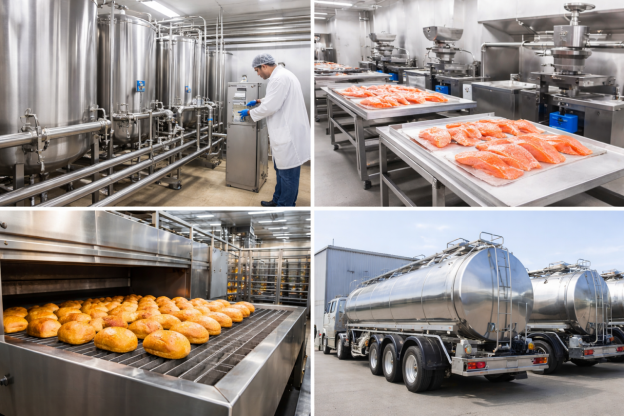
Food Processing Tanks
304L is commonly used for general storage and processing tanks. 316L is often selected for acidic, salty, wet, or more aggressive products.
Food Conveyor Systems
304 works for many general conveyor frames and surfaces. 316 is better for seafood, meat, wet processing, and washdown areas.
Meat and Seafood Equipment
316 or 316L is often selected where equipment is exposed to brines, salt, moisture, chloride-based cleaners, organic residues, and frequent washdown.
Sanitary Piping and Fittings
316L is often used for welded sanitary systems, especially when the line handles salt, acid, moisture, or chemical cleaning cycles. Buyers can review Voyage Metal’s stainless steel pipe product category for available pipe and tube options.
Practical Buying Tips for Food Grade Stainless Steel
| Buying Point | What to Check | Why It Matters |
|---|---|---|
| Application | Direct food contact, indirect contact, structure, cover, frame, or decorative panel | Different parts may require different stainless steel grades |
| Environment | Dry, wet, salty, acidic, hot, or chemical-cleaned | Corrosion risk changes with real service conditions |
| Fabrication | Welding, bending, cutting, polishing, machining, or deep drawing | Processing method can affect grade and surface selection |
| Surface finish | 2B, No. 4, BA, polished, or specified Ra value | Cleanability depends heavily on surface condition |
| Certificates | Mill Test Certificate, heat number, standard, chemical composition, mechanical properties | Traceability supports inspection, quality control, and project documentation |
| Packaging | PVC film, wooden pallet, waterproof wrapping, pipe-end protection | Good packaging reduces scratches, stains, and shipping damage during export |
Documents Buyers Should Request Before Ordering
Mill Test Certificate
The MTC should show grade, heat number, chemical composition, mechanical properties, standard, size, and production batch information.
Heat Number Traceability
Heat number traceability helps connect the delivered material with production and inspection records.
Surface Finish Confirmation
For food-contact or hygienic applications, surface finish and Ra value should be confirmed when required by the project.
Additional Inspection
PMI, third-party inspection, dimensional checks, or special packaging requirements can be arranged depending on the buyer’s quality plan.
For sheet and plate projects, buyers can compare available stainless steel product forms through Voyage Metal’s stainless steel plate category.
Summary
Food grade stainless steel should be selected by application, not by grade name alone. 304 and 304L work well for many general food-processing environments, while 316 and 316L are better suited to salt, acid, chloride exposure, wet processing, aggressive cleaning, and welded hygienic systems.
430 can be a cost-effective choice for selected dry or low-corrosion food-area components. The final decision should consider food type, cleaning chemicals, salt and acid exposure, welding needs, surface finish, Ra value, certification, and supplier traceability.
Food Grade Stainless Steel Supply Support from Voyage Metal
For industrial buyers, food equipment manufacturers, and fabrication companies, material consistency is just as important as grade selection. Voyage Metal supports stainless steel material supply based on grade, size, surface finish, tolerance, certification, and export packaging requirements.
- 304 / 304L / 316 / 316L / 430 stainless steel grade support
- Sheet, plate, coil, pipe, tube, and bar supply
- Mill Test Certificate and heat number traceability
- 2B, No. 4, BA, and polished surface options
- Cut-to-size and project-based supply
- Export packaging for B2B orders
FAQ
What is food grade stainless steel?
Food grade stainless steel refers to stainless steel grades and surface conditions suitable for food-contact or food-processing environments.
What stainless steel grade is commonly used for food processing equipment?
304 stainless steel is commonly used for general food processing equipment. 316 and 316L are better for salty, acidic, wet, or aggressive environments.
Is 430 stainless steel food grade?
430 stainless steel can be used for selected dry, low-corrosion food-area components, but it is not recommended for salty, acidic, constantly wet, or frequently washed food-contact equipment.
Why is 316 stainless steel used for seafood and meat processing?
316 stainless steel contains molybdenum, which improves resistance to chloride-related corrosion from salt, moisture, brines, and cleaning chemicals.
How do you choose between 304 and 316 stainless steel for food use?
Choose 304 for mild general food equipment. Choose 316 when the equipment will contact salt, chlorides, acids, aggressive cleaning chemicals, or constant moisture.
What surface finish is needed for food grade stainless steel?
Many food-contact surfaces use 2B, No. 4, BA, or polished finishes. For stricter sanitary applications, buyers often specify 32 microinch Ra, about 0.8 micrometer Ra, or smoother.