
 EN
EN



What Is Austenitic Stainless Steel? Grades, Properties, Applications, and RFQ Checklist
Quick Answer
Austenitic stainless steel is a major stainless steel family known for good corrosion resistance, formability, weldability, and usually non-magnetic behavior in the annealed condition. Common austenitic stainless steel grades include 304, 304L, 316, and 316L.
For industrial buyers, the family name is only a starting point. Before approving material, confirm the exact grade, applicable standard, product form, dimensions, tolerance, surface finish, quantity, inspection documents, and service environment.
The common mistake is to treat every austenitic stainless steel grade as interchangeable. A coil intended for forming, a plate for fabricated equipment, and a pipe for a fluid system may require different grade, finish, dimensional, and document checks.
What Makes Austenitic Stainless Steel Different?
“Austenitic” describes a stainless steel family with an austenitic structure at normal service conditions. This structure is one reason why many austenitic grades offer good ductility, forming performance, and weldability.
Austenitic stainless steels are often associated with non-magnetic behavior in the annealed condition, but a magnet is not a reliable grade-identification or acceptance tool. Cold work, fabrication history, steel fasteners, and nearby components can make a quick field check misleading.
The practical buying questions are: Which grade is required? Which product standard applies? Will the material be formed, welded, machined, or exposed to a specific process environment? Engineering and procurement teams should confirm those points before accepting an equivalent grade.
Austenitic Stainless Steel Properties
The exact properties depend on grade, product form, heat treatment condition, and applicable standard. However, most austenitic stainless steels are selected because they offer a useful balance of corrosion resistance, fabrication performance, and availability.
| Property | Typical Austenitic Stainless Steel Feature | Buyer Check |
|---|---|---|
| Corrosion resistance | Good general corrosion resistance; 316 and 316L are often selected where better resistance than 304 is needed. | Confirm actual media, temperature, cleaning chemicals, and exposure condition. |
| Formability | Generally suitable for bending, forming, drawing, and fabrication. | Confirm product form, thickness, finish, and forming requirements. |
| Weldability | Many grades are commonly welded, especially low-carbon variants such as 304L and 316L. | Confirm welding procedure, grade variant, and project specification. |
| Magnetism | Usually non-magnetic in the annealed condition, but cold work may change magnetic response. | Do not use magnet response as the only acceptance method. |
| Common grades | 304, 304L, 316, 316L, 321, 347, 309S, 310S. | Match the grade with the standard, product form, and application. |
Common Austenitic Stainless Steel Grades: 304, 304L, 316, and 316L
Commonly requested austenitic stainless steel grades include 304, 304L, 316, and 316L. These grades are widely used in sheet, plate, coil, pipe, tube, bar, and fabricated components.
304 stainless steel is often used for general industrial and commercial applications where good corrosion resistance and fabrication performance are required. 304L is the low-carbon version and is often considered when welding requirements are important.
316 stainless steel is commonly selected when the service environment requires better corrosion resistance than standard 304. 316L is the low-carbon version of 316 and is widely requested for welded assemblies, process equipment, and corrosion-related projects.
If your project requires 304 or 316 material in several product forms, review our 304 and 316 stainless steel supplier page for common supply forms and engineering-use procurement details.
| Grade | Common Buying Reason | Typical RFQ Focus |
|---|---|---|
| 304 | General-purpose austenitic stainless steel for many fabrication and equipment uses. | Product form, dimensions, finish, tolerance, and MTC. |
| 304L | Often requested where welding or low-carbon requirements matter. | Confirm low-carbon grade requirement and applicable standard. |
| 316 | Often selected where better corrosion resistance than 304 is required. | Confirm environment, media, temperature, and specification. |
| 316L | Common for welded equipment, process systems, and more demanding corrosion conditions. | Confirm welding context, documentation, and surface condition. |
Austenitic Stainless Steel vs Ferritic Stainless Steel
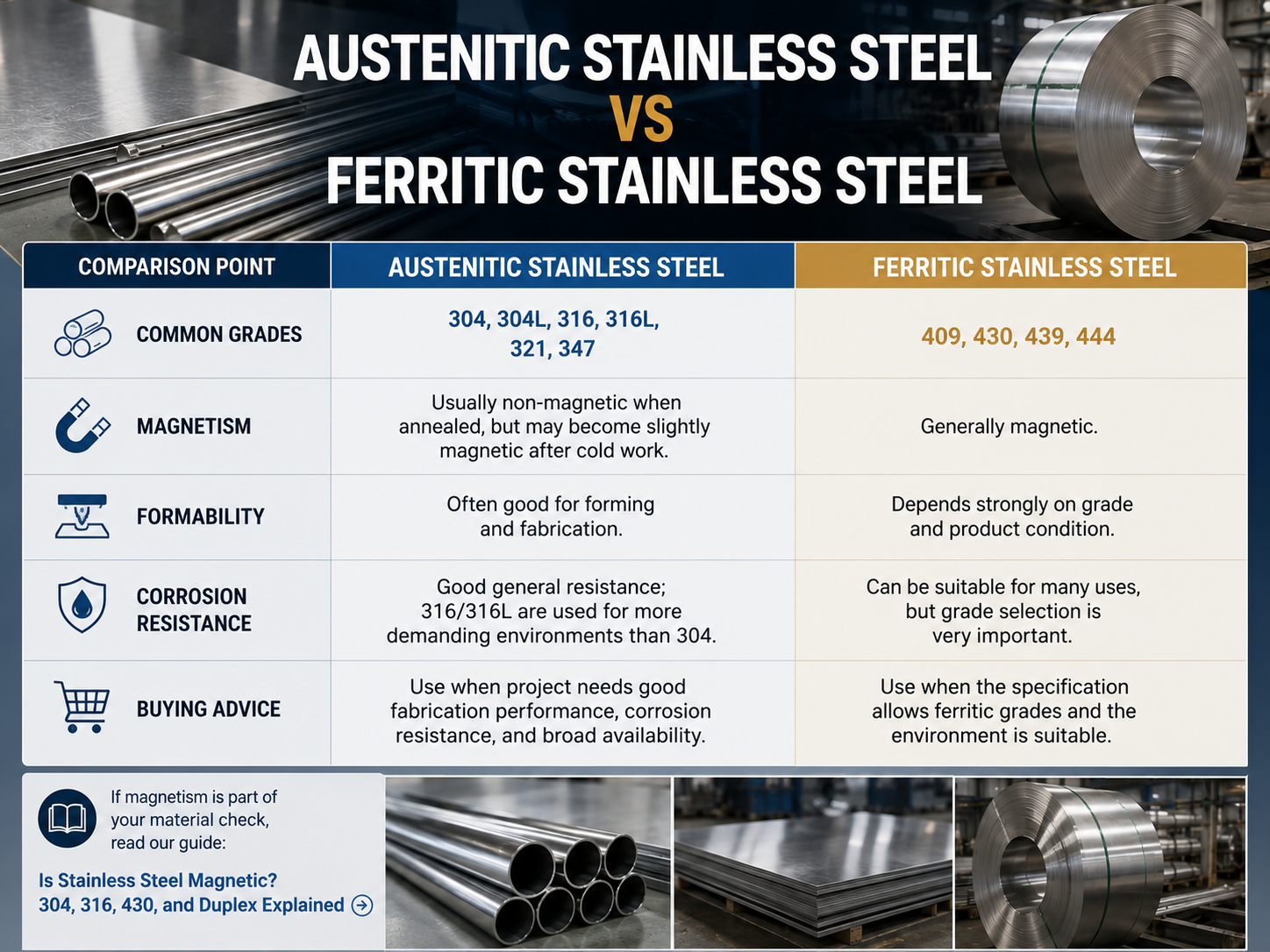
Buyers often compare austenitic stainless steel with ferritic stainless steel when reviewing cost, corrosion resistance, magnetic response, and fabrication requirements. The better choice depends on the service condition and project specification.
| Comparison Point | Austenitic Stainless Steel | Ferritic Stainless Steel |
|---|---|---|
| Common grades | 304, 304L, 316, 316L, 321, 347 | 409, 430, 439, 444 |
| Magnetism | Usually non-magnetic when annealed, but may become slightly magnetic after cold work. | Generally magnetic. |
| Formability | Often good for forming and fabrication. | Depends strongly on grade and product condition. |
| Corrosion resistance | Good general resistance; 316/316L are used for more demanding environments than 304. | Can be suitable for many uses, but grade selection is very important. |
| Buying advice | Use when project needs good fabrication performance, corrosion resistance, and broad availability. | Use when the specification allows ferritic grades and the environment is suitable. |
If magnetism is part of your material check, read our guide: Is Stainless Steel Magnetic? 304, 316, 430, and Duplex Explained.
Product Form Changes the Specification Check
The same austenitic stainless steel grade may be supplied in several forms, but the RFQ details change with each form. Start with the finished product form, then state the information needed to manufacture, inspect, pack, and compare it.
For sheet and plate, confirm thickness, width, length, tolerance, edge condition, surface finish, and any cutting requirement. For coil, add coil width, surface protection, slitting, and cut-to-length requirements where relevant.
For stainless steel pipes and tubes, confirm outside diameter, wall thickness, length, end condition, production route where specified, and the relevant dimensional standard.
Avoid descriptions such as “industrial grade.” A clear request helps the supplier quote stainless steel products on the same basis and helps your team compare offers without hidden scope differences.
Standards and Inspection Documents
The applicable standard may govern material designation, dimensions, testing, marking, and delivery condition. ASTM, ASME, EN, JIS, GB/T, and project specifications can all matter, depending on the application and market. Give the standard reference in enough detail for the supplier and inspection team to understand the requirement.
If a mill test certificate, also called an MTC, or other inspection document is needed, include it in the RFQ before quotation. State whether chemical analysis, mechanical test results, dimensional inspection, surface inspection, third-party inspection, or a required document format is part of the supply scope.
For grade naming and standard comparison, you may also read: AISI 316 vs ASTM 316 Stainless Steel.
Common Applications of Austenitic Stainless Steel
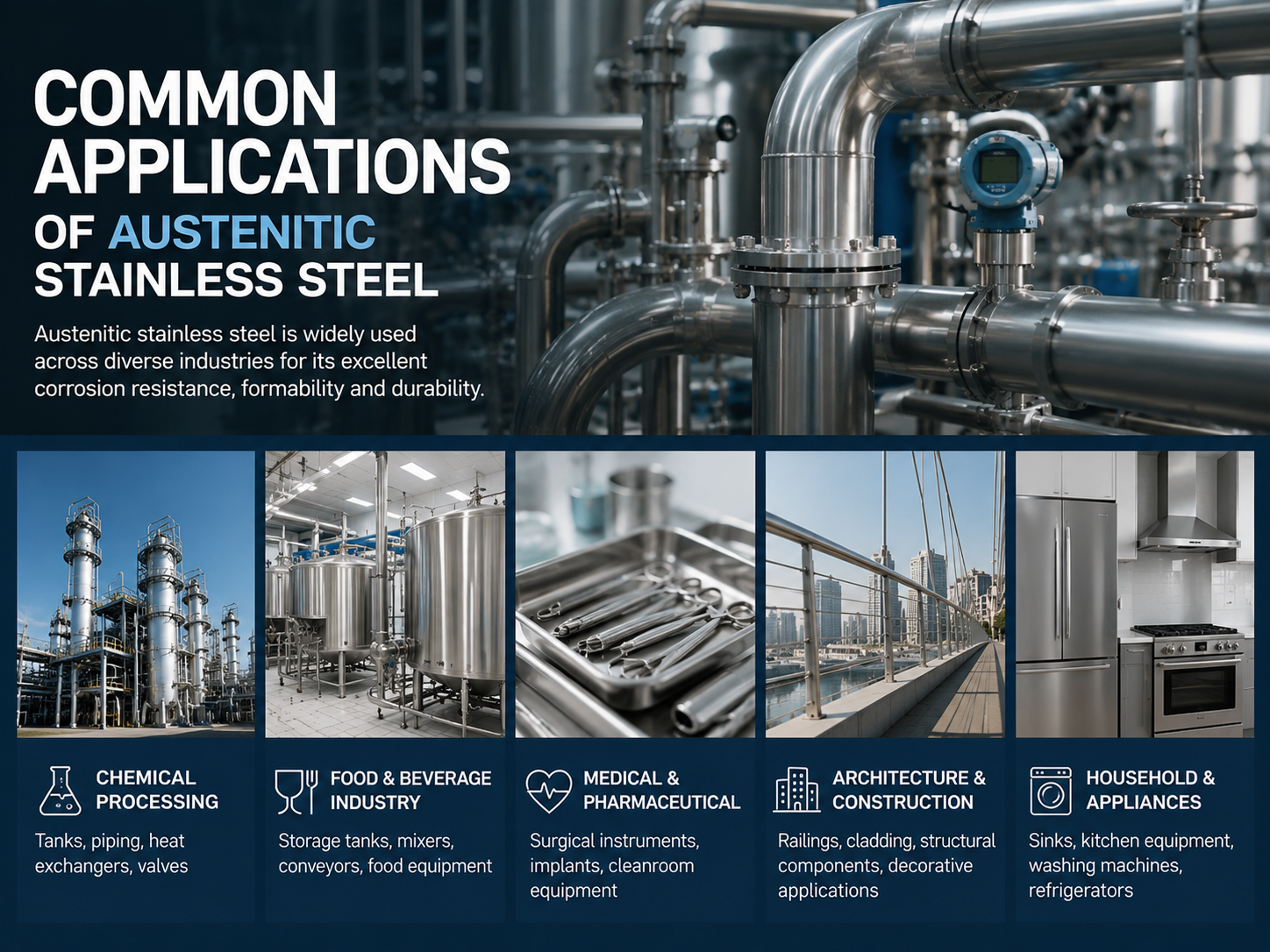
Austenitic stainless steels are used in many industrial and commercial applications because they combine corrosion resistance, clean appearance, and fabrication performance. However, one grade does not fit every service condition.
| Application Area | Common Material Requirement | Buyer Review Point |
|---|---|---|
| Process equipment | Corrosion resistance, weldability, and document traceability. | Confirm media, temperature, cleaning practice, and MTC requirements. |
| Food and beverage equipment | Clean surface, fabrication quality, and suitable corrosion resistance. | Confirm surface finish, cleaning chemicals, and hygiene-related requirements. |
| Architectural components | Appearance, surface finish, and weather exposure performance. | Confirm finish, handling protection, exposure location, and maintenance expectations. |
| Pipe and fluid systems | Correct grade, wall thickness, dimensional standard, and inspection documents. | Confirm OD, wall thickness, end condition, pressure-related requirements, and test scope. |
| Fabricated parts | Formability, weldability, and stable supply condition. | Confirm drawing, tolerance, cutting, bending, and welding context. |
When Should Buyers Choose 304, 316, or 316L?
Choose 304 when the project requires a widely available general-purpose stainless steel and the service environment is suitable. Choose 304L when the specification requires a low-carbon 304 variant, especially when welding is part of the fabrication route.
Choose 316 when the environment requires better corrosion resistance than 304. Choose 316L when welding, corrosion control, and low-carbon requirements are important in the same project.
Do not select grade by price alone. A lower-priced offer may involve a different standard, finish, tolerance, document scope, or product condition. For project materials, compare quotations line by line.
Specification Checklist for an Austenitic Stainless Steel RFQ
Include the following information when requesting a quote for austenitic stainless steel sheet, plate, coil, pipe, tube, bar, or fabricated material:
- grade and applicable material or product standard;
- product form: sheet, plate, coil, pipe, tube, bar, wire, or another defined form;
- thickness or wall thickness, width or diameter, length, and tolerance;
- surface finish, edge condition, coating, or protective film if relevant;
- forming, welding, or machining context when it affects supply;
- quantity, packing, marking, and destination requirements;
- MTC, inspection, and other document requirements;
- application and service environment details;
- any drawing, project specification, or approved vendor requirement.
Common RFQ Mistakes to Avoid
Many stainless steel quotation problems come from incomplete descriptions. The following issues often lead to price differences, delivery delays, or material disputes:
- requesting only “304 stainless steel” without product form, standard, size, or finish;
- comparing sheet, plate, coil, pipe, and tube prices without checking tolerance and supply condition;
- assuming 304, 304L, 316, and 316L can be replaced freely;
- using magnet response as the only material check;
- forgetting to request MTC or third-party inspection before quotation;
- not explaining welding, forming, pressure service, or corrosion environment requirements.
FAQ
What is austenitic stainless steel?
Austenitic stainless steel is a stainless steel family with an austenitic structure at normal service conditions. Common grades include 304, 304L, 316, and 316L. It is widely used because of its corrosion resistance, formability, weldability, and broad availability.
Are all austenitic stainless steels non-magnetic?
Many austenitic stainless steels are commonly non-magnetic in the annealed condition, but that is not a dependable acceptance test for grade or compliance. Cold work, fabrication condition, and mixed materials may affect a simple magnet check.
Is 304 the same as every austenitic stainless steel?
No. 304 is one common austenitic stainless steel grade, but selection depends on the applicable standard, product form, fabrication route, service environment, and project requirements.
What is the difference between 304 and 316 stainless steel?
304 is a widely used general-purpose austenitic stainless steel. 316 is commonly selected when better corrosion resistance than 304 is required. The final choice should be based on the project specification and service environment.
Why do buyers often choose 316L stainless steel?
316L is often selected for welded equipment, process systems, and corrosion-related applications where a low-carbon 316 variant is required. Buyers should still confirm the applicable standard, product form, dimensions, and inspection documents.
What should be checked when comparing stainless steel quotes?
Compare grade, standard, product form, dimensions, tolerance, surface finish, quantity, packing, inspection documents, and commercial terms on the same basis. A lower price may reflect a different supply scope.
Request a Quote with the Right Details
Send the grade, standard, product form, size, thickness or wall thickness, tolerance, surface finish, quantity, packing requirement, inspection document needs, and application. Include drawings or a specification sheet when fabrication, welding, pressure service, or a corrosive environment is involved.
For stainless steel sheet, plate, coil, pipe, tube, and bar requirements, contact Voyage Metal with your specification so our team can review the grade, form, and document requirements before quotation.