
 EN
EN



410 vs 316 Stainless Steel: Key Differences and Selection Guide
The main difference between 410 and 316 stainless steel is their metallurgy: 410 is a martensitic grade that can be hardened by heat treatment; 316 is a molybdenum-bearing austenitic grade. Buying either material by grade name alone can lead to the wrong hardness, fabrication condition or corrosion performance. Start with the service environment and finished-part requirement, then specify the product form and delivery condition.
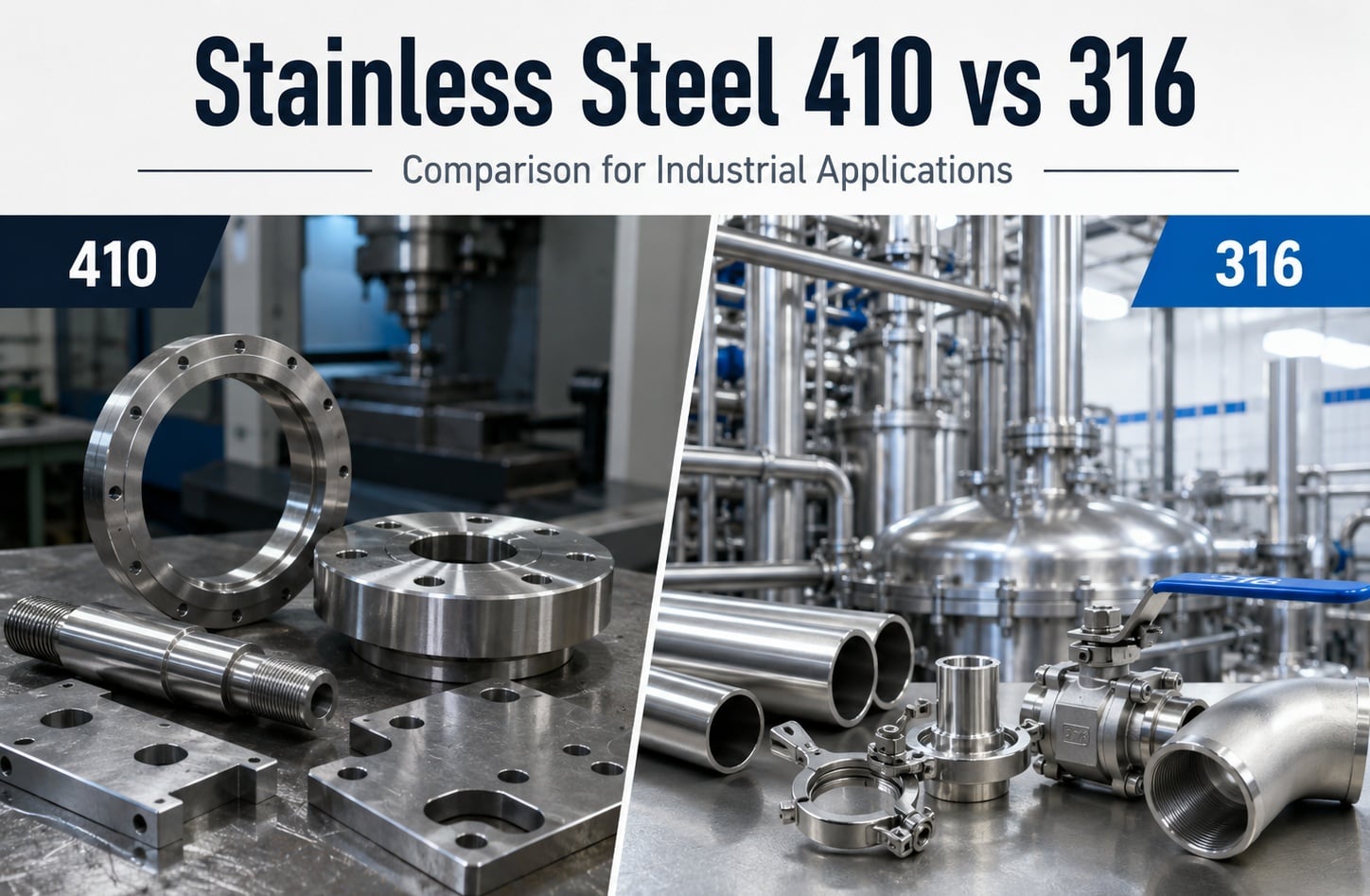
410 vs 316 Stainless Steel: Material Comparison
The table separates material behaviour from purchasing instructions. Its descriptions are a starting point for selection, not guaranteed properties for every plate, coil, pipe or bar.
| Comparison point | 410 stainless steel | 316 stainless steel |
|---|---|---|
| Metallurgical family | Martensitic: a chromium stainless grade with a hardening response to suitable heat treatment. | Austenitic: a chromium-nickel stainless grade containing molybdenum. |
| Hardness and heat treatment | Hardness can be developed by hardening and tempering. Specify the required final condition. | Does not harden through a quench-and-temper route. Cold working can increase strength. |
| Corrosion selection | Usually considered for less aggressive conditions; surface finish and heat treatment matter. | Generally offers more corrosion resistance than common martensitic grades, but remains vulnerable in some chloride environments. |
| Welding and forming | Welding needs particular care over cracking and the heat-treatment sequence. | Generally more adaptable to welded and formed construction; grade variant and procedure still matter. |
| Magnetic behaviour | Magnetic. | Usually weakly magnetic or non-magnetic when annealed; processing can change the response. |
| Buying requirement | Grade, form, size, condition and required hardness or mechanical acceptance. | Grade, form, size, surface, fabrication route and service exposure. |
Technical basis: Atlas 410 data sheet, Atlas 316 data sheet and BSSA material-selection guidance. Their general descriptions do not establish what a particular supplier has in stock.
Why Composition and Structure Change the Choice
Martensitic and austenitic describe different steel structures. They help explain why the grades respond differently to heat treatment and fabrication. 410 relies on a chromium-based alloy design and a suitable carbon level for hardening. 316 includes nickel and molybdenum in its alloy design; the latter contributes to its corrosion behaviour.
Exact chemical composition should come from the applicable product standard and material test certificate, or MTC. An MTC records test results for the supplied material. A generic online composition table is not a substitute for checking the ordered grade, heat number and specification.
ATI identifies Type 410 as martensitic stainless steel. For a broader explanation of the other family, Outokumpu describes austenitic stainless steels and their response to cold working.
410 Stainless Steel vs 316: Hardness and Strength
410 can be hardened and then tempered. Tempering is a subsequent heat treatment used to adjust the balance of properties after hardening. Its hardness therefore depends on the treatment and delivery condition; annealed 410 and hardened 410 should not be treated as the same purchasing specification.
316 gains strength through cold working, which means deforming the metal below its recrystallization temperature. It does not use the same hardening route as 410. Neither grade should receive a single universal hardness or tensile-strength value without stating the product form, processing condition and test requirements.
For a shaft or wear-related part: give the supplier the final hardness requirement, machining allowance and inspection criteria. For a formed panel, describe the bends, surface requirement and acceptable delivery condition. These are different purchasing problems even when nominal dimensions match.
316 vs 410 Stainless Steel: Corrosion Resistance
Common austenitic grades generally provide more corrosion resistance than martensitic grades such as 410. That makes 316 a frequent candidate when corrosion is the main selection concern. It does not make 316 suitable for every liquid, cleaning chemical or marine installation.
316 can still experience pitting and crevice corrosion in chloride-containing conditions. Pitting produces localized holes; crevice attack occurs in restricted spaces such as joints. Temperature, concentration, deposits, surface finish and cleaning practice can change the outcome. The Atlas 316 data sheet specifically cautions that its marine-grade reputation is not immunity to seawater corrosion.
Describe the actual medium and exposure cycle instead of writing only “outdoor” or “marine.” For 410, include the required heat treatment and finish in that discussion. For either grade, service suitability must be assessed against the project specification.
Welding, Forming and Machining Differences
Welding a hardenable martensitic grade requires attention to cracking risk and the treatment sequence. A qualified procedure should establish whether preheating or post-weld treatment is necessary. A general comparison article cannot choose a welding consumable or set process temperatures for a specific joint.
316 is generally more accommodating for welding and forming, although austenitic steel work hardens during deformation. The fabricator must account for the actual thickness, geometry and material condition. If 316L is proposed for a welded assembly, confirm that variant explicitly rather than silently replacing the requested 316.
For machining, ask whether the material will arrive annealed, cold worked or hardened. Compare quotations at the same condition and finished-part requirement. A low raw-material quotation may leave additional machining, heat treatment or inspection work outside the stated scope.
Which Grade Fits the Application?
Evaluate 410 for hardness-led parts
For a mechanical component with a specified hardening route, evaluate 410 alongside the wear mechanism, corrosion exposure and finished-part acceptance criteria. Application names alone do not establish suitability.
Evaluate 316 for corrosion and fabrication needs
For a welded vessel, formed component or process-contact part, assess 316 against the medium, cleaning routine, joining method and surface requirement. Obtain project-specific advice for aggressive service.
These examples describe material-selection questions, not a promise that finished components or every grade/form combination are available from Voyage Metal.
Compare Specifications Before Comparing Quotes
Keep plate, coil, pipe and bar requirements separate. A property shown for flat-rolled material should not automatically be transferred to another product specification. State the required standard and edition, dimensions, tolerance, surface and delivery condition so quotations cover the same request.
Check that the material documentation matches the ordered grade and form. If a proposed substitute has a different designation, ask for a documented comparison against your specification. Similar names or appearances do not establish equivalence.
FAQ: Stainless Steel 410 vs 316
SS410 vs SS316: Do Abbreviations Change the Material?
These shortened search terms still need a complete purchase specification. Write the requested grade, product standard, form and delivery condition in the order. An abbreviation alone does not define acceptance requirements or establish equivalence between standards.
Is 410 stainless steel better than 316?
Neither is universally better. A hardness-led part and a corrosion-sensitive welded component may need different material characteristics. Compare the service conditions and required delivery state before selecting a grade.
Are 410 and 316 stainless steel magnetic?
410 is magnetic. Annealed 316 normally has a low magnetic response, but processing can affect it. A magnet test cannot certify either grade; use traceable material records and any identification testing required by the project.
Can 410 replace 316 stainless steel?
No automatic substitution should be assumed. Check corrosion exposure, mechanical requirements, fabrication, product form and the governing specification before accepting a change.
Is 410 always cheaper than 316?
Compare quotations for matching form, size, condition, quantity and inspection scope. Price and finished-part cost can change with processing and order requirements; this guide does not provide a fixed cost ranking.
410 vs 316 RFQ Checklist
Send one complete requirement so the team can review material and supply options manually.
Explore stainless steel plate, stainless steel coil, stainless steel pipe or stainless steel bar, then send the exact grade and form for confirmation.
Contact Us to Discuss Your Material Requirement
Send your specification and application details for manual review. Include size, tolerance, surface, quantity, documents, packing and destination so the team can clarify the request before replying.