
 EN
EN




Can You Weld Stainless Steel? Methods, Grades, and RFQ Checklist
Yes, stainless steel can be welded. The more important question is whether the selected grade, welding method, filler metal, surface finish, and inspection plan are suitable for the final service environment.
Stainless steel welding is common in sheet, plate, pipe, tube, tank, frame, equipment, and structural fabrication. However, a clean-looking weld does not always mean the welded part will perform well in corrosion, pressure, temperature, or hygiene-sensitive applications.
For industrial buyers, the question should not only be “can you weld stainless steel?” A better question is: which stainless steel grade should be welded, by which process, with which filler metal, and under which inspection requirement?
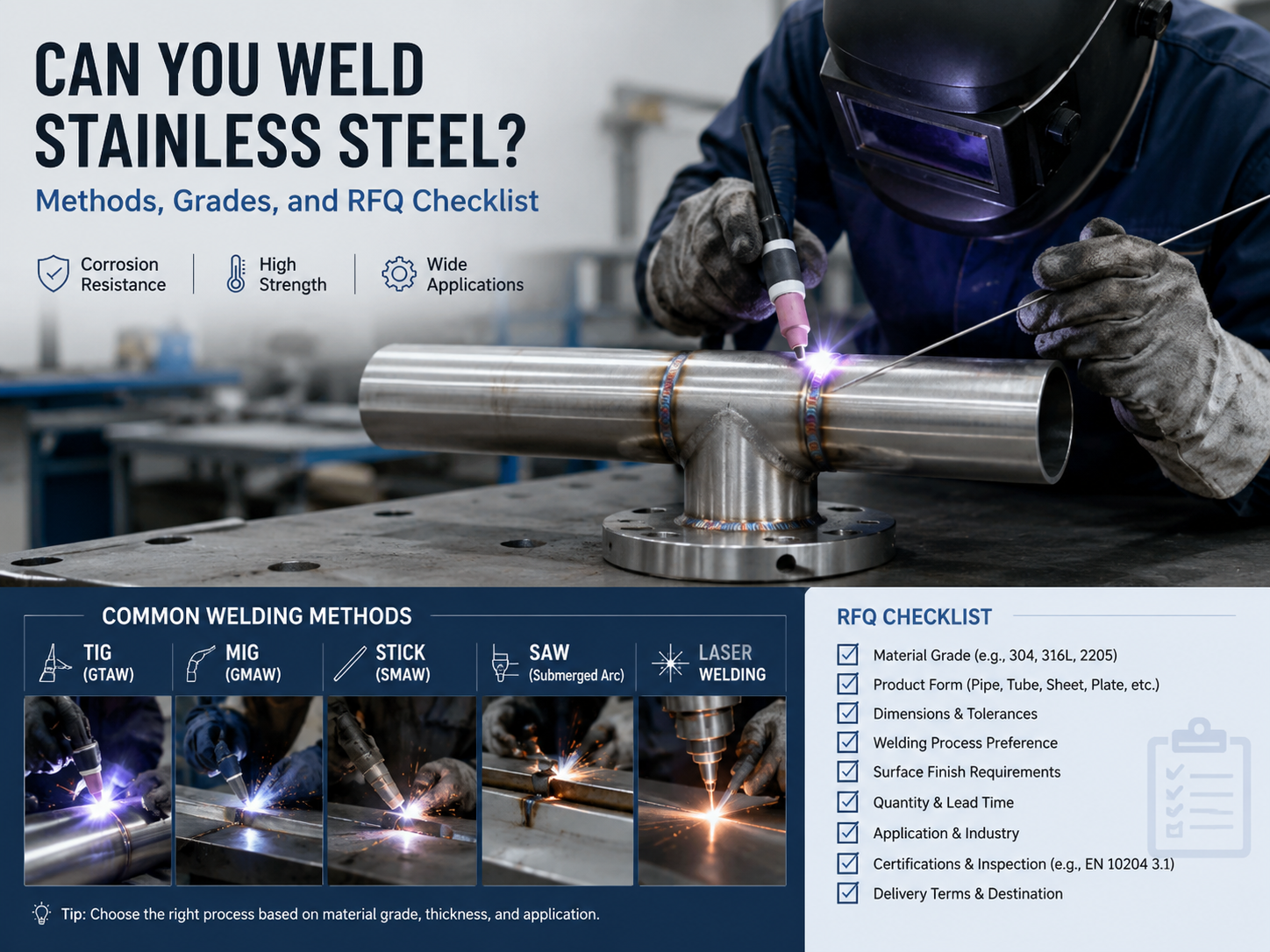
Quick Answer
Yes. Stainless steel can be welded by TIG, MIG, laser welding, resistance welding, and other fabrication methods. Common welded stainless steel grades include 304, 304L, 316L, 321, 347, and some duplex stainless steels such as 2205.
For buyers, the final choice should depend on the product form, thickness, service environment, applicable standard, filler metal, surface finish, and inspection requirement. One welding method or post-weld treatment does not fit every stainless steel grade.
Can Stainless Steel Be Welded?
Yes, stainless steel can be welded in many industrial applications. Stainless steel sheet can be welded into cabinets, panels, tanks, and equipment covers. Stainless steel plate can be welded for pressure equipment, structural parts, and heavy fabrication. Stainless steel pipe and tube can be welded for fluid systems, heat exchangers, food processing lines, and chemical equipment.
The challenge is that stainless steel depends on its surface condition for corrosion resistance. Welding introduces heat into the joint area. If heat input, shielding gas, filler metal, cleaning, or finishing is not controlled properly, the weld area may become a weak point.
This is why stainless steel welding should be treated as a technical specification issue, especially for marine, chemical, food processing, pharmaceutical, pressure equipment, and visible architectural applications.
Why Stainless Steel Welding Needs More Care
Compared with carbon steel, stainless steel often requires more attention to heat control, contamination control, and post-weld surface treatment. Heat tint, iron contamination, rough grinding marks, poor shielding, or unsuitable filler metal may reduce corrosion resistance near the weld.
Thickness also matters. Thin stainless steel sheet may distort during welding. Thick stainless steel plate may require careful joint preparation, welding sequence, and inspection. Stainless steel pipe and tube may also require internal weld quality control, especially when used in pressure, sanitary, or fluid systems.
For buyers, vague requirements such as “welded stainless steel part” or “304 stainless fabrication” are usually not enough. The supplier should know the grade, standard, dimensions, drawing, tolerance, surface finish, application environment, and document requirements before confirming production.
Common Stainless Steel Welding Methods
Different stainless steel welding methods are used depending on thickness, joint design, appearance requirement, production volume, and inspection level. TIG welding, MIG welding, laser welding, and resistance welding are among the most common methods used in stainless steel fabrication.
| Welding Method | Common Use | Buyer Notes |
|---|---|---|
| TIG welding stainless steel | Thin sheet, pipe, tube, sanitary parts, visible welds, precision fabrication | Often selected when weld appearance and control are important. Production speed may be slower than MIG. |
| MIG welding stainless steel | Plate, frames, tanks, equipment parts, general fabrication | Useful for higher productivity. Wire, shielding gas, and parameters should match the project requirement. |
| Laser welding stainless steel | Thin sheet, precision parts, automated production, low-distortion components | Can reduce heat input and distortion, but joint fit-up and equipment control are important. |
| Resistance welding stainless steel | Sheet parts, lap joints, mass-production components | Often used for repeated production parts rather than heavy structural welding. |
| Project-specific welding | Pressure equipment, chemical service, special fabrication | May require an approved welding procedure, welder qualification, NDT, or project-specific inspection. |
Weldability of Common Stainless Steel Grades
Many stainless steel grades are weldable, but they do not behave exactly the same during welding. Grade selection should consider corrosion resistance, strength, temperature, carbon content, and the final service environment.
| Grade | General Weldability | Common Buyer Notes |
|---|---|---|
| 304 stainless steel | Good | Common for general fabrication, tanks, equipment frames, and architectural parts. |
| 304L stainless steel | Very good | Often preferred for welded parts because of its low-carbon designation. Confirm the applicable standard and MTC. |
| 316 stainless steel | Good | Used where better corrosion resistance than 304 is required, but welding details still need confirmation. |
| 316L stainless steel | Very good | Commonly selected for welded parts in food processing, marine, chemical, and higher-corrosion environments. |
| 321 stainless steel | Good | Stabilized stainless steel often used where elevated temperature service is considered. |
| 347 stainless steel | Good | Often used in high-temperature or welded applications where stabilized stainless steel is required. |
| 2205 duplex stainless steel | Weldable but stricter | Requires better control of heat input, filler selection, and welding procedure compared with common austenitic grades. |
| 2507 super duplex stainless steel | Weldable but demanding | Used for severe corrosion environments. Welding should be controlled by project specifications and qualified procedures. |
304, 304L, 316L, and Duplex Stainless Steel: What Buyers Should Know
304 stainless steel is widely used for general fabrication because it offers a practical balance of corrosion resistance, formability, and cost. It is common in equipment frames, cabinets, kitchen equipment, tanks, and decorative parts.
304L stainless steel is often considered when welding is important. The “L” grade has lower carbon content, which can help reduce certain welding-related corrosion risks. However, buyers should still confirm the exact standard, thickness, surface finish, and inspection requirement.
316L stainless steel is often selected for applications with higher corrosion risk, such as some chloride-containing environments, food processing, marine components, and chemical equipment. However, 316L does not mean universal corrosion resistance. The actual service environment, temperature, concentration, and cleaning condition still matter.
Duplex stainless steels such as 2205 and 2507 can offer higher strength and corrosion resistance in selected environments, but welding control is more demanding. Heat input, interpass temperature, filler metal, and inspection should be reviewed carefully for duplex stainless steel welding projects.
What Can Go Wrong When Welding Stainless Steel?
Stainless steel welding problems are not always visible at first. A weld may look acceptable but still create long-term performance issues if the welding and finishing process is not controlled.
- Heat tint: colored oxide near the weld may reduce corrosion performance if not properly removed when required.
- Distortion: thin stainless steel sheet or tube can deform because of welding heat.
- Iron contamination: carbon steel tools, brushes, or work surfaces may contaminate the stainless surface.
- Wrong filler metal: unsuitable filler can reduce weld strength or corrosion resistance.
- Poor shielding gas control: poor gas coverage may cause oxidation, porosity, or poor weld appearance.
- Rough grinding marks: aggressive grinding can damage the surface finish and create corrosion points.
- Unclear inspection requirement: missing inspection details can create disputes after production.
- Wrong grade for the environment: even a good weld cannot solve the problem if the selected stainless grade is unsuitable for the service condition.
Stainless Steel Welding Filler Metal: What Buyers Should Confirm
Filler metal should not be guessed only from the base grade name. The welding procedure, service environment, joint design, and applicable standard should determine the filler selection.
For example, welding 304 stainless steel, 316L stainless steel, or duplex stainless steel may require different filler choices. Dissimilar welding, such as stainless steel to mild steel, requires even more careful review because the joint may face different mechanical and corrosion behavior on each side.
If the project already has a drawing, WPS, customer specification, or engineering requirement, the buyer should send it before quotation. This helps avoid incorrect assumptions about filler metal, weld size, inspection, and surface treatment.
Surface Finish, Heat Tint, and Post-Weld Cleaning
Surface finish is important in stainless steel welding because corrosion resistance and appearance are both affected by the weld area. Heat tint is the colored oxide layer that can appear near a stainless weld. In some applications, heat tint may need to be removed by brushing, pickling, passivation, grinding, polishing, or another approved method.
The correct post-weld treatment depends on the application. A mill finish plate, brushed sheet, mirror sheet, sanitary tube, or visible architectural part may require different finishing requirements. For food, pharmaceutical, marine, and chemical service, post-weld cleaning should be discussed before production rather than after delivery.
Buyers should also confirm whether the welded area must match the surrounding surface finish. This is especially important for visible panels, handrails, equipment covers, decorative tubes, and architectural stainless steel parts.
Specification Checklist for Buyers
Before placing an RFQ for stainless steel welding or welded stainless steel materials, buyers should prepare a clear specification. This reduces quotation errors and helps the supplier check whether the material, process, and inspection plan are realistic.
| Item to Confirm | Why It Matters |
|---|---|
| Stainless steel grade | 304, 304L, 316L, duplex, and other grades do not weld or perform the same way. |
| Product form | Sheet, plate, pipe, tube, bar, and fabricated parts create different joint and thickness concerns. |
| Thickness or wall thickness | Thin material may distort; thicker material may need more preparation and inspection. |
| Welding process | TIG, MIG, laser, resistance welding, and other methods fit different production and finish needs. |
| Filler metal | It should match the welding procedure, base metal, and service conditions. |
| Surface finish | Brushed, mirror, sanitary, polished, or mill finish surfaces may need different post-weld treatment. |
| Inspection document | MTC, dimensional report, weld inspection, NDT, or other documents may be required. |
| Applicable standard | ASTM, ASME, EN, JIS, GB/T, or project specifications should be confirmed. |
| Application environment | Marine, chemical, food processing, pressure, high-temperature, and decorative uses may require different controls. |
Standards and Documents to Mention
Stainless steel sheet and plate buyers often refer to ASTM A240 or EN 10088. Stainless steel pipe buyers may refer to ASTM A312 or project pipe specifications. For pressure equipment, ASME or customer engineering specifications may also apply.
A product name alone is not enough. Buyers should ask the supplier to confirm grade, standard, material certificate availability, dimensional tolerance, surface finish, welding-related inspection, and post-weld treatment requirements.
For more demanding projects, buyers may also need to confirm WPS, PQR, welder qualification, NDT, hydrostatic testing, PMI, or third-party inspection. These requirements should be stated before production because they can affect cost, lead time, and manufacturing route.
RFQ Checklist for Stainless Steel Welding Projects
- stainless steel grade, such as 304, 304L, 316L, 321, 347, 2205, or 2507;
- product form, such as sheet, plate, pipe, tube, bar, or fabricated part;
- thickness, wall thickness, outside diameter, length, or cut size;
- drawing, sketch, or joint design if available;
- required standard and inspection document;
- welding process or welding procedure requirement if already specified;
- filler metal requirement if applicable;
- surface finish before and after welding;
- post-weld cleaning requirement, such as pickling, passivation, polishing, or grinding;
- tolerance, edge condition, and weld appearance requirement;
- service environment, such as marine, chemical, food, pressure, heat, or outdoor use;
- quantity, packing, destination, and delivery schedule.
Frequently Asked Questions
Can you weld stainless steel?
Yes. Stainless steel can be welded by TIG, MIG, laser welding, resistance welding, and other fabrication methods. The suitable method depends on grade, thickness, joint design, appearance, and service environment.
Can stainless steel be MIG welded?
Yes. Stainless steel can be MIG welded in many fabrication projects. The wire, shielding gas, welding parameters, thickness, and surface requirement should match the welding procedure.
Is TIG or MIG better for stainless steel welding?
TIG welding is often preferred for thin material, pipe, tube, sanitary parts, and visible welds. MIG welding is often used for higher productivity in plate, frame, tank, and general fabrication work. The better choice depends on the project requirement.
Is 316L easier to weld than 316?
316L is often selected when welding is important because of its low-carbon designation. However, final suitability still depends on the project standard, thickness, joint design, filler metal, and service environment.
Can stainless steel be welded to mild steel?
It may be possible in some projects, but dissimilar metal welding needs careful filler selection, corrosion review, and inspection planning. Buyers should not assume that the same filler metal or welding procedure can be used for all dissimilar joints.
Does welding reduce stainless steel corrosion resistance?
It can if the weld area has heat tint, contamination, poor cleaning, wrong filler metal, or unsuitable welding conditions. Post-weld cleaning, pickling, passivation, or polishing may be required depending on the application.
What information should I send for a stainless steel welding RFQ?
Send the grade, product form, thickness or wall thickness, drawing, welding process if specified, filler metal requirement, surface finish, tolerance, standard, inspection document, quantity, packing, destination, and service environment.
Need Stainless Steel Materials for Welded Fabrication?
For a stainless steel welding RFQ, send Voyagemetal your grade, standard, drawing, thickness or wall thickness, welding requirement, filler or procedure requirement if available, surface finish, tolerance, inspection document, quantity, packing, and application environment.
Our team can help review whether stainless steel sheet, plate, pipe, or tube is suitable for your welded project. You can also review related stainless steel products, stainless steel plate, and stainless steel pipe options.