
 EN
EN



316 vs 316L Stainless Steel: Key Differences for Welding, Corrosion & Buying
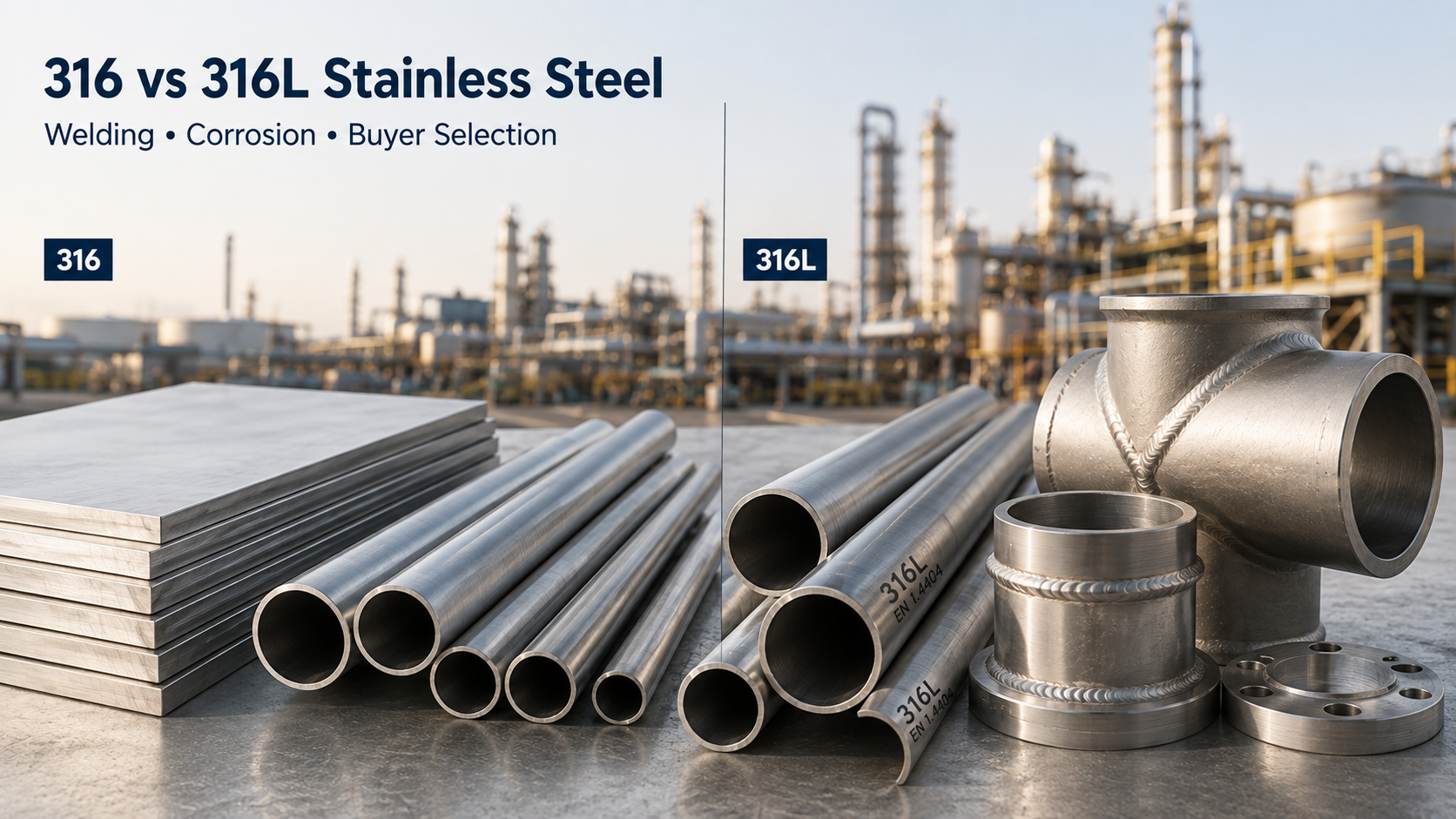
316 and 316L stainless steel have very similar chromium, nickel and molybdenum content, but 316L contains less carbon. That lower carbon level reduces the risk of sensitization and intergranular corrosion after welding, which is why 316L is widely specified for welded piping, tanks and process equipment.
The difference between 316 and 316L is therefore not that one grade is always better. The correct choice depends on welding, service conditions, product form, applicable material standard and project requirements.
316 vs 316L Stainless Steel: Quick Comparison
| Buyer Question | 316 Stainless Steel | 316L Stainless Steel |
|---|---|---|
| Main difference | Standard-carbon 316 grade | Low-carbon version of 316 |
| UNS designation | S31600 | S31603 |
| Maximum carbon | Commonly specified up to 0.08% | Commonly specified up to 0.03% |
| Welding | Weldable, but sensitization must be considered | Often preferred for welded corrosive service |
| General corrosion resistance | Very similar to 316L in many conditions | Very similar to 316 in many conditions |
| Intergranular corrosion after welding | Greater concern under sensitizing conditions | Lower risk because of reduced carbon |
| Automatically interchangeable? | No. Check the applicable standard, MTC, drawing and project requirements. | |
What Is the Difference Between 316 and 316L Composition?
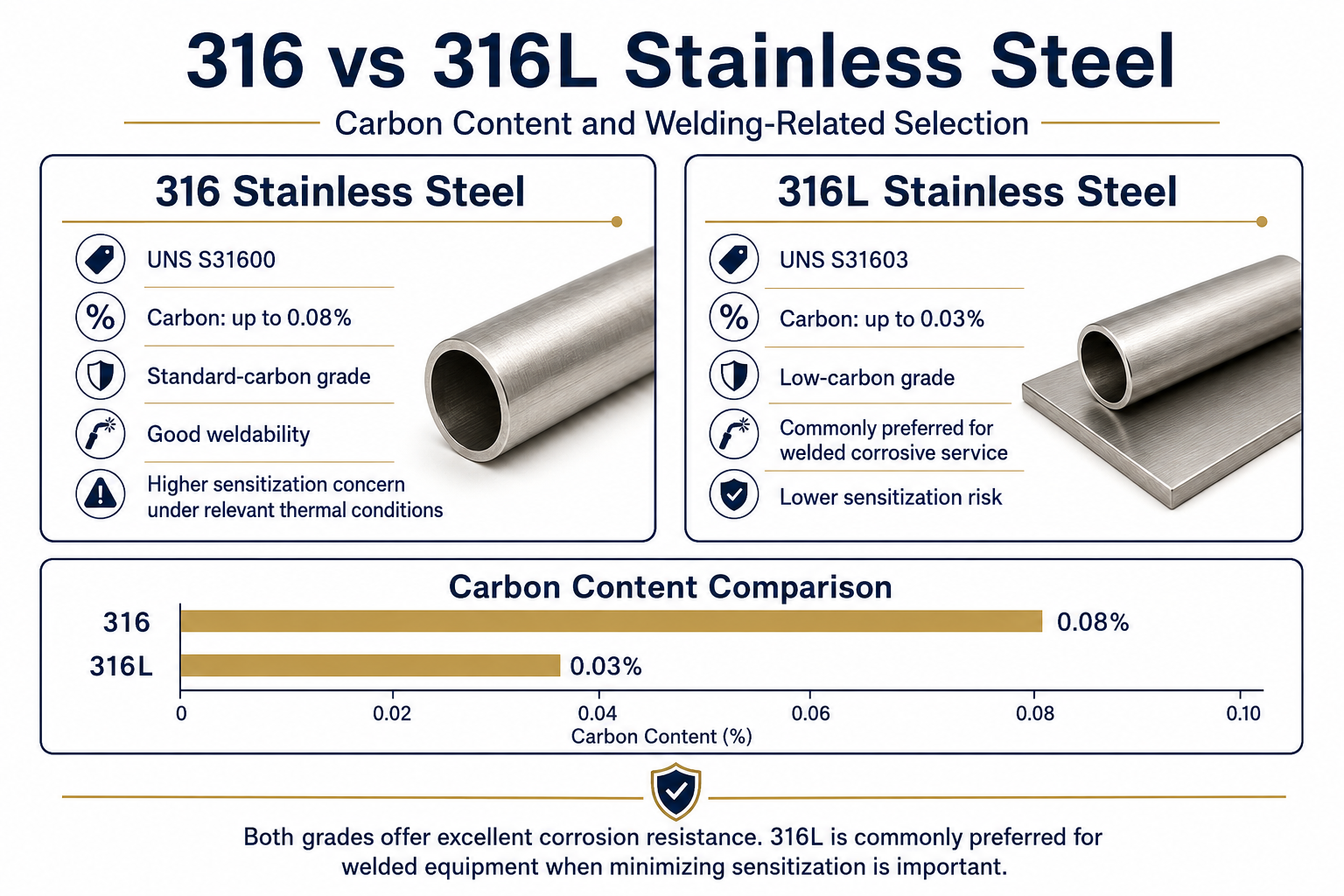
The main chemical difference between 316 and 316L stainless steel is carbon content.
UNS: S31600
Carbon: commonly specified up to 0.08%
Grade type: standard-carbon 316
UNS: S31603
Carbon: commonly specified up to 0.03%
L: low carbon
Both grades are austenitic chromium-nickel-molybdenum stainless steels. Their chromium, nickel and molybdenum ranges overlap significantly under common product specifications.
For a broader explanation of the low-carbon grade itself, see the 316L stainless steel properties, composition and applications guide.
| Element | 316 | 316L | Why It Matters |
|---|---|---|---|
| Carbon | Higher permitted maximum | Lower permitted maximum | Affects sensitization risk after welding |
| Chromium | Similar range | Similar range | Supports the passive corrosion-resistant layer |
| Nickel | Similar range | Similar range | Helps stabilize the austenitic structure |
| Molybdenum | Similar range | Similar range | Improves localized corrosion resistance compared with many 304-type grades |
Exact chemical limits should always be checked against the applicable product specification rather than a generic grade chart.
316 vs 316L Mechanical Properties
316 and 316L generally have similar mechanical behavior for many purchasing decisions. The carbon difference is usually more important than small differences shown in generic strength tables.
Specified mechanical properties can change according to:
- the applicable ASTM, ASME or EN specification;
- plate, sheet, pipe, tube or bar product form;
- material thickness, diameter or wall thickness;
- heat-treatment condition; and
- cold working and manufacturing route.
The applicable product specification and Material Test Certificate should therefore take priority over generic online property charts.
316 vs 316L for Welding: Why Carbon Content Matters
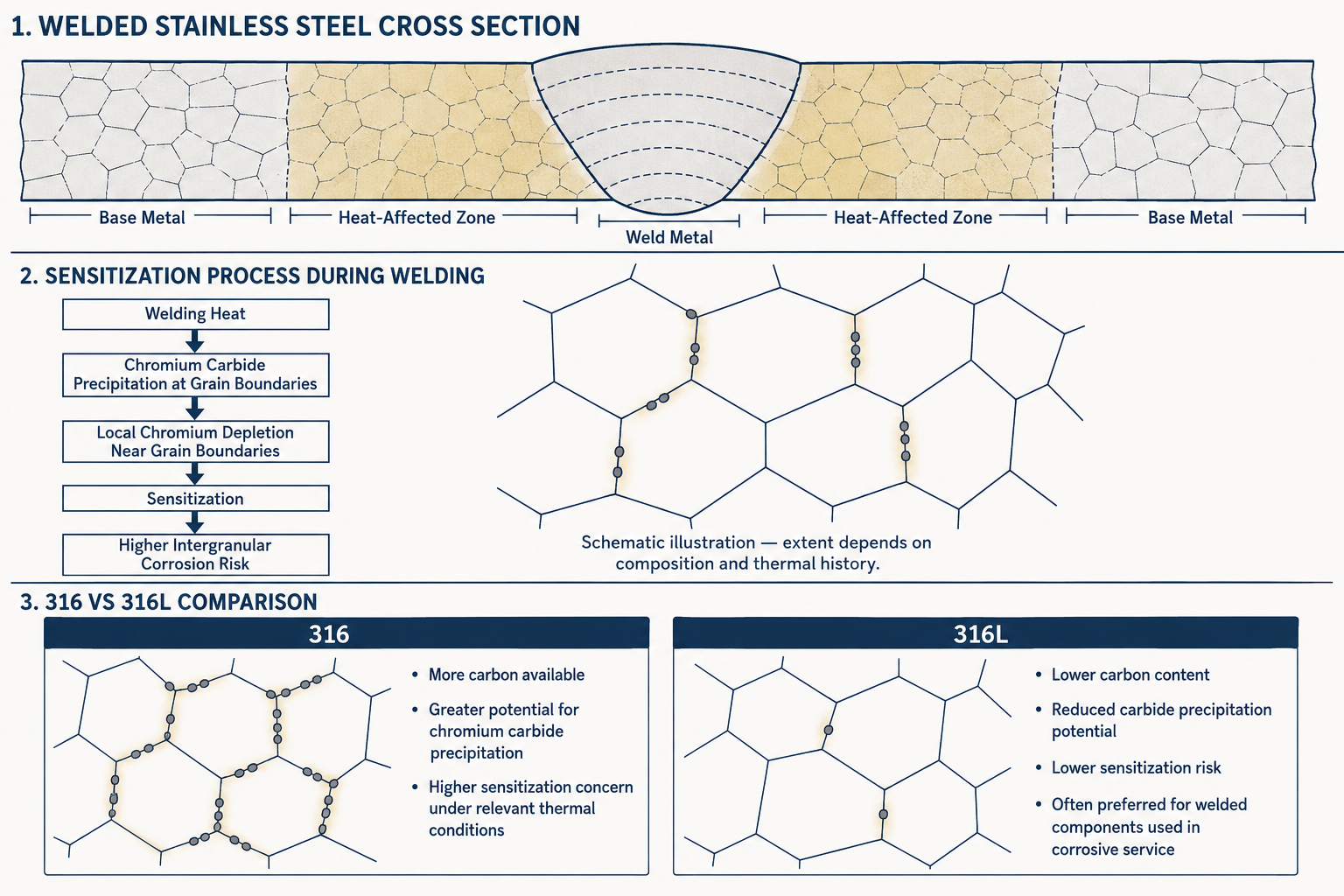
Welding is one of the main reasons engineers and fabricators choose 316L instead of standard 316.
For a broader explanation of welding methods and grade selection, see Can You Weld Stainless Steel? Methods, Grades and Buyer Considerations.
How Sensitization Can Develop
Why Does 316L Reduce This Risk?
316L contains less carbon available to combine with chromium during welding heat exposure. This reduces the tendency for harmful chromium carbide precipitation.
More carbon may be available for carbide formation.
Sensitization requires more attention under relevant thermal conditions.
Intergranular corrosion can become a concern in corrosive service.
Less carbon is available for carbide formation.
Sensitization risk is reduced.
The grade is therefore commonly selected for many welded corrosive applications.
This difference is particularly important when a fabricated component remains in the as-welded condition instead of receiving suitable post-weld solution heat treatment.
Where Is 316L Commonly Considered?
- process piping and welded pipe spools;
- chemical processing equipment;
- food and beverage processing equipment;
- welded tanks and process vessels;
- fabricated fittings and components;
- water-treatment and selected desalination components where service conditions permit 316L; and
- industrial equipment exposed to corrosive process fluids.
316 vs 316L Corrosion Resistance: Is 316L Better?
Not in every situation.
Because the chromium, nickel and molybdenum contents of 316 and 316L are generally similar, the two grades usually provide similar general corrosion and pitting resistance when compared in equivalent metallurgical conditions.
The main corrosion advantage of 316L appears when its lower carbon content reduces the consequences of sensitizing thermal exposure.
What About Chloride Environments?
The molybdenum in the 316 family gives these grades better resistance to localized corrosion than many 304-type stainless steels.
For applications where the main decision is between 304 and 316, see 304 and 316 stainless steel for engineering applications.
Both 316 and 316L can still suffer from:
- pitting corrosion;
- crevice corrosion;
- chloride stress corrosion cracking under unfavorable conditions; and
- accelerated corrosion as chloride concentration and temperature increase.
Hot seawater, concentrated chloride solutions, stagnant crevices and aggressive chemical environments may require duplex stainless steel, higher-alloy austenitic stainless steel, nickel alloys or another material system.
316 vs 316L Stainless Steel Standards
316 and 316L are material grades. ASTM A240, A312, A269 and A276 are product specifications.
Buyers who need a clearer explanation of the difference between grade names and product standards can review AISI 316 vs ASTM 316 stainless steel.
Plate, Sheet and Strip
Commonly used for stainless steel plate, sheet and strip for pressure-vessel and general applications.
Example: ASTM A240 Type 316L stainless steel plate
Stainless Steel Pipe
Common specification for seamless, welded and heavily cold-worked welded austenitic stainless steel pipe.
Example: ASTM A312 TP316L stainless steel pipe
General-Service Tube
Commonly used for seamless and welded austenitic stainless steel tubing for general service.
Example: ASTM A269 TP316L stainless steel tube
Bar and Shape
Commonly encountered for stainless steel bars and shapes.
Example: ASTM A276 Type 316L stainless steel bar
For flat-product purchasing considerations, see the stainless steel plate grades, thickness and ASTM standards guide.
Buyers who are unsure whether a project requires pipe or tube can also review the stainless steel pipe vs tube guide.
ASTM A479/A479M may also apply to stainless steel bars and shapes used in boilers and other pressure-vessel applications.
These standards are common purchasing entry points. The actual project specification, standard edition, testing, certification and inspection requirements should always be confirmed before ordering.
316 or 316L: Which Should Buyers Choose?
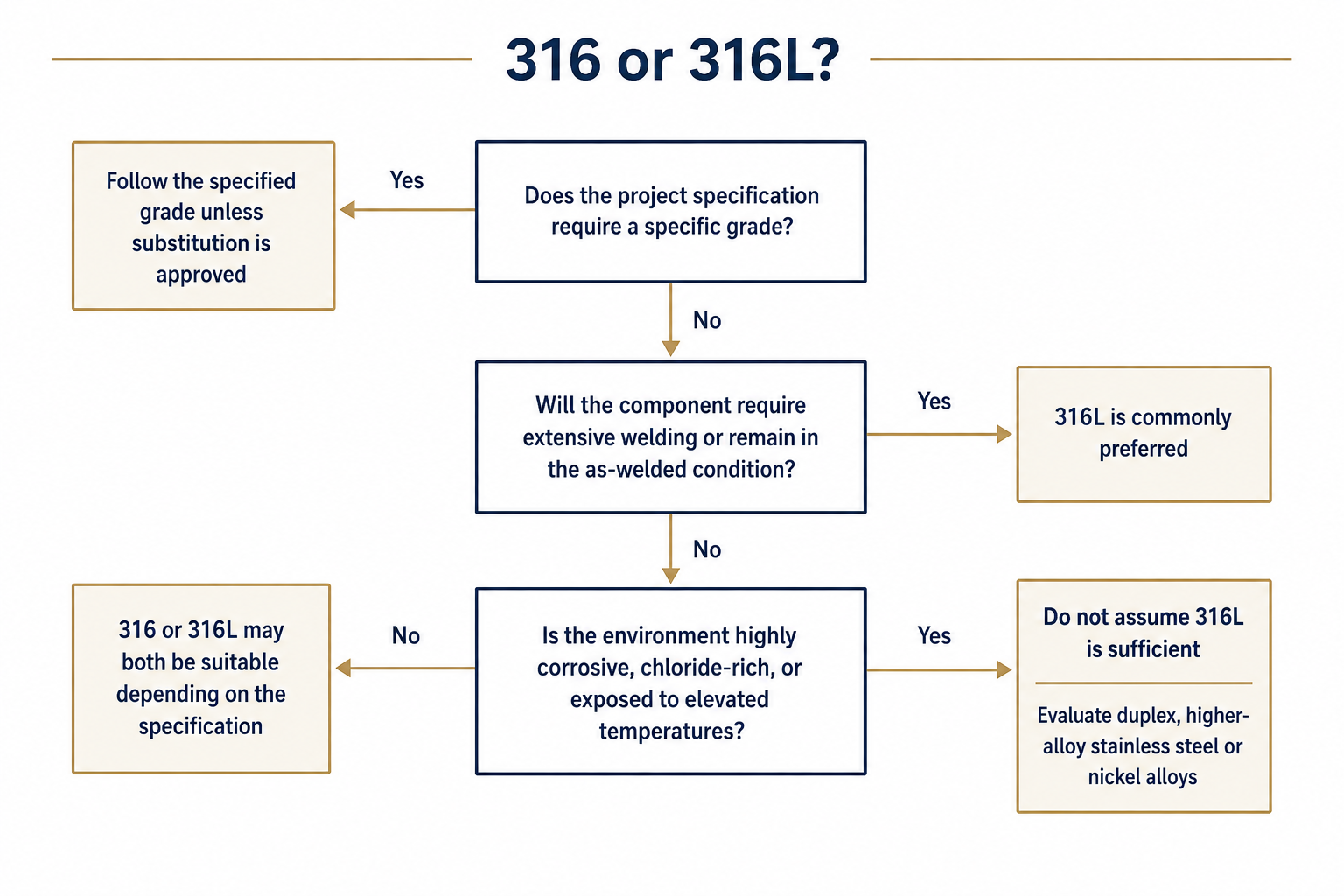
Follow the specified grade unless an approved substitution process allows a change.
Continue to evaluate fabrication and service conditions.
316L is commonly preferred because its lower carbon content reduces sensitization risk.
316 may remain technically suitable depending on the applicable specification and service.
Do not assume that changing from 316 to 316L solves the corrosion problem. Evaluate duplex, higher-alloy stainless steel or nickel alloys as required.
316 or 316L may both be technically suitable if permitted by the project specification.
Can 316 and 316L Be Used Interchangeably?
Sometimes, but not automatically.
If a drawing, piping class or material specification explicitly requires 316L, standard 316 should not be substituted without approval from the responsible purchaser or engineer.
If a project specifies 316, material supplied as 316L may sometimes be acceptable, particularly when the supplied material is certified to meet both grade requirements.
Acceptance should still be checked against:
- chemical composition;
- mechanical requirements;
- the applicable product specification;
- the Material Test Certificate;
- the Purchase Order; and
- project substitution rules.
What Does 316/316L Dual Certified Mean?
Stainless steel may be supplied with documentation showing 316/316L dual certification.
This generally means the tested material satisfies the applicable requirements for both grade designations under the relevant product specification.
Dual certification does not mean that every piece of 316 and every piece of 316L are automatically identical or interchangeable.
316 vs 316L Price: Does 316L Cost More?
There is no reliable rule that 316L must always cost more or less than 316.
The final stainless steel quotation can be affected by:
| Pricing Factor | Why It Matters |
|---|---|
| Product form | Plate, pipe, tube and bar follow different production and stock routes. |
| Dimensions | Thickness, diameter, pipe schedule and tolerances affect material use and availability. |
| Quantity | Mill quantities and small stock orders can have very different unit pricing. |
| Manufacturing route | Seamless, welded, cold-worked or processed products may have different costs. |
| Surface finish | Special finishes can add processing cost. |
| Testing and certification | PMI, NDT, third-party inspection and additional documentation can affect price. |
| Availability | Stock position and mill production schedule can affect both price and delivery. |
| Delivery terms | Destination, packing and Incoterm influence the commercial comparison. |
In many industrial quotations, product availability, dimensions and certification requirements have a greater effect on the final price than the nominal difference between 316 and 316L.
What Should Buyers Include in a 316 or 316L RFQ?
- grade: 316, 316L or required dual certification;
- UNS designation if required;
- product form: plate, sheet, pipe, tube or bar;
- applicable ASTM, ASME, EN or project specification;
- dimensions and tolerances;
- wall thickness or pipe schedule where applicable;
- seamless or welded construction if required;
- surface finish;
- quantity and required lengths;
- heat-treatment condition;
- Material Test Certificate requirements;
- EN 10204 3.1 certification if specified;
- Positive Material Identification if required;
- Non-Destructive Testing requirements;
- third-party inspection requirements;
- packing requirements; and
- Incoterm and destination.
Example RFQ Description
This gives a supplier much more useful information than simply asking for a quotation for “316L stainless pipe.”
316 vs 316L Stainless Steel: Buyer Summary
| Decision Point | Buyer Takeaway |
|---|---|
| Main difference | 316L has a lower maximum carbon content than 316. |
| Welding | 316L is commonly preferred where sensitization after welding is a concern. |
| General corrosion | 316 and 316L usually perform similarly when carbon-related sensitization is not governing. |
| Chloride resistance | The L designation does not provide a major increase in chloride pitting resistance. |
| Standards | 316 and 316L are grades; ASTM A240, A312, A269 and A276 apply to different product forms. |
| Substitution | Do not substitute grades automatically. Follow project documentation and the MTC. |
For procurement teams, the useful question is not simply whether 316 or 316L is better. The correct question is: Which grade, product standard and documentation package match the fabrication method and actual service conditions?
Sourcing 316 and 316L Stainless Steel Products
Voyage Metal supplies 316 and 316L stainless steel in common industrial forms including plate, sheet, pipe, tube and bar for project-based requirements.
For process piping, food-processing equipment, chemical fabrication and general industrial projects, quotations can be prepared according to the requested grade, product specification, dimensions, surface condition, quantity and documentation requirements.
For a more accurate technical and commercial comparison, include the applicable ASTM, ASME or EN specification together with size, quantity, drawings and inspection requirements in the RFQ.
FAQ About 316 vs 316L Stainless Steel
What Is the Main Difference Between 316 and 316L Stainless Steel?
The main difference is carbon content. 316L is the low-carbon version of 316 and commonly limits carbon to a maximum of 0.03%. The lower carbon content reduces the risk of sensitization and intergranular corrosion after welding.
Why Is 316L Preferred for Welding?
316L contains less carbon available to form chromium carbides during welding heat exposure. This reduces sensitization and lowers the risk of intergranular corrosion, especially when the component remains in the as-welded condition.
Is 316L More Corrosion Resistant Than 316?
Not in every environment. Their chromium, nickel and molybdenum contents are similar, so general corrosion and pitting resistance are often similar. The main corrosion advantage of 316L is its lower susceptibility to sensitization after welding.
What Does 316/316L Dual Certified Mean?
Dual-certified material has been produced and tested so that it satisfies applicable requirements for both 316 and 316L under the relevant product specification. Buyers should still verify the MTC and project requirements.
Should I Choose 316 or 316L?
Start with the project specification. If extensive welding, as-welded corrosive service or a low-carbon requirement is involved, 316L is often preferred. Severe chloride environments may require a higher-alloy material instead of either grade.
What ASTM Standards Are Commonly Used for 316L?
Common entry points include ASTM A240/A240M for plate, sheet and strip, ASTM A312/A312M for pipe, ASTM A269/A269M for general-service tubing and ASTM A276/A276M for bars and shapes.