
 EN
EN




How to Cut Aluminum Plate: Methods, Alloy Selection and Industrial Applications
How to Cut Aluminum Plate: An Industrial Buyer Guide to Methods, Tolerance and RFQ Preparation
For industrial aluminum plate sourcing or processing, the cutting approach should be confirmed together with the alloy, temper, thickness, drawing tolerance, required edge quality and the next fabrication step.
This guide helps engineers, fabricators and procurement teams compare the questions they should settle before requesting cut-to-size aluminum plate for an industrial project. A generic cutting description is not a substitute for project-specific process confirmation or quotation review.
Quick Answer: What Should Industrial Buyers Confirm Before Cutting Aluminum Plate?
Start with the plate thickness, drawing or profile, tolerance, edge-quality expectation and next fabrication step. Then confirm the alloy and temper with the project specification. Different cutting routes may be considered depending on the project; the final route should be confirmed with the applicable equipment, process requirements and buyer documentation.
Industrial RFQ Checklist for Aluminum Plate Cutting
Before requesting a quote or discussing a cutting route, prepare the information below. It helps the supplier review the request without assuming an unconfirmed material condition or process capability.
- Required aluminum alloy and temper, if already specified
- Plate thickness, width and length
- Drawing, profile, hole pattern or required finished dimensions
- Dimensional tolerance and edge-quality expectation
- Quantity, application and next fabrication step
- Packing, inspection document and delivery-location requirements
For source-material review, see our aluminum plate options. When your requirements are ready, send the drawing and aluminum plate details for review.
Start with Application
Machining, marine use, welding, structural loading and surface appearance all affect the correct cutting method.
Match Alloy and Temper
6061, 5052, 5083, 6082 and 7075 behave differently during cutting, bending, welding and machining.
Control Tolerance
Thickness, flatness, squareness and edge quality should be confirmed before cutting, not after delivery.
Aluminum Plate Cutting Workflow
For industrial projects, aluminum plate cutting should follow a clear workflow. This helps reduce wrong material selection, poor edge quality, machining problems and receiving disputes.
Why Aluminum Plate Cutting Is Different from Cutting Steel
Aluminum is lighter, softer and more thermally conductive than carbon steel or stainless steel. These properties make aluminum easier to machine in many cases, but they also create different cutting challenges.
During cutting, aluminum can generate built-up edge, burrs, vibration or surface marks if tooling, feed rate or clamping is not suitable. Some aluminum alloys cut cleanly, while others require more attention to heat control, edge quality and downstream machining allowance.
Compared with steel, aluminum also requires careful handling after cutting. Scratches, dents, moisture marks and improper stacking may affect appearance and acceptance, especially for visible panels, marine parts, equipment covers and anodized components.
Common Aluminum Plate Cutting Methods Compared
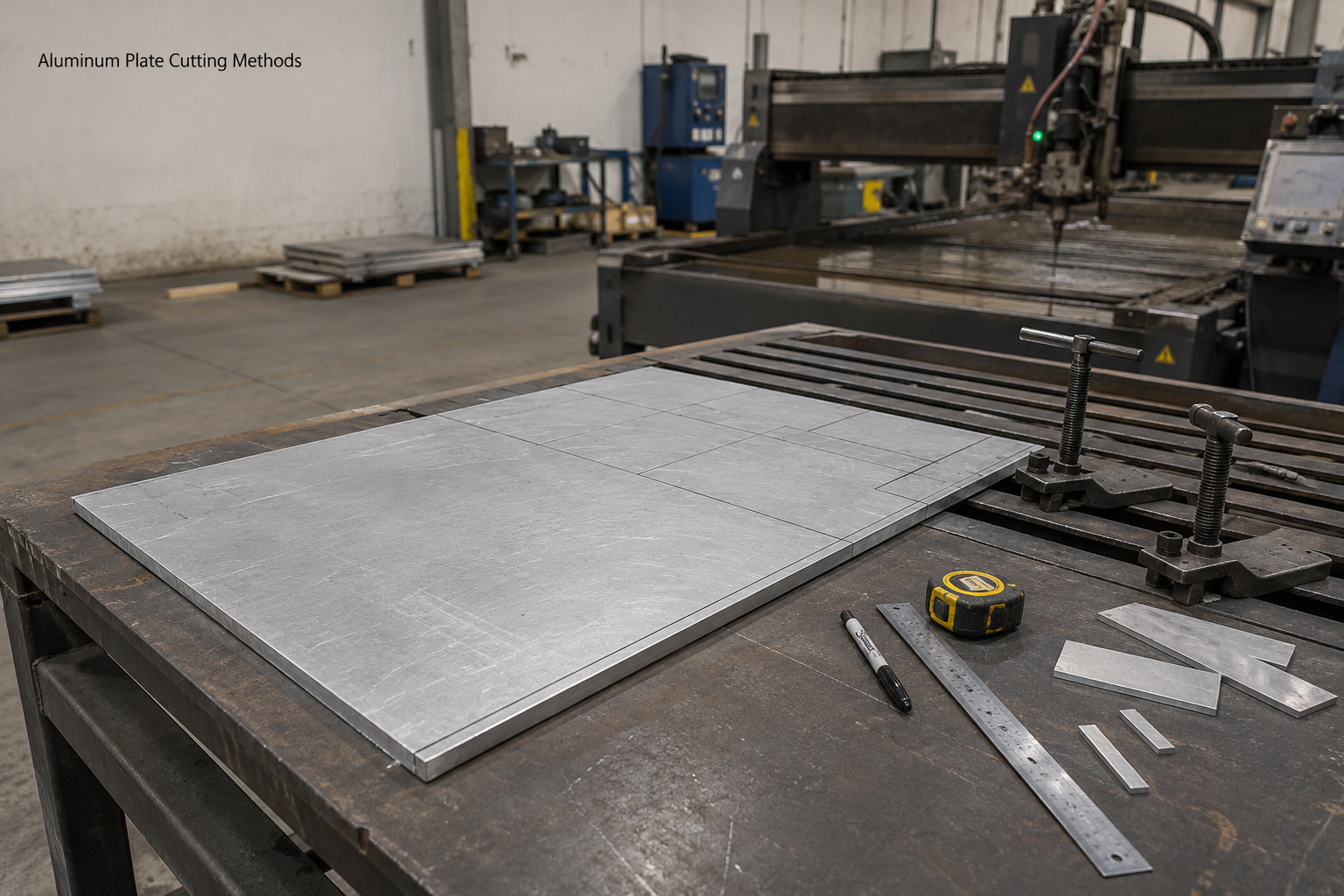
Different cutting methods are used for different plate thicknesses, part shapes and industrial requirements. The table below gives a practical comparison.
| Cutting Method | Typical Use | Advantages | Application Notes |
|---|---|---|---|
| Saw cutting | Thick plate, rectangular blanks, machining stock | Stable, practical and suitable for straight cuts | Common for machining blanks, base plates and structural parts. Cutting allowance and deburring should be confirmed. |
| Shearing | Thin plate and sheet-like material | Fast and cost-efficient for simple straight cuts | May create burrs or edge deformation. Not ideal for tight-tolerance machined components. |
| Waterjet cutting | Complex profiles, thick plate, heat-sensitive parts | No heat-affected zone and suitable for many shapes | Useful for aerospace, marine, machinery and precision profiles. Edge taper and tolerance should be reviewed. |
| Laser cutting | Selected aluminum thicknesses and precision profiles | Clean and efficient when equipment capability matches the material | Reflectivity and thickness affect performance. Edge finishing may still be required. |
| Plasma cutting | Thicker aluminum plate where rougher edges are acceptable | Fast cutting for certain heavy plate applications | Heat effect and edge condition should be considered before final machining or welding. |
| CNC routing | Profiles, slots, holes and repeatable plate parts | Good for controlled shapes and repeat production | Tooling, chip removal and clamping are important for stable results. |
How Alloy Grade Affects Aluminum Plate Cutting
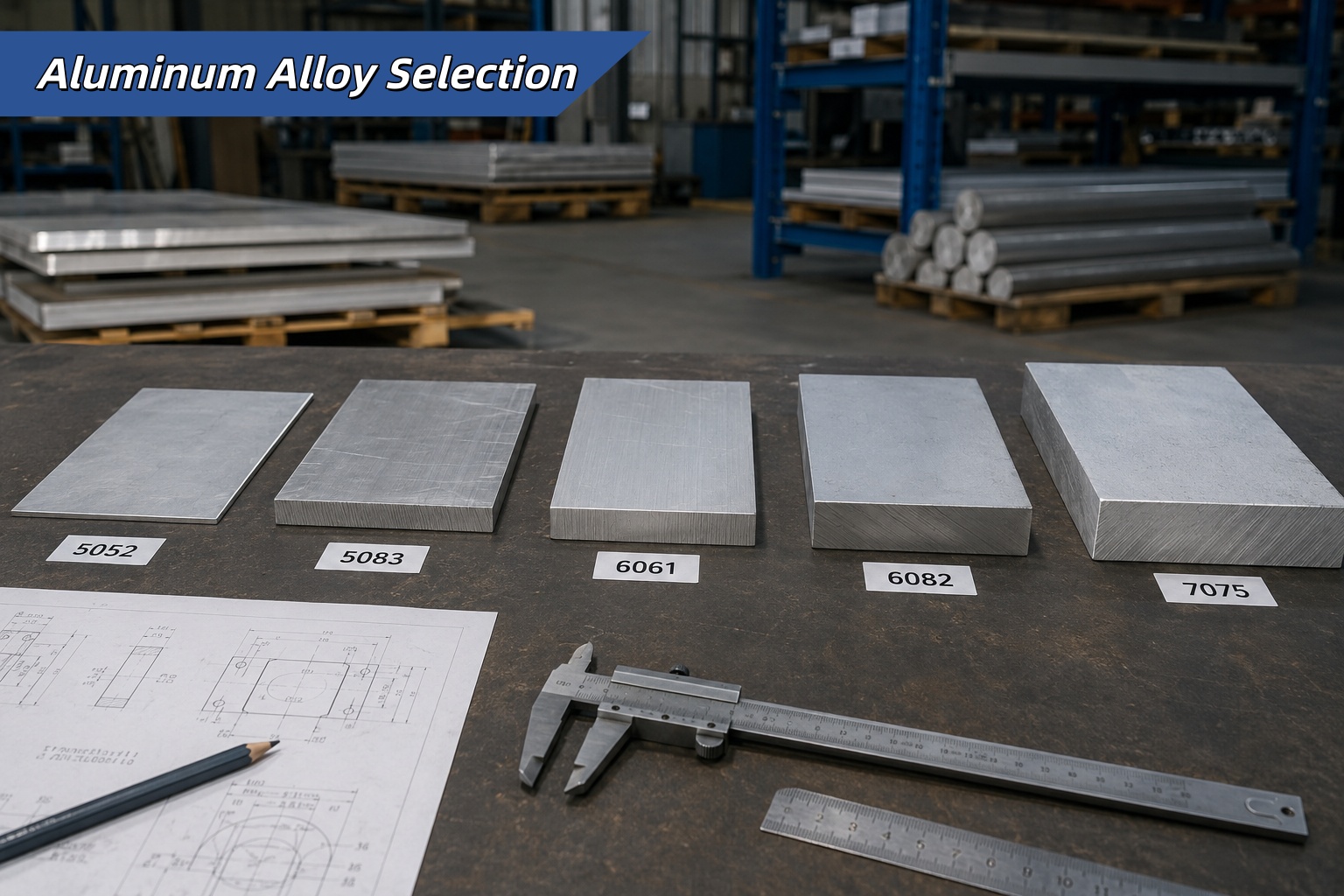
Aluminum plate is available in many alloy series, and each alloy has different cutting, forming, welding and corrosion-resistance behavior. Choosing the right alloy is often more important than choosing the cutting method alone.
5052 Aluminum Plate
5052 is known for good corrosion resistance, formability and weldability. It is often used for marine components, fuel tanks, equipment panels, vehicle parts and general fabrication.
5083 Aluminum Plate
5083 is widely used in marine, shipbuilding, transportation and pressure-related applications because of its strength and seawater resistance.
6061 Aluminum Plate
6061 aluminum plate offers a balanced combination of strength, machinability, weldability and corrosion resistance. 6061 T6 is often used for machined parts, frames and fixtures.
6082 Aluminum Plate
6082 is often used in structural and engineering applications, especially in markets where EN standards are common. It is suitable for machined parts, frames and load-bearing components.
7075 Aluminum Plate
7075 is a high-strength alloy used where strength-to-weight ratio is critical. It may be selected for aerospace, molds, tooling and high-stress components.
General Plate Selection
For broader product selection, buyers can review available aluminum plate options according to grade, thickness, temper and application.
Application-Based Aluminum Plate Selection
In real projects, aluminum plate is usually selected according to application conditions rather than grade name alone.
| Application | Common Alloy Choices | Key Requirements |
|---|---|---|
| Machined parts and fixtures | 6061, 6082, 7075 | Machinability, dimensional stability, strength and flatness |
| Marine and seawater environments | 5052, 5083 | Corrosion resistance, weldability and long-term durability |
| Transportation and vehicle parts | 5052, 5083, 6061, 6082 | Lightweight strength, formability and fabrication performance |
| Equipment panels and covers | 5052, 6061 | Surface quality, flatness, corrosion resistance and appearance |
| Molds and tooling | 6061, 7075 or project-specified tooling plate | Machining performance, stability, thickness control and surface finish |
| Structural components | 6061, 6082, 5083 | Strength, weldability, standards compliance and load-bearing performance |
Thickness, Tolerance and Flatness: What Changes as Plate Gets Thicker?
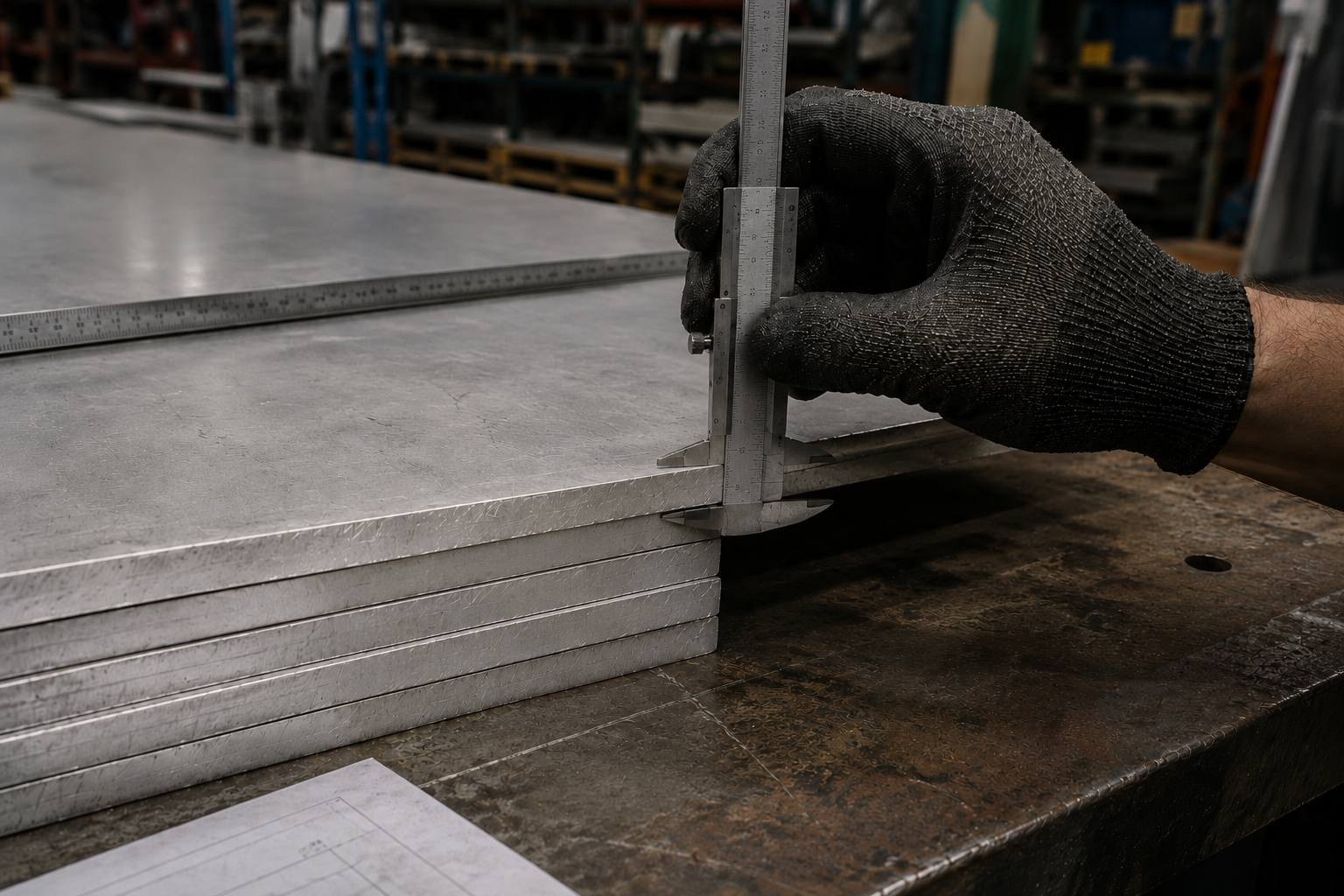
Thickness is only one part of aluminum plate specification. As plate thickness increases, cutting allowance, flatness control, handling weight and machining preparation become more important.
For machining blanks, extra cutting allowance is often needed so the machine shop can finish the part to the final drawing size. For large panels, equipment covers and base plates, flatness may be more important because warped plate can create assembly problems.
For visible or surface-sensitive parts, protective film, interleaving and careful packing may be required to reduce scratches during cutting, stacking and shipment. For corrosion-sensitive applications, storage and moisture protection should also be considered. Related handling notes can be found in this article on aluminum sheet corrosion prevention.
Standards and Certification for Aluminum Plate
Industrial aluminum plate is often supplied according to standards such as ASTM, EN, ISO or project-specific requirements. Common references may include ASTM B209 for aluminum and aluminum-alloy sheet and plate, EN 485 for aluminum sheet, strip and plate, and EN 573 for aluminum alloy designation and chemical composition.
For engineering projects, buyers may request mill test certificates to confirm chemical composition, mechanical properties and traceability. Certificate requirements should be confirmed before cutting because cut-to-size pieces may need clear labeling and traceable packing.
Practical Checklist Before Cutting Aluminum Plate
When to Use Aluminum Plate, Coil, Bar or Pipe
Although this article focuses on aluminum plate, some projects may be better served by another aluminum product form. If the part will be stamped, rolled or produced continuously, aluminum coil may be more efficient. If the final component is a shaft, spacer, fixture or solid machined part, aluminum bar may reduce waste. If the design requires a lightweight frame or tubular structure, aluminum pipe or tube may be more suitable.
Choosing between plate, coil, bar and pipe should be based on the drawing, production route, waste rate, fabrication process and logistics cost.
FAQ
What is the best method for cutting aluminum plate?
The best method depends on thickness, alloy, shape, tolerance and edge quality. Saw cutting is common for straight blanks, waterjet cutting is suitable for complex shapes without heat influence, and CNC routing, laser or plasma may be selected for specific industrial needs.
Can aluminum plate be cut with a saw?
Yes. Saw cutting is widely used for aluminum plate, especially for straight cuts, thick plate and machining blanks. Proper blade selection, clamping, feed rate and cutting allowance help improve edge quality and dimensional control.
Which aluminum plate is good for machining?
6061 and 6082 aluminum plates are commonly used for machining and structural parts. 7075 may be selected when higher strength is required. The final choice should consider strength, corrosion resistance, dimensional stability and project standards.
Which aluminum plate is used for marine applications?
5052 and 5083 aluminum plates are commonly used where corrosion resistance is important. 5083 is often selected for marine and seawater-related applications because of its strength and corrosion resistance.
Why does aluminum temper matter?
Temper affects strength, bendability, machinability and fabrication behavior. The same alloy in different tempers may perform differently during cutting, bending, welding or final service.
Do cut-to-size aluminum plates need certificates?
For industrial projects, buyers may require mill test certificates, inspection documents or traceability records. These requirements should be confirmed before cutting and shipment.
Conclusion
Cutting aluminum plate is not only a processing question. It is also a material selection and application question. The right cutting method depends on alloy, temper, thickness, tolerance, edge quality and how the plate will be used after cutting.
For industrial applications, buyers should define the final use first, then select the suitable aluminum alloy, temper, cutting method, certification and packing requirements. This approach helps reduce machining problems, assembly issues and material rejection after delivery.
Need Aluminum Plate for Industrial Applications?
Voyage Metal supplies aluminum plate in different alloys, tempers and sizes for machining, marine, structural, transportation and fabrication applications. Send your grade, temper, thickness, size, tolerance, quantity and certification requirements for review.
Contact Voyage Metal