
 EN
EN



Duplex 2205 vs 316L Stainless Steel: Strength, Chloride Resistance and When to Upgrade
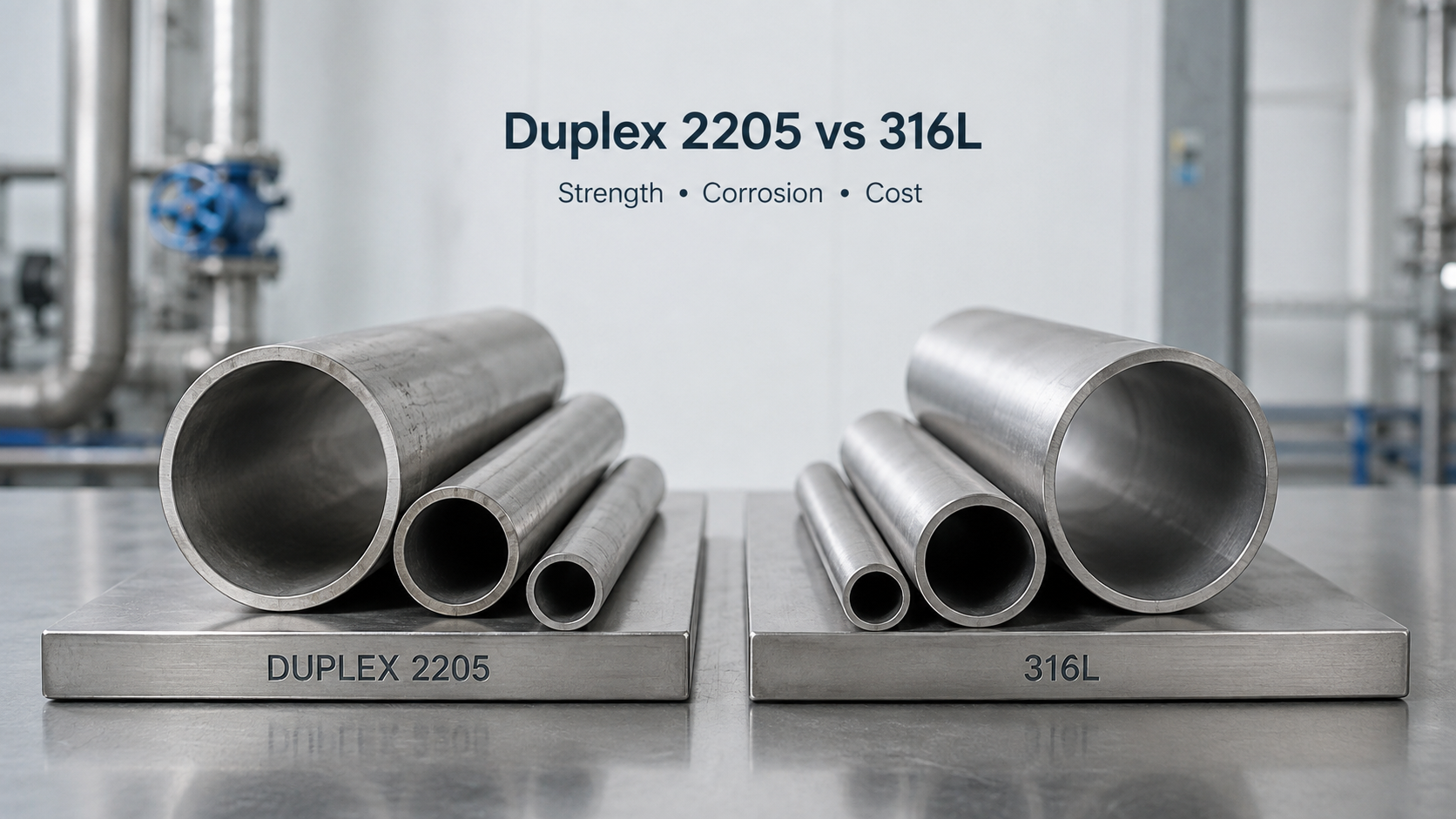
Choosing between 2205 vs 316L stainless steel becomes more important when a project involves chlorides, seawater, higher temperatures, pressure, or demanding corrosion conditions.
316L is widely used because it combines corrosion resistance, weldability, formability and broad availability. Duplex 2205 offers a different balance: much higher strength and stronger resistance to chloride-related corrosion, especially chloride stress corrosion cracking.
For engineers and procurement teams, however, the question is not simply which material is better. The real question is whether 316L provides enough corrosion resistance and strength for the operating environment, or whether Duplex 2205 provides a useful engineering advantage.
2205 vs 316L Stainless Steel: Quick Comparison
| Property | 316L Stainless Steel | Duplex 2205 |
|---|---|---|
| Typical UNS designation | S31603 | S32205 / S31803 |
| Structure | Austenitic | Ferritic-austenitic duplex |
| Mechanical strength | Standard austenitic strength level | Substantially higher |
| Pitting resistance | Good in many moderate environments | Higher in chloride-bearing environments |
| Chloride SCC resistance | More susceptible as temperature and environmental severity rise | Substantially higher resistance |
| Formability | Generally easier | Higher forming force is normally required |
| Welding | Widely understood and relatively forgiving | Good weldability, but tighter procedure control is important |
| Typical selection logic | Moderate corrosion and general fabrication | Chloride exposure, SCC concern or higher strength demand |
2205 vs 316L Chemical Composition and Microstructure
The difference between 2205 and 316L begins with chemistry and microstructure.
316L Stainless Steel
316L, UNS S31603, is an austenitic stainless steel . Chromium helps form the passive corrosion-resistant surface, nickel supports the austenitic structure, and molybdenum improves resistance to localized corrosion compared with grades such as 304.
The “L” identifies the low-carbon version of 316. Lower carbon helps reduce the risk of sensitization and related intergranular corrosion during welded fabrication.
For a broader overview of composition, properties and applications, see our guide to what 316L stainless steel is .
Duplex 2205 Stainless Steel
Duplex 2205 contains both ferrite and austenite. This mixed structure is responsible for many of its most important characteristics, including substantially higher strength and stronger resistance to chloride stress corrosion cracking than conventional austenitic stainless steels such as 316L.
2205 is commonly purchased as UNS S32205 or S31803 depending on the product specification and project requirements.
Typical Chemical Composition Comparison
| Element | 316L | Duplex 2205 | Why It Matters |
|---|---|---|---|
| Chromium (Cr) | Typically around 16–18% | Typically around 22% | Supports passivation and corrosion resistance |
| Nickel (Ni) | Typically around 10–14% | Typically around 5% | Helps control austenitic structure and phase balance |
| Molybdenum (Mo) | Typically around 2–3% | Typically around 3% | Improves resistance to pitting and crevice corrosion |
| Nitrogen (N) | Relatively low | Controlled addition, typically around 0.15–0.20% | Improves strength and localized corrosion resistance |
| Carbon (C) | Low-carbon grade | Low carbon | Important for welding and corrosion performance |
These figures are intended for comparison only. Final chemical limits must follow the applicable ASTM, ASME, EN or project specification.
PREN and Chloride Corrosion Resistance
Chromium, molybdenum and nitrogen play important roles in resistance to localized corrosion. A commonly used comparison tool is the Pitting Resistance Equivalent Number (PREN).
Using representative compositions, standard 316L commonly has a PREN in the mid-20s, while Duplex 2205 is generally above 30 and often around the mid-30s.
This helps explain why 2205 normally provides a wider operating margin than 316L against chloride-induced pitting and crevice corrosion.
Actual corrosion performance is also affected by:
- chloride concentration;
- operating temperature;
- pH;
- oxygen level;
- chemical contaminants;
- deposits and fouling;
- crevices and gasket areas;
- flow or stagnant conditions;
- surface condition;
- welding and fabrication quality.
2205 vs 316L Mechanical Properties and Strength
Strength is one of the clearest differences between these two grades.
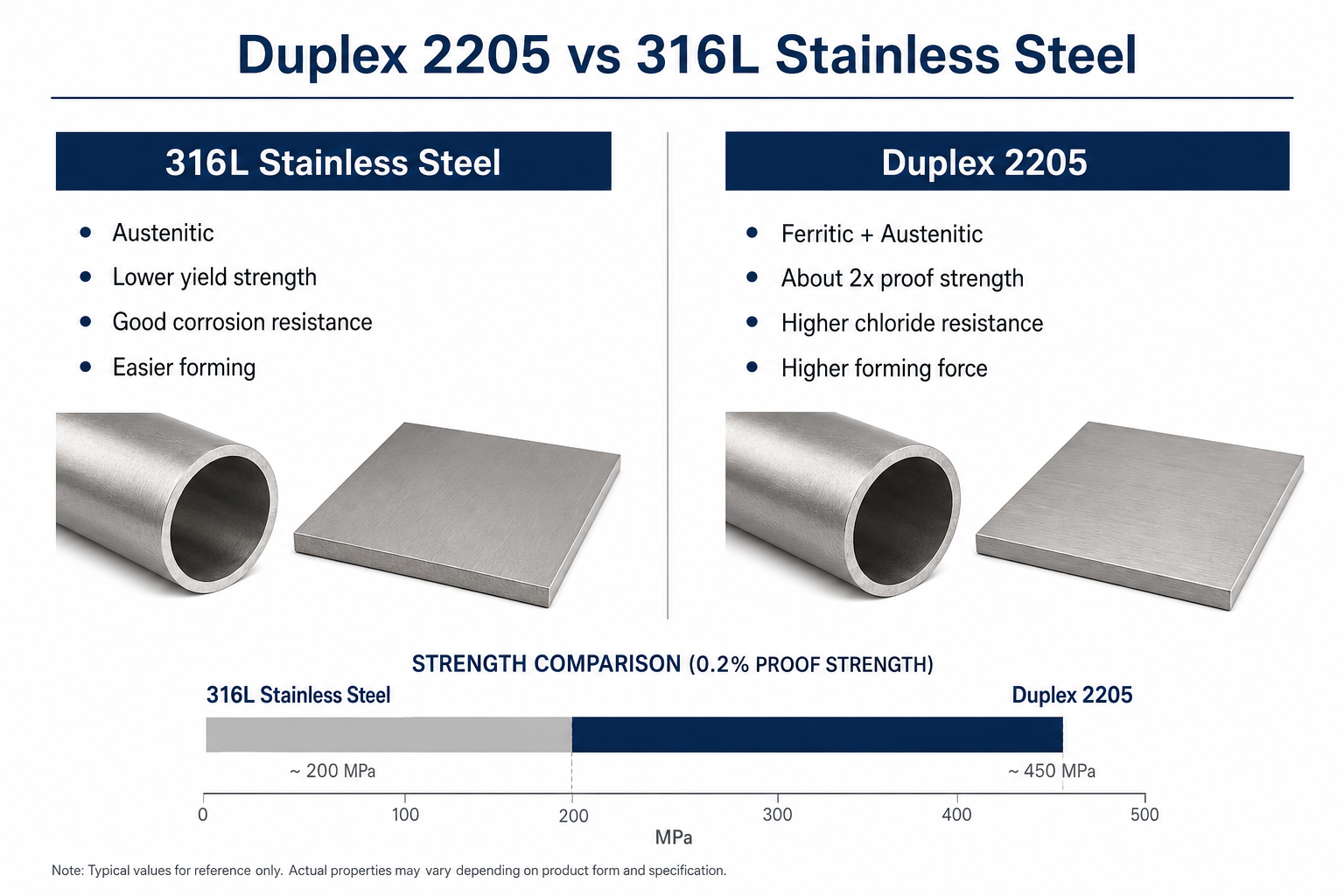
Duplex 2205 commonly provides roughly twice the proof strength of conventional austenitic stainless steels such as 316L. Exact mechanical requirements depend on product form, thickness, applicable standard and supply condition.
| Mechanical Property | 316L | Duplex 2205 |
|---|---|---|
| 0.2% proof / yield strength | Commonly around 200–240 MPa minimum range depending on specification and product form | Commonly around 450 MPa or higher depending on specification and product form |
| Tensile strength | Common specification values generally begin above approximately 500 MPa | Common specification ranges are generally substantially higher |
| Ductility | Higher | Lower than 316L but suitable for normal industrial fabrication |
| Cold forming force | Lower | Higher because of increased strength |
Values shown above are for comparison only. Plate, sheet, pipe, tube and bar specifications may use different mechanical requirements.
The additional strength of Duplex 2205 can be valuable in:
- pressure piping;
- pressure vessels;
- offshore structures;
- chemical tanks;
- load-bearing components;
- weight-sensitive equipment.
Where the applicable design code permits, higher allowable strength may allow a thinner section and lower total material weight.
2205 vs 316L Corrosion Resistance in Chloride Environments
Pitting Corrosion
Stainless steel depends on a thin passive oxide layer for corrosion resistance. Chloride ions can locally damage this layer and create small but deep pits.
316L performs well in many water, food, pharmaceutical and chemical applications. However, its corrosion margin decreases as chloride concentration, temperature or environmental severity increases.
Duplex 2205 generally provides better resistance to chloride-induced pitting because of its chromium, molybdenum and nitrogen content.
Crevice Corrosion
Crevices under gaskets, deposits, fasteners and overlapping surfaces can create more aggressive local chemistry than the surrounding process fluid.
2205 generally provides better crevice-corrosion resistance than 316L, although neither material should be selected from the grade name alone when severe chloride exposure and tight crevices are present.
Chloride Stress Corrosion Cracking
Chloride stress corrosion cracking, usually shortened to SCC, can occur when a susceptible material is exposed to both tensile stress and a damaging chloride-bearing environment.
Austenitic grades such as 316L become increasingly vulnerable to chloride SCC as temperature and environmental severity rise.
The ferritic-austenitic structure of Duplex 2205 gives it substantially stronger resistance to this failure mechanism.
This is one reason engineers often evaluate Duplex 2205 stainless steel pipe for offshore, desalination, chemical processing and chloride-bearing piping systems.
2205 vs 316L for Seawater and Marine Applications
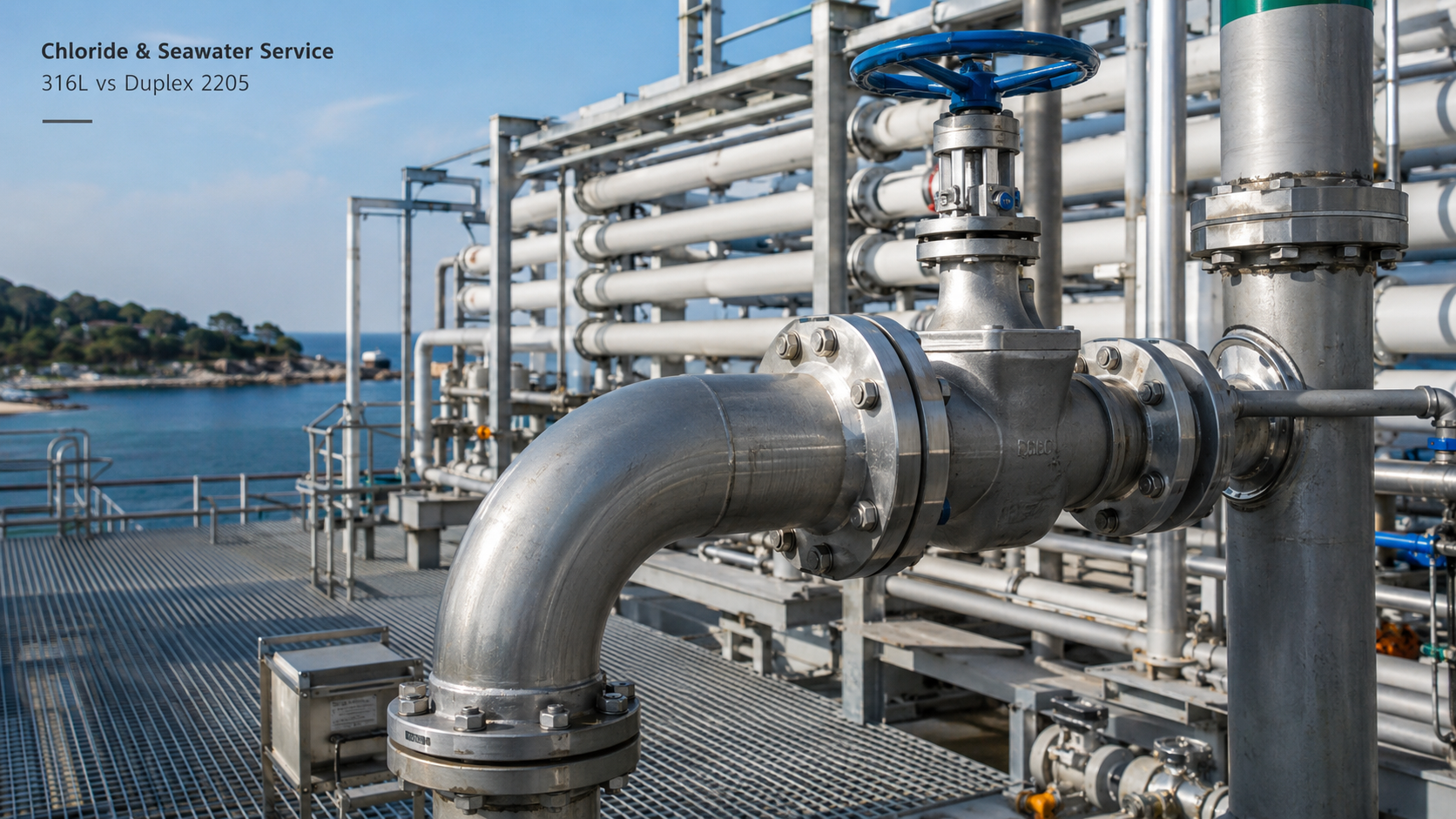
A common purchasing question is whether Duplex 2205 should automatically replace 316L for seawater service.
The answer is no. The actual seawater exposure matters.
Atmospheric Marine Exposure
316L may remain practical where exposure is mainly coastal atmosphere or intermittent salt contamination rather than continuous immersion.
Continuous Seawater Exposure
Continuous immersion creates a more demanding chloride environment and normally requires closer corrosion evaluation.
Warm Seawater
Higher temperature increases localized corrosion and SCC concerns and can change material selection significantly.
Crevices and Stagnant Zones
Gaskets, deposits and stagnant areas can create localized conditions much more severe than open flowing seawater.
Duplex 2205 generally provides a much larger corrosion margin than 316L and is commonly evaluated for desalination equipment, offshore piping, marine process equipment and brackish-water systems.
For plate-based equipment and fabrication, see 2205 duplex stainless steel plate .
316L vs Duplex 2205: Which One Should You Choose?
Choose 316L When
- Corrosion conditions are moderate and well understood.
- The application has a proven history of successful 316L service.
- Easy forming and fabrication are important.
- Higher duplex strength provides little design advantage.
- The project does not involve severe chloride exposure.
Evaluate Duplex 2205 When
- Chloride-induced pitting is a significant concern.
- Warm chloride service creates SCC risk.
- Existing 316L equipment has suffered pitting or SCC.
- Higher strength can improve the engineered design.
- The application involves desalination, offshore or aggressive chloride-bearing fluids.
These are screening guidelines rather than automatic material-selection rules. The operating medium, concentration, temperature, pressure, crevice conditions and required design life must still be considered.
When Is 316L Stainless Steel Still Enough?
The presence of chlorides does not automatically mean that 316L must be replaced with Duplex 2205.
316L remains widely used for:
- food and beverage equipment;
- pharmaceutical processing;
- fresh-water systems;
- compatible chemical processing;
- general industrial tanks;
- architectural and coastal applications without severe immersion;
- fabricated equipment where easy forming and welding are priorities.
For flat-product purchasing, see 316L stainless steel sheet and plate .
For pipe and tube applications, see 316 and 316L stainless steel pipe and tube .
Welding 2205 vs 316L Stainless Steel
316L Welding
316L is one of the most familiar stainless steels for fabrication. Most experienced stainless steel fabricators already have established procedures for cutting, forming and welding this grade.
Its relatively high ductility also makes many forming operations easier than with Duplex 2205.
Duplex 2205 Welding
Duplex 2205 has good weldability when suitable procedures are used. However, welding requires more control because the weld metal and heat-affected zone must maintain a suitable ferrite-austenite balance.
Important factors include:
- qualified welding procedures;
- controlled heat input;
- controlled interpass temperature;
- appropriate filler metal;
- shielding and backing gas control;
- joint preparation;
- post-weld cleaning and pickling where required.
Poor welding practice can affect phase balance, toughness and corrosion resistance.
2205 vs 316L Cost: Is Duplex 2205 More Expensive?
There is no fixed price difference between 2205 and 316L. Stainless steel prices vary with raw-material markets, alloy surcharges, product form, dimensions, quantity, mill origin and processing requirements.
For industrial purchasing, comparing only price per kilogram can therefore be misleading.
| Cost Factor | Why It Matters |
|---|---|
| Material price | Changes with alloy markets, supply route, product form and quantity |
| Required weight | Higher duplex strength may reduce required material in some engineered designs |
| Fabrication | 316L is generally easier to form and more familiar to fabricators |
| Welding | 2205 may require tighter procedure control and more experienced fabrication |
| Inspection and testing | Critical duplex projects may require additional inspection or testing |
| Maintenance | Improved corrosion resistance may reduce future maintenance in suitable applications |
| Downtime | Material failure can cost much more than the original material difference |
For continuous sheet-processing or fabricated components, Voyage Metal also supplies 2205 duplex stainless steel coil .
2205 vs 316L for Common Industrial Applications
| Application | 316L | Duplex 2205 | Main Selection Question |
|---|---|---|---|
| Fresh-water systems | Often suitable | May be unnecessary unless strength or corrosion conditions justify it | What is the actual water chemistry? |
| Food processing | Widely used | Application-specific | What cleaning chemicals and chlorides are involved? |
| Chemical processing | Suitable for many compatible media | Strong candidate for more demanding chloride service | What chemicals, concentrations and temperatures are present? |
| Desalination | Requires careful application-specific evaluation | Frequently evaluated | Which process stage, chloride level and temperature apply? |
| Offshore piping | Possible in selected environments | Frequently considered | Is exposure atmospheric, process-side or direct seawater exposure? |
| Heat exchangers | Common in suitable fluids | Useful where chloride exposure is more severe | What fluids contact each side and what is the maximum metal temperature? |
| Pressure equipment | Widely used | Higher strength can provide a design advantage | What does the applicable pressure code permit? |
Standards for 2205 and 316L Stainless Steel
“2205 stainless steel” or “316L stainless steel” alone is not a complete industrial purchase specification. The required standard depends on product form and project requirements.
- ASTM A240/A240M – stainless steel plate, sheet and strip;
- ASTM A790/A790M – seamless and welded ferritic-austenitic stainless steel pipe;
- ASTM A789/A789M – seamless and welded ferritic-austenitic stainless steel tubing for general service;
- UNS S31603 – common UNS designation for 316L;
- UNS S32205 / S31803 – common UNS designations associated with Duplex 2205;
- EN 1.4404 – common European designation associated with 316L;
- EN 1.4462 – common European designation associated with Duplex 2205.
Buyers should confirm the exact project standard, dimensions, testing and certification requirements rather than assuming that equivalent grade names make all product specifications interchangeable.
For other corrosion-resistant grades, see Voyage Metal's corrosion-resistant stainless steel range .
What to Include in an RFQ for 2205 or 316L
A complete RFQ helps suppliers confirm product availability, manufacturing route and specification requirements more efficiently.
Specify the Grade
Provide 316L, UNS S31603, Duplex 2205, S32205, S31803 or the exact project designation.
Define the Product
Confirm pipe, tube, plate, sheet, coil or bar together with dimensions and required quantity.
Share Service Conditions
Include the process medium, chloride level, operating temperature and pressure where relevant.
Confirm Documentation
List standards, testing, inspection and MTC requirements such as EN 10204 3.1.
- grade and UNS or EN designation;
- ASTM, ASME, EN or project standard;
- outside diameter and wall thickness for pipe or tube;
- plate or sheet thickness, width and length;
- quantity;
- seamless or welded construction where applicable;
- surface finish;
- operating medium;
- chloride concentration where relevant;
- normal and maximum operating temperature;
- design or operating pressure;
- corrosion allowance;
- mechanical or corrosion testing requirements;
- inspection requirements;
- Material Test Certificate requirements;
- project-specific marking, packing and documentation.
Final Comparison: 316L or Duplex 2205?
Key Takeaway
316L remains a practical choice when corrosion conditions are moderate, fabrication simplicity matters and the grade already has a proven service history. Duplex 2205 becomes more attractive when chloride pitting, chloride stress corrosion cracking or higher mechanical strength becomes an important design factor.
The final decision should not come from the grade name alone.
Operating medium, chloride concentration, temperature, pressure, crevice conditions, fabrication method, product form, expected service life and project standard should all be reviewed together.
Need 2205 or 316L Stainless Steel for Your Project?
Voyage Metal supplies Duplex 2205 and 316L stainless steel for international industrial purchasing, including pipe, tube, plate, sheet and coil products.
Send your required grade, dimensions, quantity, standard, operating environment and certification requirements for material matching and quotation.
FAQ: 2205 vs 316L Stainless Steel
What is the main difference between Duplex 2205 and 316L?
316L is an austenitic stainless steel, while 2205 has a ferritic-austenitic duplex structure. Duplex 2205 generally provides substantially higher strength and better resistance to chloride stress corrosion cracking, while 316L remains easier to form and suitable for many moderate corrosion environments.
Is Duplex 2205 stronger than 316L?
Yes. Duplex 2205 commonly provides roughly twice the proof strength of conventional austenitic stainless steels such as 316L. Exact values depend on product form, thickness, material specification and supply condition.
Is 2205 more corrosion resistant than 316L?
In chloride-bearing environments, 2205 generally offers stronger resistance to pitting, crevice corrosion and chloride stress corrosion cracking. However, this does not mean that 2205 is more resistant in every chemical environment.
What chloride level is safe for 316L stainless steel?
There is no single chloride concentration that is safe for 316L in every application. Temperature, pH, oxygen, deposits, crevices, flow conditions, stress and exposure time can all affect corrosion behavior.
Is Duplex 2205 suitable for seawater?
Duplex 2205 offers substantially stronger chloride resistance than 316L and is often evaluated for marine, brackish-water and seawater-related systems. Severe seawater exposure, elevated temperatures, stagnant conditions and tight crevices may still require a higher-alloy material.
Is Duplex 2205 more expensive than 316L?
Not necessarily on a total-project basis. Material prices change over time, and the higher strength of Duplex 2205 can sometimes reduce required material weight. Buyers should compare total installed and lifecycle cost rather than only price per kilogram.
Can Duplex 2205 be welded?
Yes. Duplex 2205 has good weldability when suitable procedures are used. Heat input, interpass temperature, filler metal, shielding and backing gas, and post-weld cleaning require more control than routine 316L fabrication.